I like a painting which makes me want to stroll in it. ” Pierre-Auguste Renoir
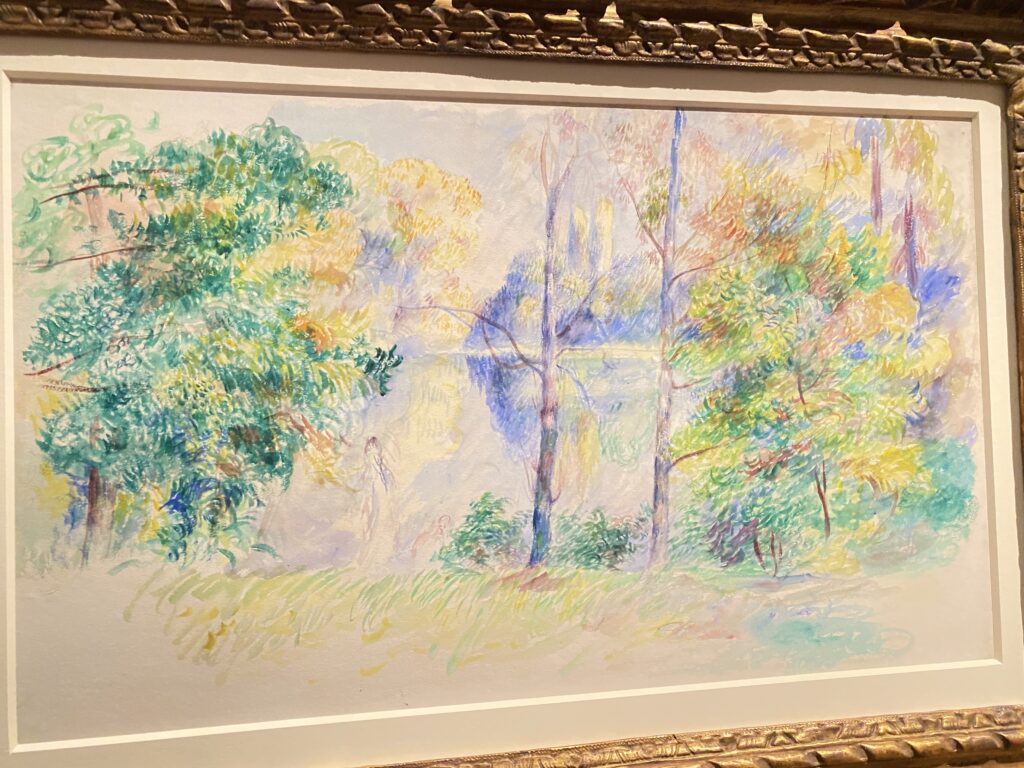
“View of a Park,” ca. 1885-90, watercolor, The Morgan Library
Step into the eternal spring of Renoir in a new exhibition of his drawings at The Morgan Library and Museum. November brings its own kind of beauty, but the dappled Impressionist light of Renoir’s art is a joyfully irresistible invitation.
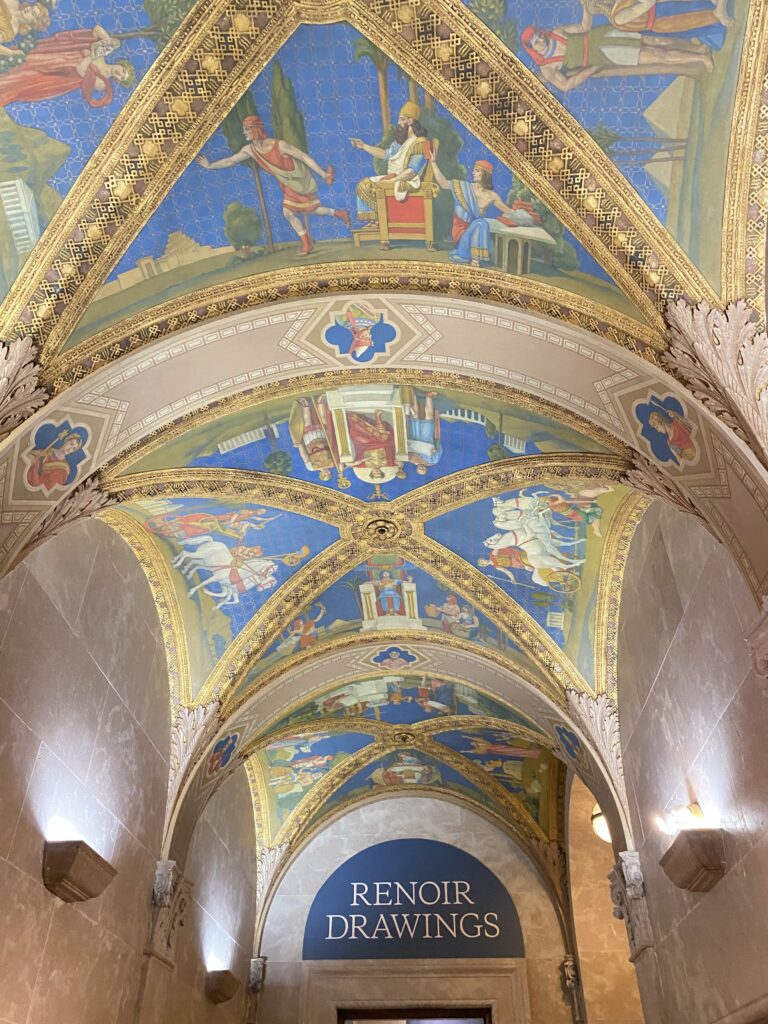
The Morgan Library exhibition is an incredible opportunity to enjoy Renoir’s rarely displayed drawings and see the process for several of his great works. The exhibition with the artist’s drawings and paintings in two large galleries features works from museums and private collections around the world. Visitors receive an overview in the room adjoining the galleries that includes two filmed interviews with Renoir from 1915 and 1920. The size of the exhibition is ideal for enjoying his art in pen and ink, pencil, chalk, pastels, watercolor, oil, and even plaster.
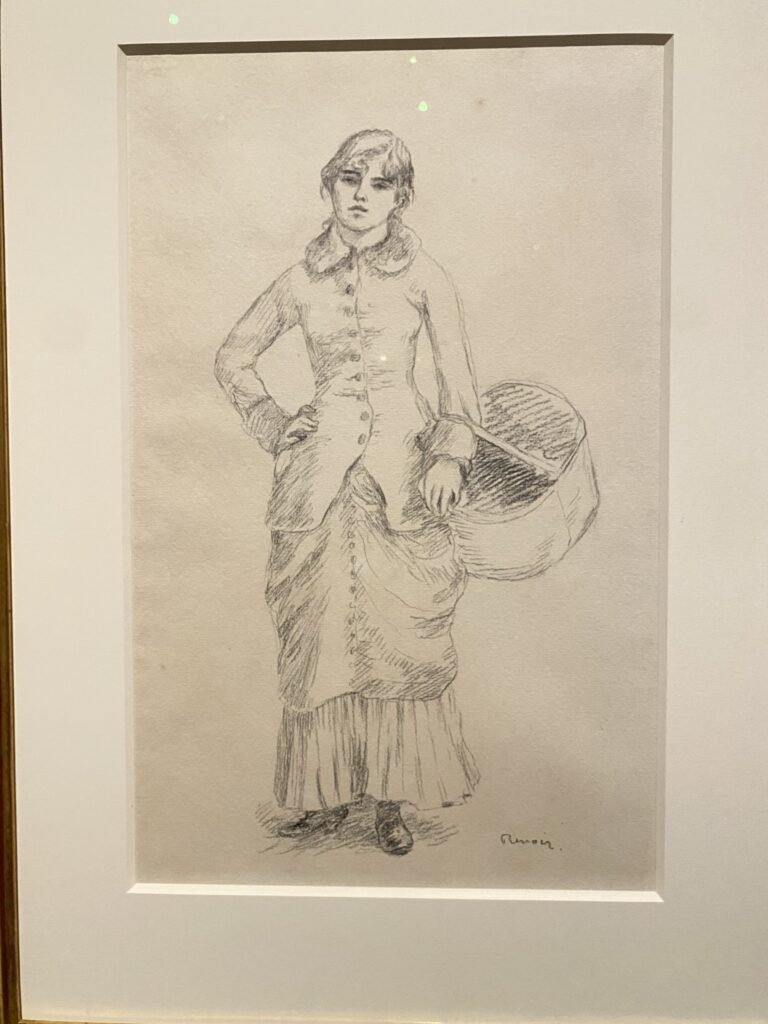
“Portrait of a Girl,” 1879, pastel, The Albertine Museum, Vienna
Renoir is an artist whom we all think we know, but the meticulously curated exhibition offered new insights, not just revisits to his beloved works. Some of these prompted more research into Renoir’s life and art.
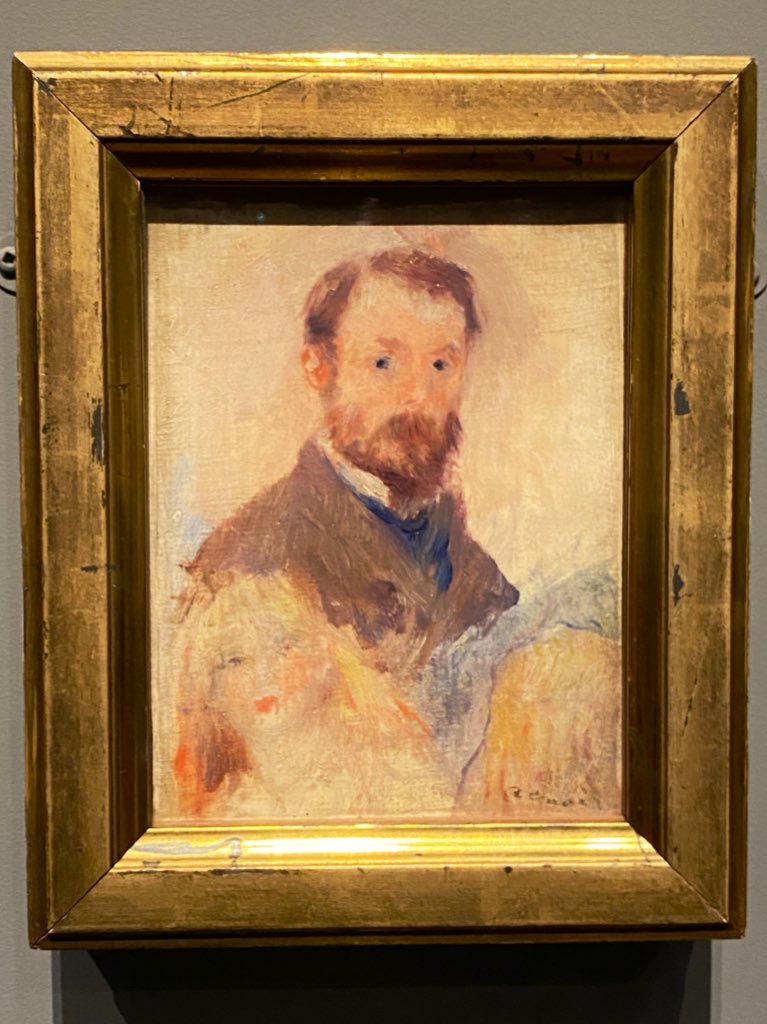
“Self-Portrait,” 1879, oil, Musee d’Orsay, Paris
Renoir as a decorative artist
Renoir, who was from a family of artisans, originally studied decorative arts and saw himself as a craftsman, not an artist. “To my mind, a picture should be something pleasant, cheerful, and pretty, yes pretty! There are too many unpleasant things in life as it is without creating still more of them.” One of seven children, Pierre-Auguste spent his first few years in Limoges, known for its porcelain and high-end leather goods industries. Around the time of his birth in 1841 and during early childhood, there were riots among the poor workers. (Limoges was the city of the first consolidated French workers’ union in 1895.) When Renoir was a small boy, his family moved to Paris, so his father, a tailor, might find work. Renoir apprenticed at a porcelain factory and was highly skilled at painting decorative flowers. Clearly talented, he got a permit to sketch at the Louvre, which was near his home. Having saved a bit, Renoir took night classes at the Ecoles Beaux-Arts (School of Fine Arts) and painting lessons with Swiss-born Charles Gleyere, who had studied with renowned Neoclassical portrait artist Jean Auguste Dominique Ingres. Renoir surprised his serious teacher by sharing, “If painting were not a pleasure to me I should certainly not do it”.
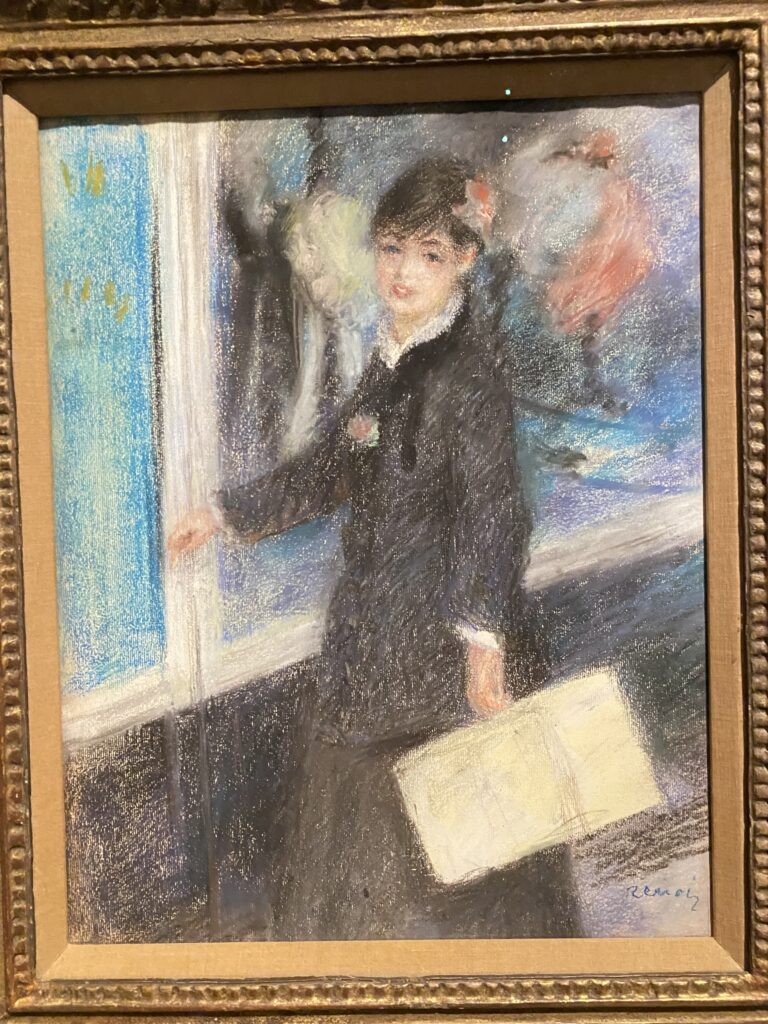
“The Milliner,” ca. 1879, The Virginia Museum of Fine Arts, Richmond
Renoir joined Claude Monet, Camille Pissarro, Berthe Morisot, Edgar Degas, and Alfred Sisley, among others, as part of the Anonymous Society of Painters for an independent art exhibition in 1874. The studio owner, Gaspard-Félix Tournachon, known as “Nadar,” a caricaturist, journalist, and photographer, was also an outlier known for taking the first aerial photograph from a hot-air balloon. The artists exhibited outside the established Salon, which was the annual show of the Academie des Beaux-Arts (Academy of Fine Arts). For the Salon, a jury selected the works that the public would see. Following the exhibition, the group’s name came from Claude Monet’s “Impression, Sunrise” and a critic’s comment that it was indeed only an impression, an unfinished painting.
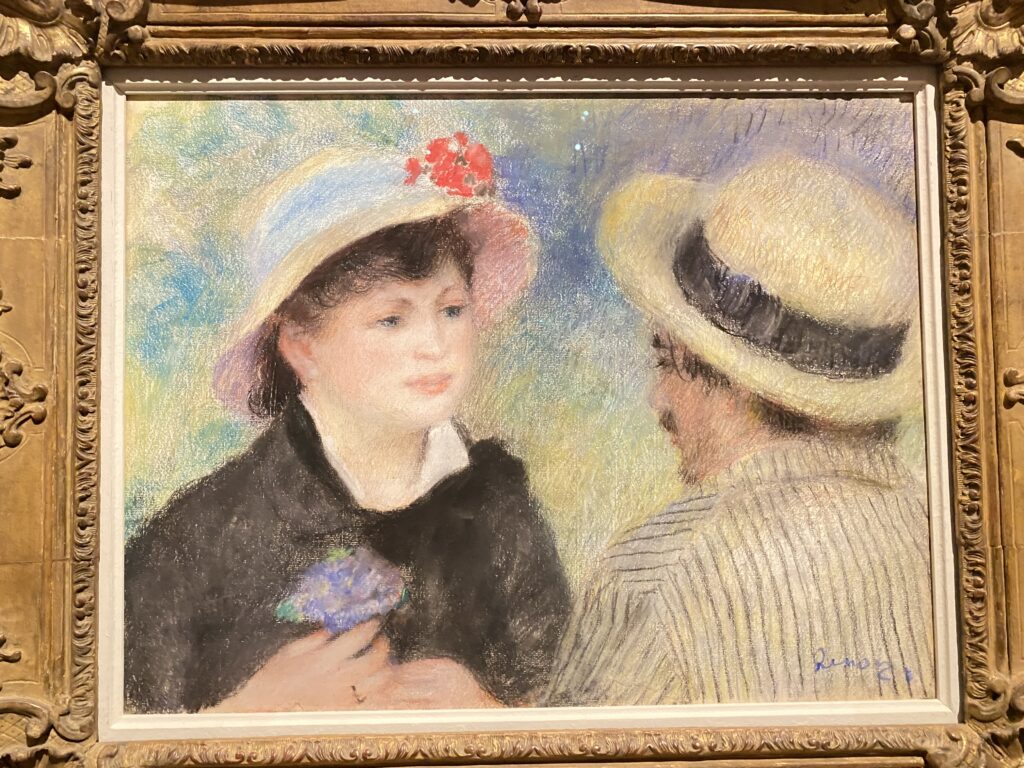
“Boating Couple,” 1880-81, smaller pastel work for “Luncheon of the Boating Party,” Museum of Fine Arts, Boston
After a period of creating sketches as a young artist and student, Renoir adopted the “spontaneous painting” of his fellow Impressionists and began his work directly on canvas. Like the other Impressionists, whose works were originally rejected by the artistic establishment, Renoir enjoyed plein air painting, or outdoor painting “in the open air,” which captured natural light. An innovation with the production of the paints allowed for this, and Renoir and his peers made full use of the opportunity. They often painted with, and influenced, each other.
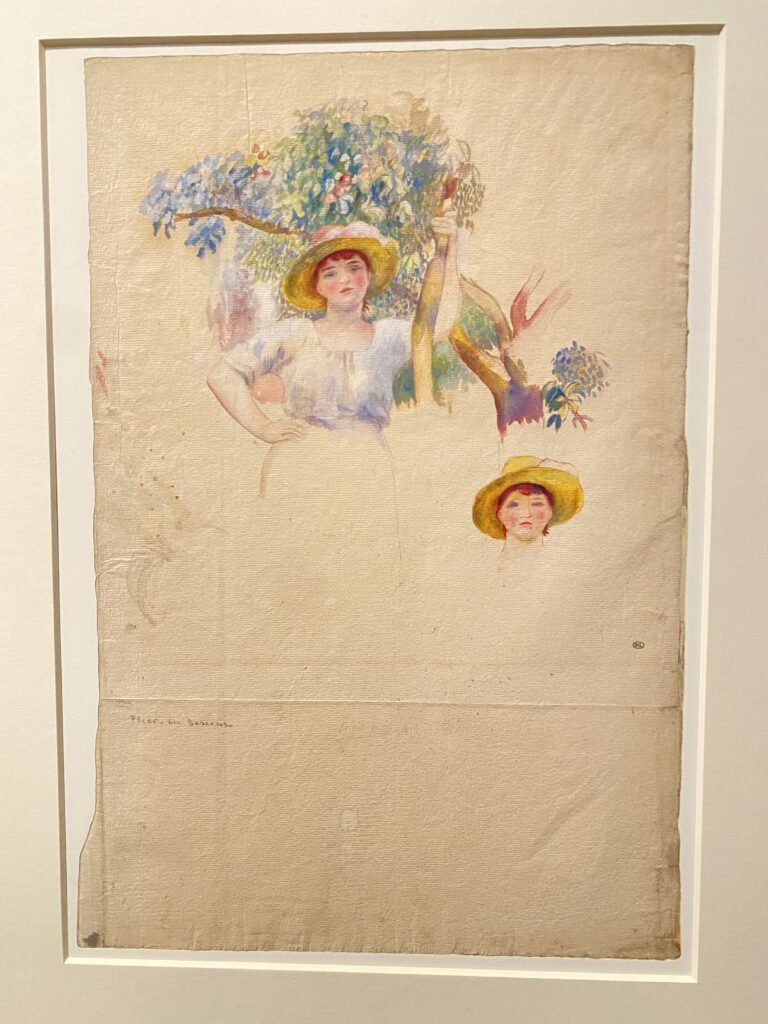
“Harvest,” ca. 1885, watercolor, white opaque watercolor, graphite, and varnish (unusually), Musee d’Orsay, Paris
“Impressionism” captured the artists’ “snapshot” style and brushstrokes. In addition to natural light, they favored the use of bright colors, another result of improved paints, and did not varnish their works, which was done for a formal look. Such techniques lent themselves to painting nature and the countryside.
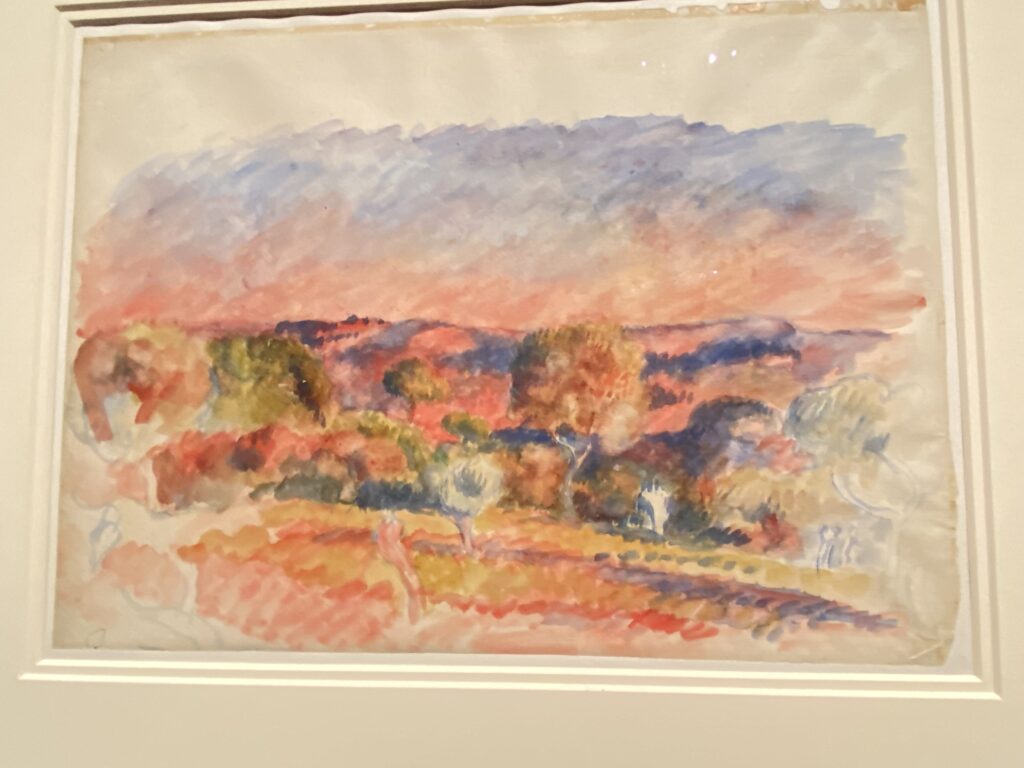
“Landscape,” 1899, watercolor, The Metropolitan Museum of Art, New York
Regarding subject matter, Renoir painted working-class subjects as well as wealthy patrons, which is how he met his wife, Aline Victorine Charigot, depicted in the portrait below. Aline was working as a dressmaker when Renoir approached her to model for him. When they married, Aline was 20, and he was 38. After 18 years as a painter and 25 years of working in the arts, Renoir had reached career stability, which suggests a strikingly long and difficult trajectory to success.
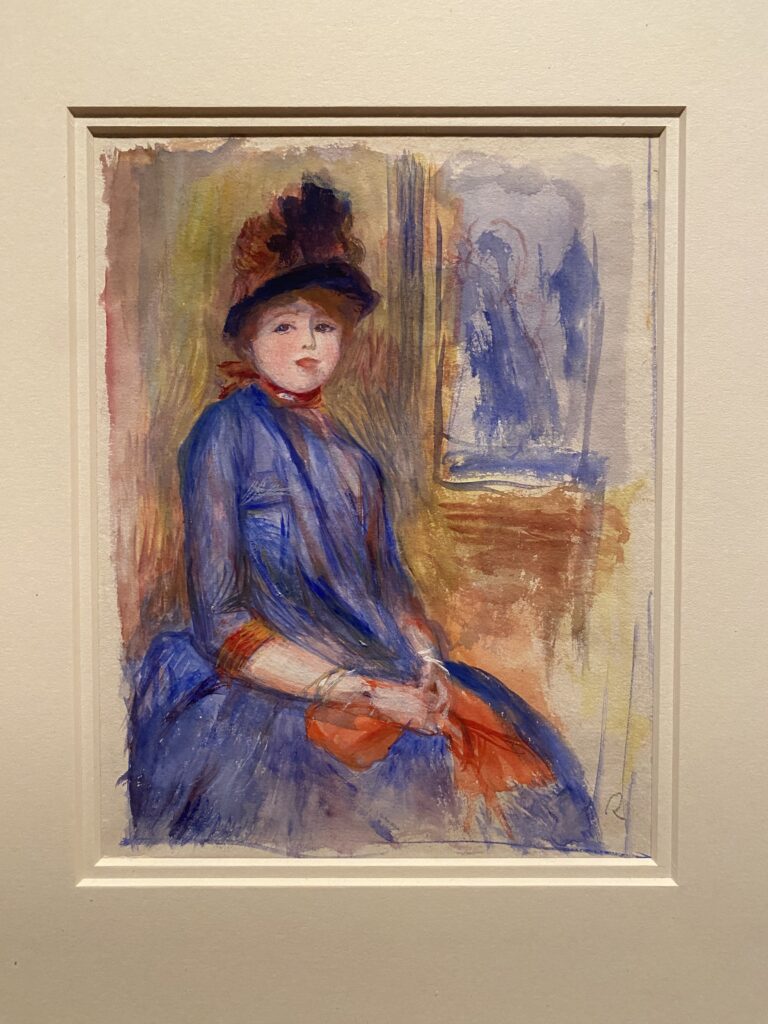
Aline sitting for “Young Woman in a Blue Dress,” ca. 1885-86, watercolor with opaque watercolor, The Metropolitan Museum of Art, New York
Renoir also earned income as an illustrator. Some illustrations were for stories, others reproduced his paintings, like “Dance in the Country” and “Dancing Couple”/“Dance at Bougival” in which Aline was the model for both.
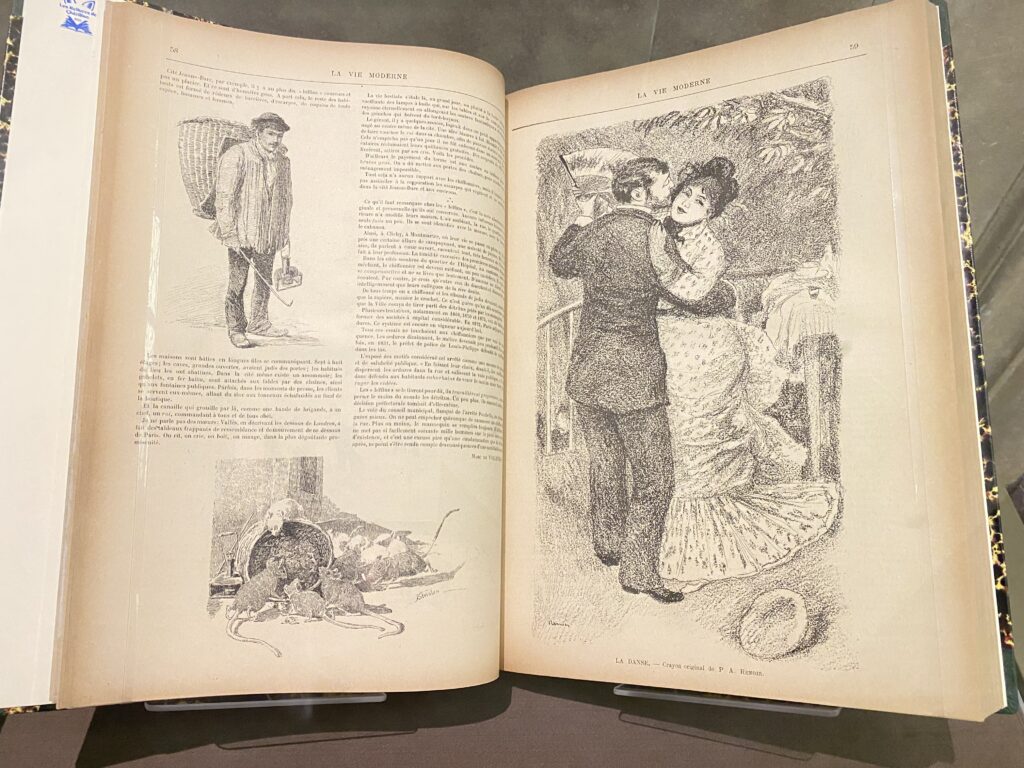
Book illustration
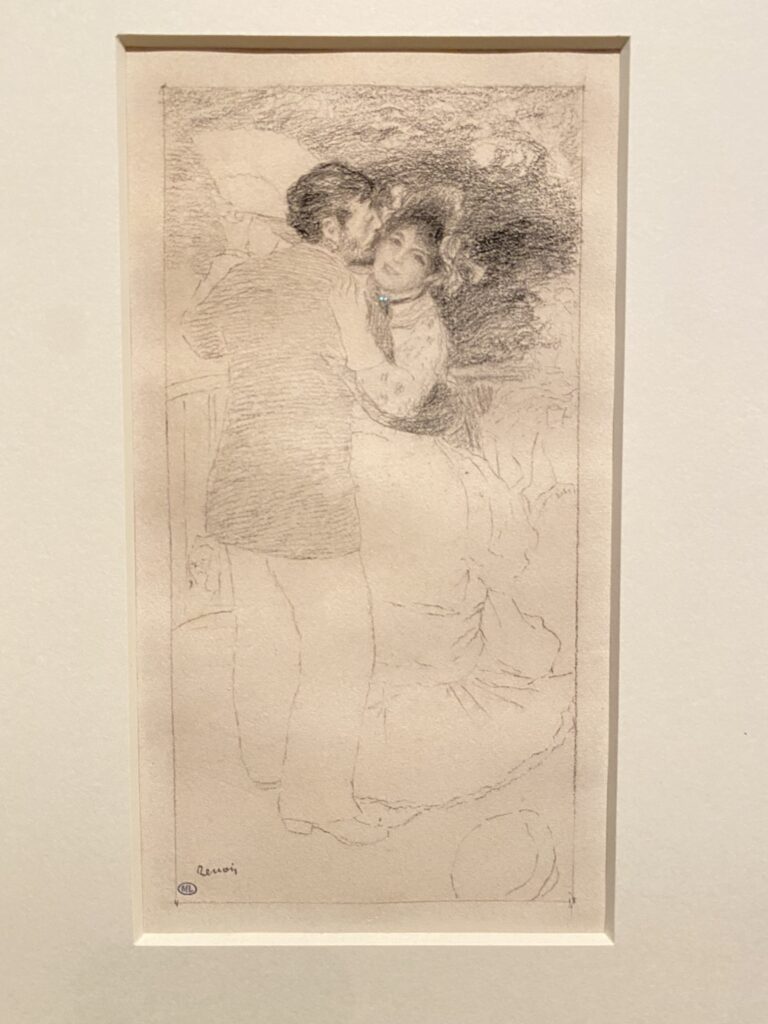
Study for “Dance in the Country, 1883, graphite, Musee d’Orsay, Paris
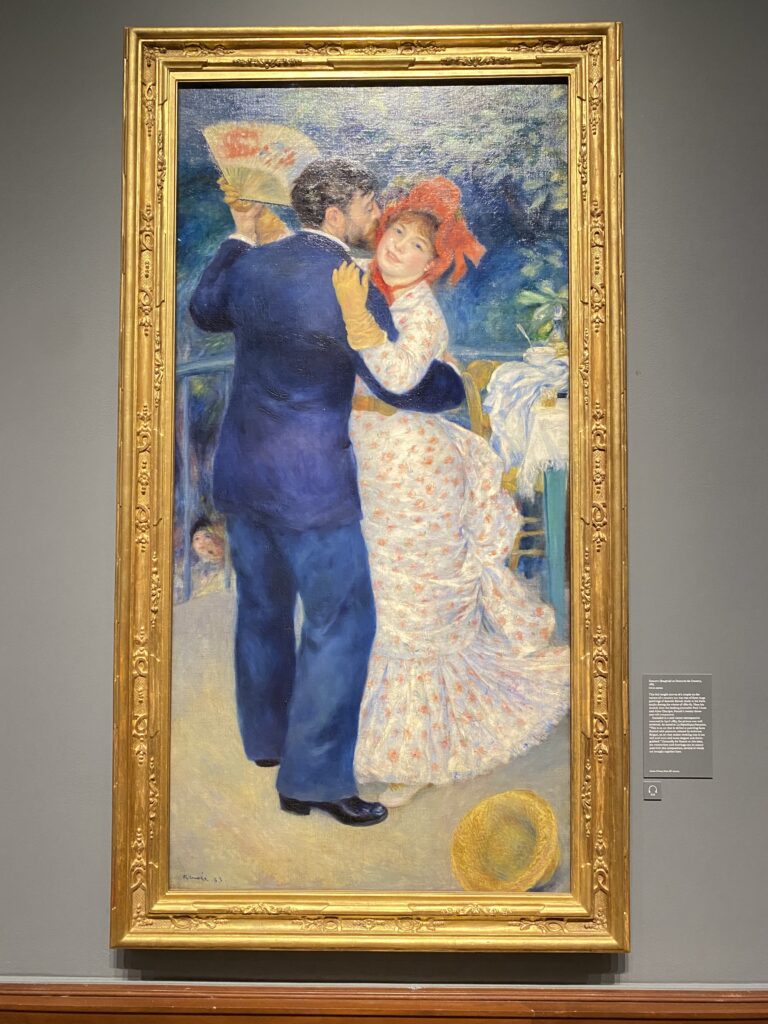
“Dancers (Bougival)” or “Dance in the Country,” 1883, oil, Musee d’Orsay, Paris
Aline and Pierre-Auguste had three sons who all had careers in the arts: Pierre, an actor, Jean, a celebrated filmmaker; and Claude, a ceramic artist. Renoir’s family was a great source of his happiness, and they were often subjects in his paintings. Aline modeled for “Luncheon of the Boating Party,” most notably, and her cousin and the family’s nanny, Gabrielle Renard, was a frequent model for Renoir, too. Before Aline, Renoir had a relationship with Lisa Trehot, another model, with whom he had a daughter, Jeanne, whom he supported. Despite Renoir’s happiness with Aline, he had affairs during the marriage. Four years before Renoir’s death, Aline passed away after a hospital visit to Jean, who was badly injured in WWI, as was his brother Pierre.
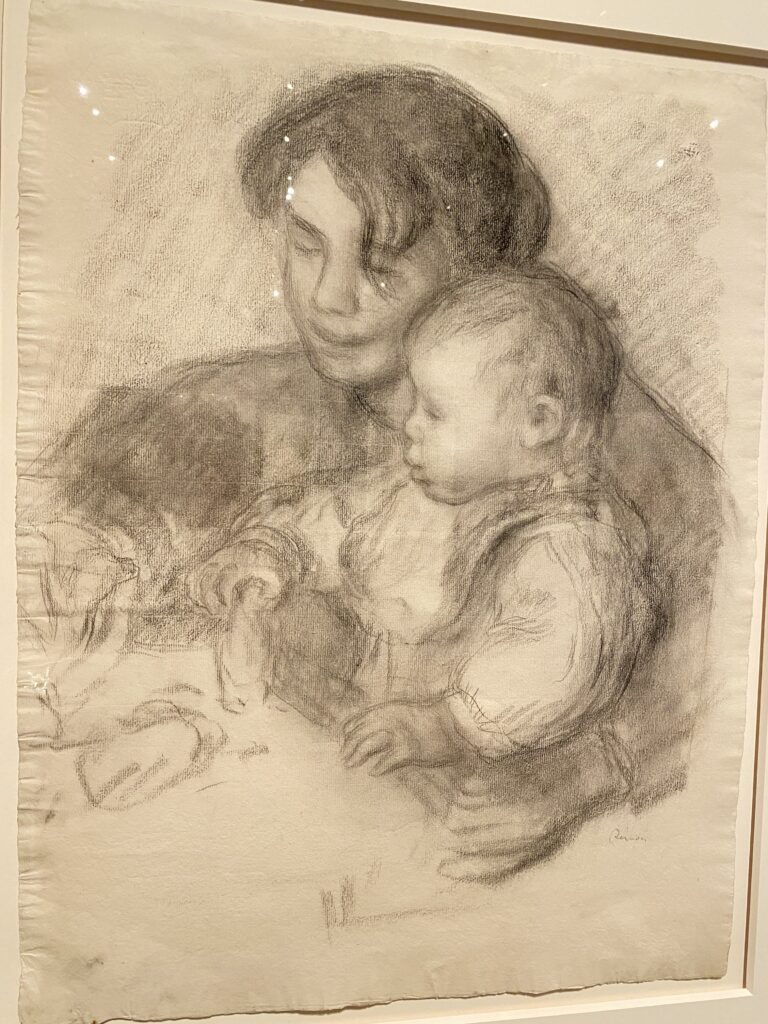
Sketch for “Gabrielle and Jean,” 1895, National Gallery of Canada, Ottawa
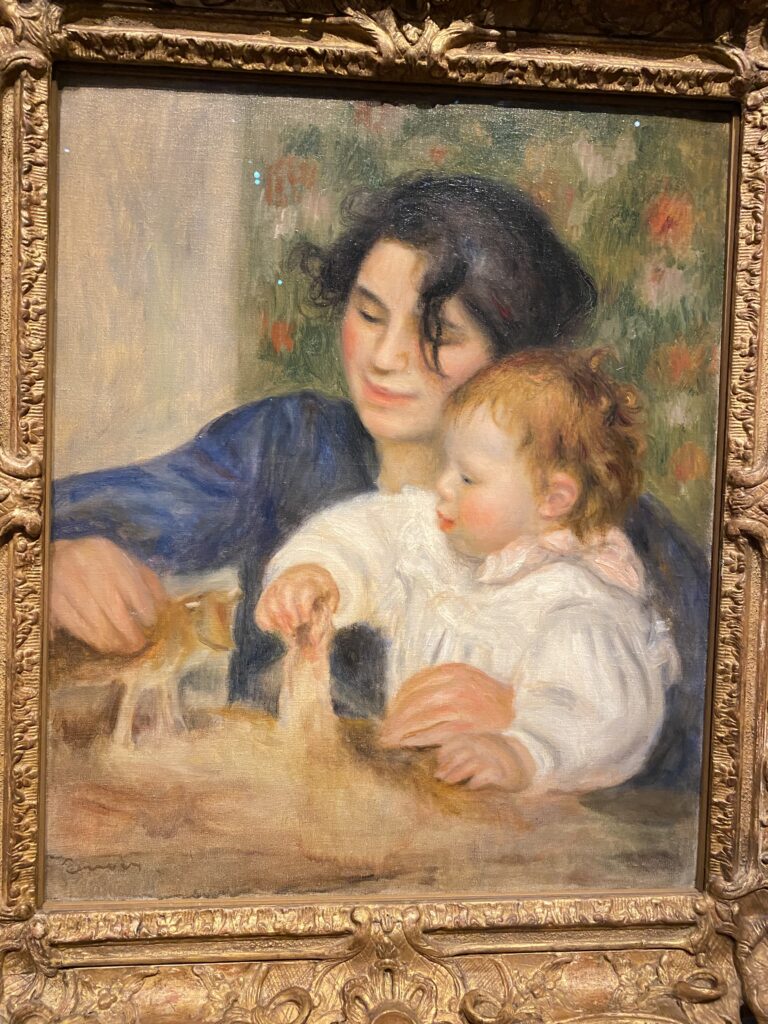
“Gabrielle and Jean,” 1895, oil, Musee de l’Organerie, Paris
(Note: On November 26th, a similar “long-lost” Renoir painting, “L’enfant et ses jouets – Gabrielle et le files de l’artiste, Jean (The Child and His Toys – Gabrielle and the artist’s son, Jean sold for $2 million dollars.)
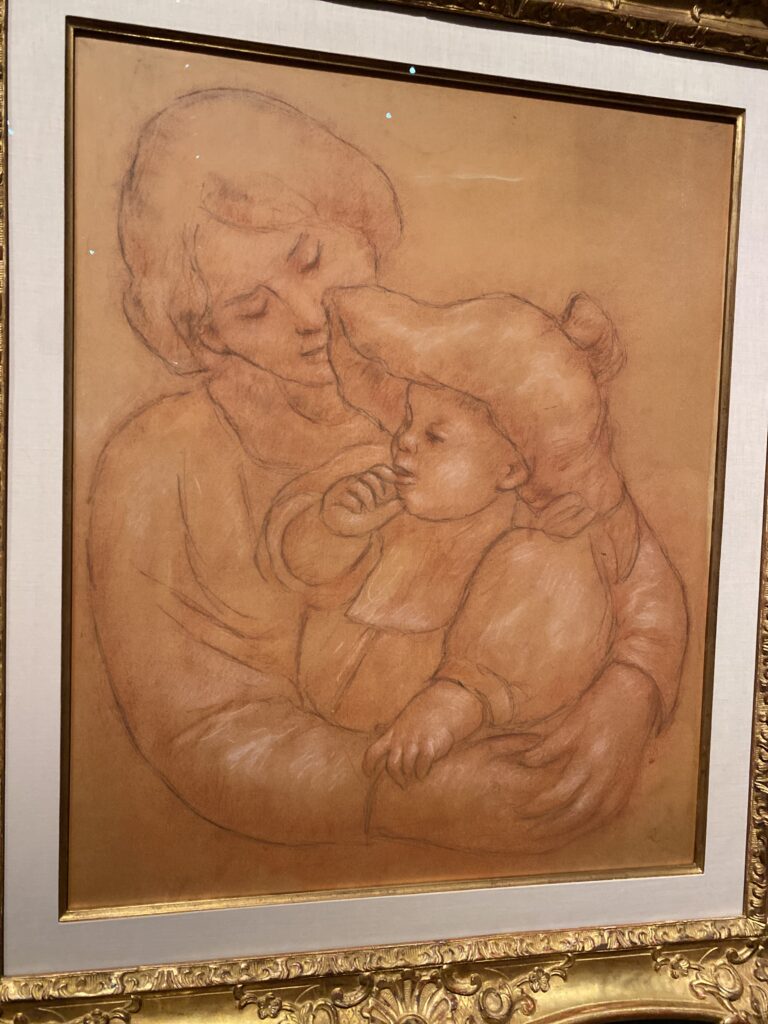
Chalk sketch of “Jean in the Arms of Gabrielle,” 1895-96, possibly reworking “Gabrielle and Jean” (exhibition note), Collection Foundation Pierre Gianadda, Martigny, Switzerland
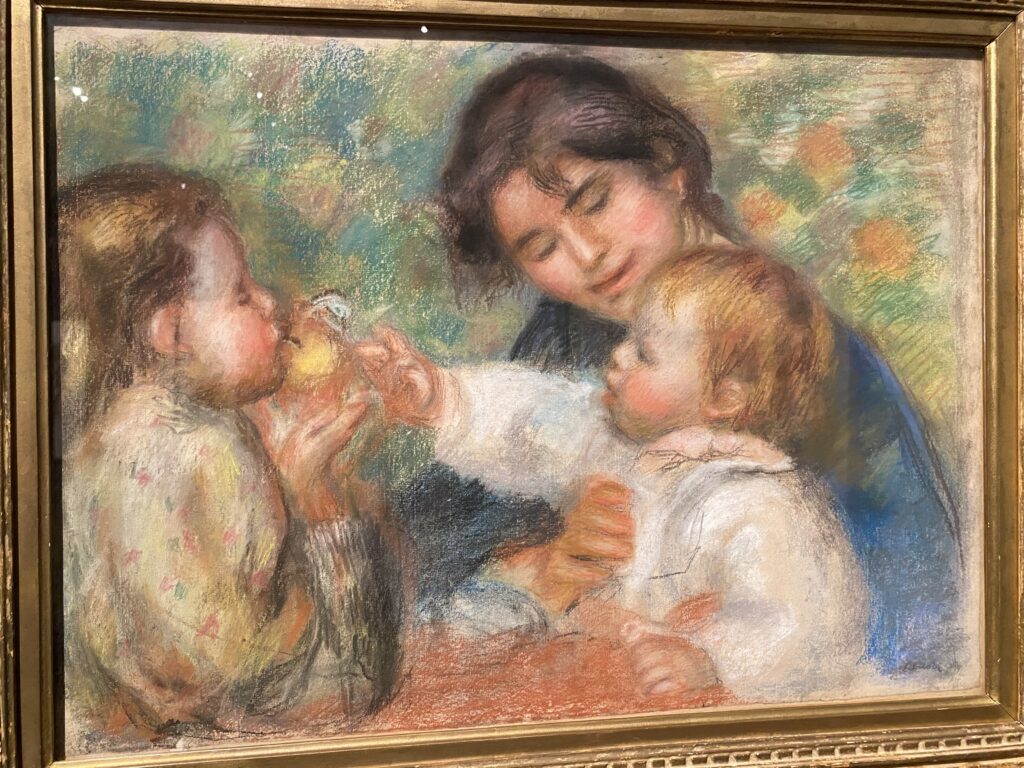
“Child with an Apple” or “Gabrielle, Jean, and a Young Girl with an Apple,” ca. 1905, Collection of Leone Cettolin Dauberville
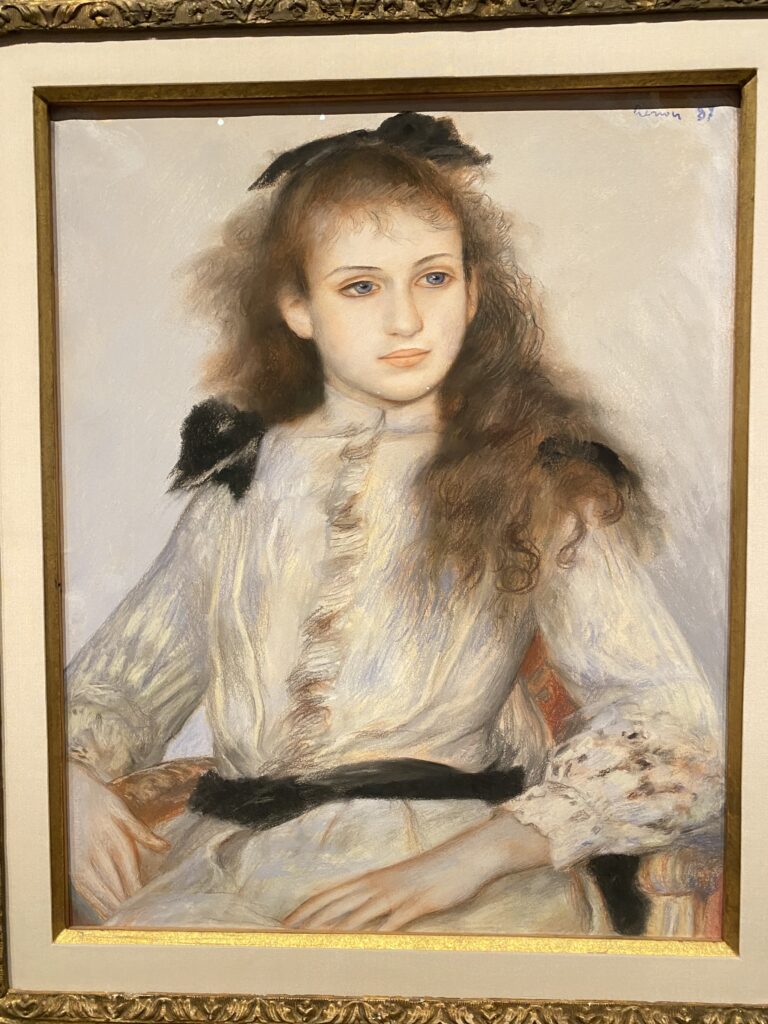
“Madeleine Adam,” 1887, pastel and graphite, Collection of Diane B. Wilsey
Division among the Impressionists
The founding members of Impressionism remained close for years. They supported each other’s work, exhibited their art together, and looked out for each other, including each other’s families. A falling out occurred over the Dreyfus affair. As a quick history refresher, between 1894 and 1906, the guilt or innocence of Alfred Dreyfus, a Jewish army captain, divided then predominantly Catholic France. Captain Dreyfus, tried twice and found guilty of espionage, was eventually exonerated. Camille Pisarro, who was Jewish and a Dreyfusard, along with Monet, supported the captain, and Edgar Degas, an anti-Dreyfusard, who was anti-Semitic, did not, which is not to suggest that the national division was about religion and not politics. In Renoir, My Father, Jean attributed his father’s artistic divergence from Pissarro to differing artistic and political views. In Growing Up with the Impressionists: The Diary of Julie Manet, based on the journals of the then-teenaged daughter of Pierre-Auguste’s dear friend Berthe Morisot, Julie wrote about Renoir and his family, with whom she first stayed at 16 after her mother died. (The diary was first edited and published in 1987 by Rosalind De Boland Roberts and Jane Roberts; the latter became a Chevalier de l’Ordre des Arts et Lettres, or ‘Knight of the Order of Arts and Letters,’ France’s top honor, in 2011. In 2017, Jane Roberts edited a second, revised edition with 472 footnotes.) Julie, who had often posed for Renoir and was clearly fond of him, noted that he sometimes shared the less generous anti-Dreyfusard opinions of the time. Renoir, however, stayed close to his Jewish sister-in-law, Blanche-Marie Blanc, and later attended the funeral of Pissarro, whereas Degas did not.
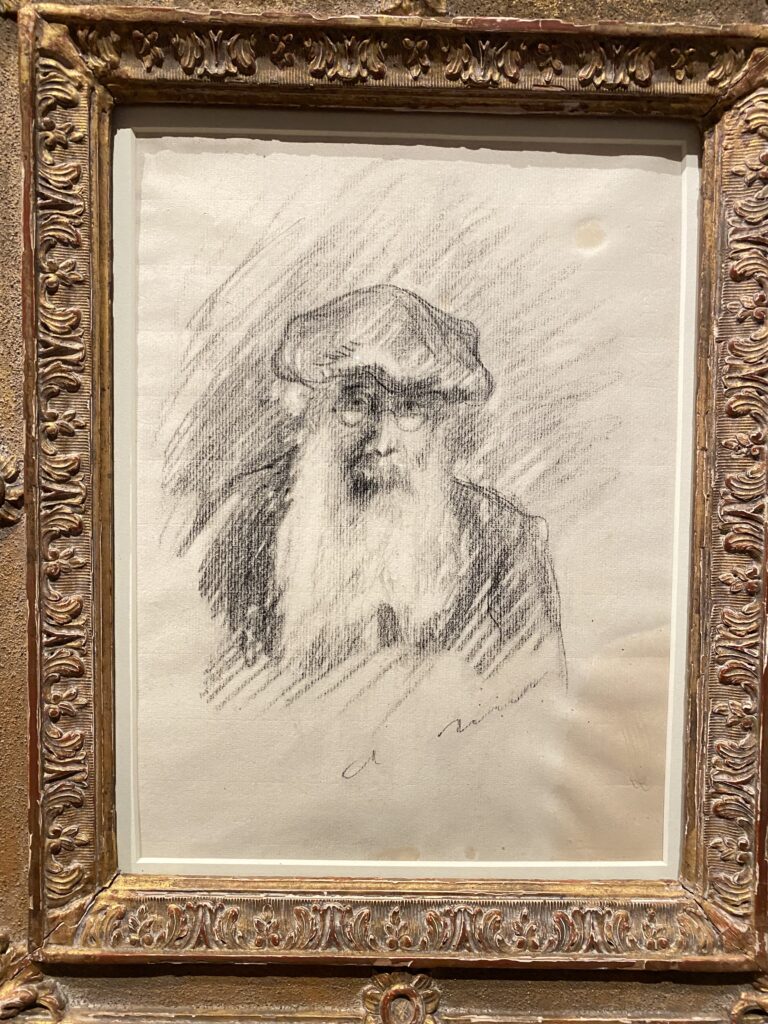
“Portrait of Camille Pissarro,” ca. 1893-94, charcoal, Dallas Museum of Art, Wendy and Emery Reves Collection
Having escaped from poverty, Renoir may have resented that he initially relied on Jewish patrons for exhibitions and commissions. Renoir’s early Jewish patrons supported his talent and influenced his early artistic direction. His portraits of these patrons, and especially those of their children, were beautiful. Greater success offered Renoir new commissions and travel around Europe and North Africa, where he saw the art of Raphael, Velázquez, and Rubens; this influenced his style, making it more classical in later years. He remained friends with the Jewish art dealers, Alexandre Bernheim-Jeune and his sons Joseph and Gaston, who curated 16 of his exhibitions. Barbara Ehrlich White, PhD., who wrote Renoir, An Intimate Biography (2017) and Renoir: His Life, Art, and Letters (1984), and also became a Chevalier des Arts et des Lettres in 2014, attests that Renoir was the Renoir whom the public knew: warm, sociable, and kind. He loved being around people, which his art reflects. Dr. White based her opinion on her review of 3,000 of his letters, 452 of which were previously unpublished.
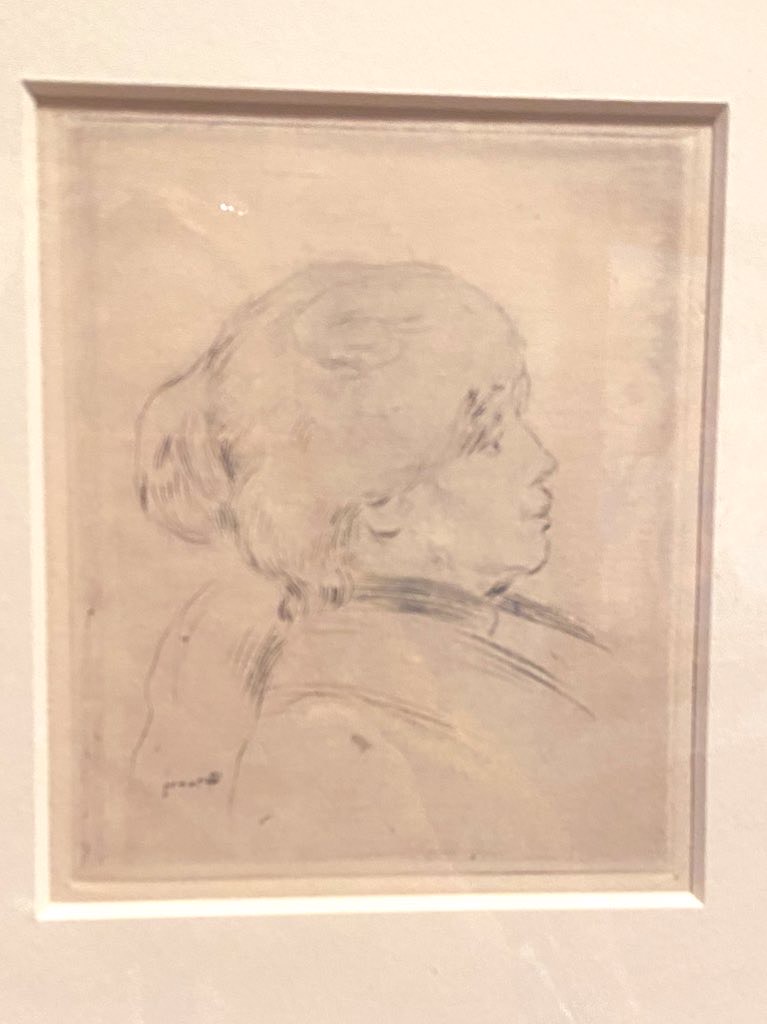
A mournful Berthe Morisot, which Renoir sketched after the death of her husband Eugene Manet for a painting memorializing her after her own passing
Renoir’s paintings were one of the first to delight me as a child, not only for their beauty, but for their joy. He depicts children with such sweetness, which helps young viewers connect with his work. This issue concerning Renoir was mentioned on one exhibit label, as far as I noted, out of more than one hundred. It stayed with me, however, and I read more about it. At this point, I leave Renoir’s legacy in this regard to art historians, but I thought that I should mention it.
The artist overcomes arthritis
“The pain passes, but the beauty remains.” Admirably, Renoir continued to paint despite having crippling and painful rheumatoid arthritis, which began when he was 50. In his late 60s, Renoir and his family moved to Cagnes-sur-Mer on the French Riviera for the warmer climate.
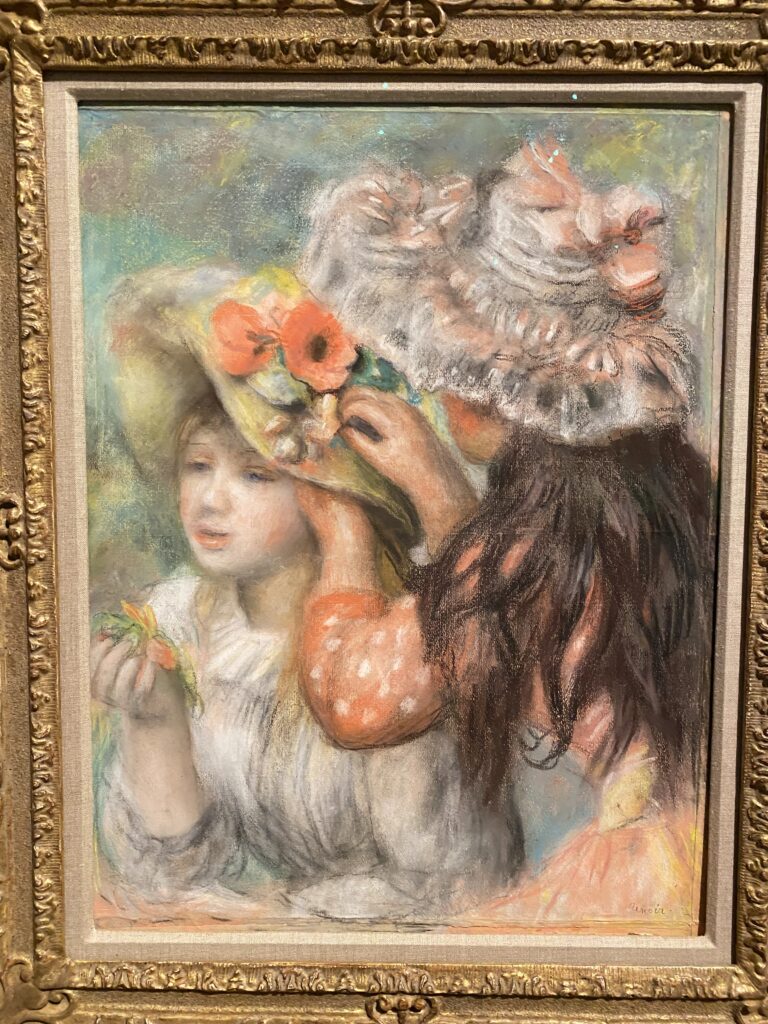
“Girls Putting Flowers in Their Hats,” 1894, oil, private collection
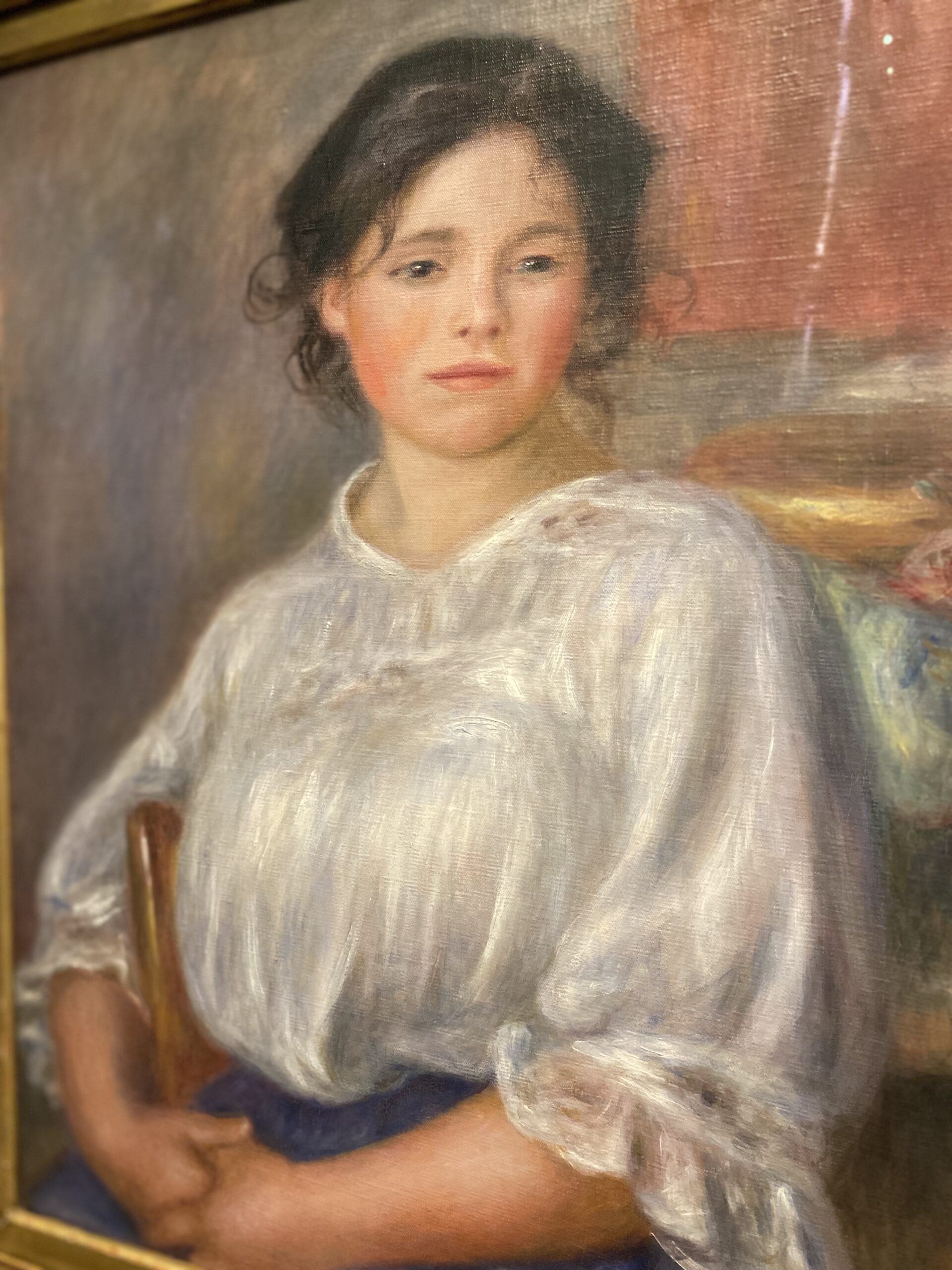
“Young Woman Seated,” 1909, oil, The Art Institute of Chicago/Admin. by Musee d’Orsay. Renoir strove for a luminous quality in his later work.
During this time, Renoir was in pain, especially when he tried to sleep, and he became progressively disabled. He did, however, paint more than 400 works, including the masterpiece, “The Great Bathers,” which is in the exhibition along with sketches, and influenced Henri Matisse and Pablo Picasso. His family and assistants placed his painter’s palette on the arm of his wheelchair and his canvas on a rolling easel. Incredibly, Renoir’s paintings became lighter and more joyful.
The film and newsreel interviews in the exhibition show the deformed joints in Renoir’s hands. Brushes were not strapped to his hands as sometimes noted, but they had to be placed into them. These interview clips were fascinating to watch, and though film was an early art form, Renoir charmed by periodically turning to the camera with a smile.
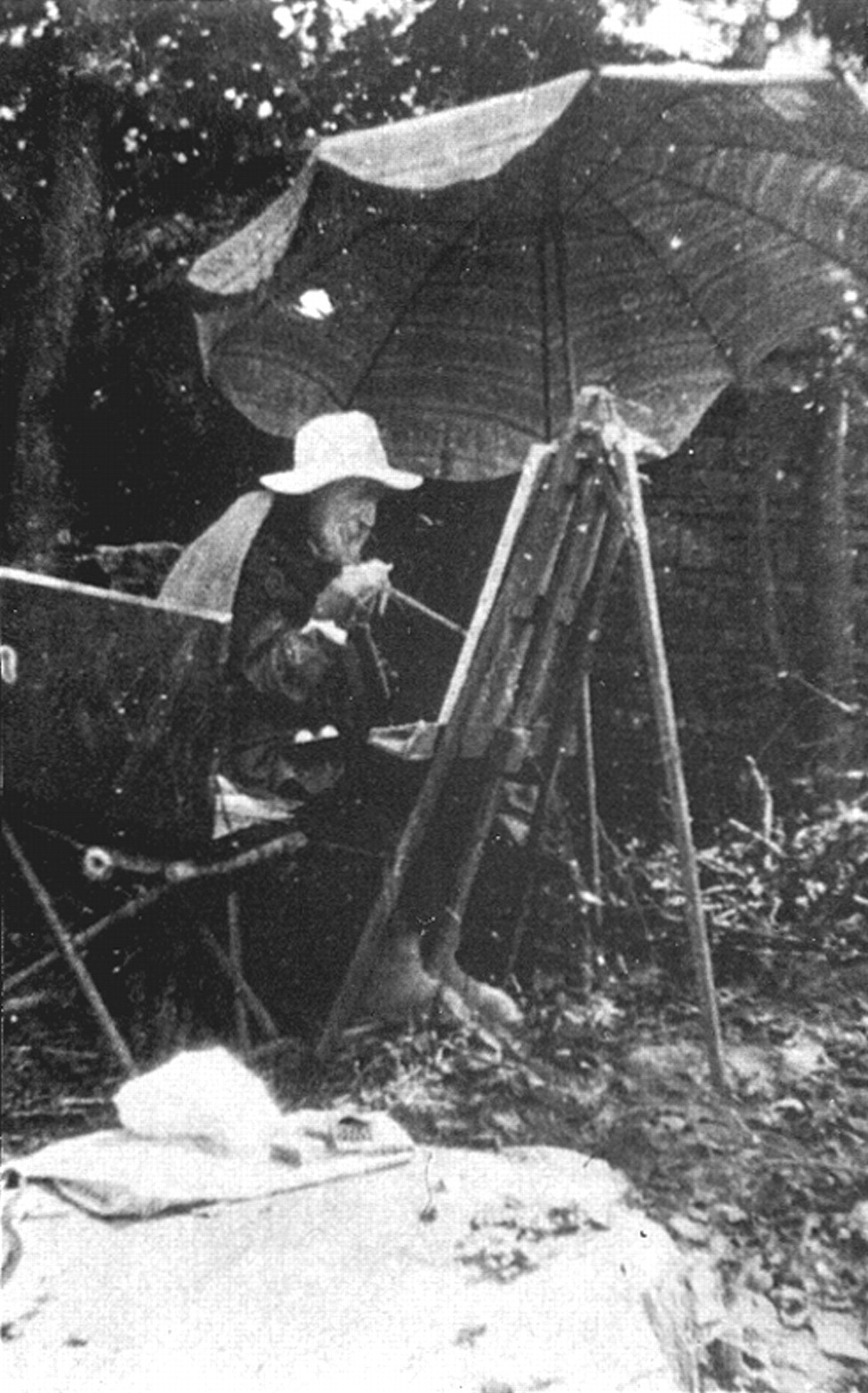
An arthritic Renoir, painting, [public domain]
On the day of his passing at 78, having painted for several hours, Renoir told his studio assistant, “I think I’m beginning to learn something about it.”
Enjoy seeing “Renoir Drawings” at The Morgan Library, which also offers detailed information about these works on their website, through February 8th.
“Sing a New Song: The Psalms in Medieval Art and Life“
The illustrated Bibles, many from The Morgan Library’s own collection, are exquisitely beautiful. As the exhibition notes, the Book of Psalms, the most popular book of the Bible, is known as Tehillum, or “Praises,” in Hebrew, and King David is credited as the primary author. The exhibition begins with King David’s composition of the Psalms, or “songs accompanied by stringed instruments” from the Greek “psalmos”.
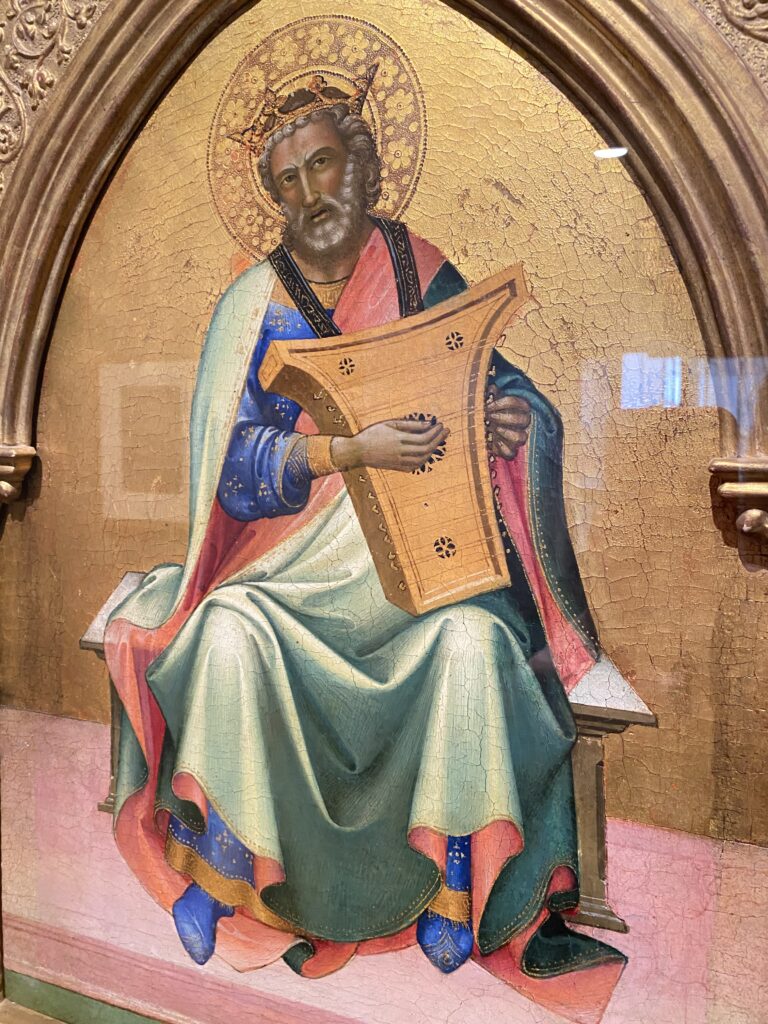
“King David as Psalmist” (instrument), 1408-10, by Lorenzo (Piero di Giovanni)
During the Middle Ages, psalters, or books with the 150 psalms, were initially the clergy’s prayerbooks. These promoted literacy and the study of Latin. Priests, monks, friars, and nuns had to recite all the psalms daily. The Book of Hours, customized psalters, were most popular among lay people, or non-clergy. The faithful looked to these prayers for hope, comfort, celebration, and forgiveness. Children had their own psalters, or primers, from which they learned to read.
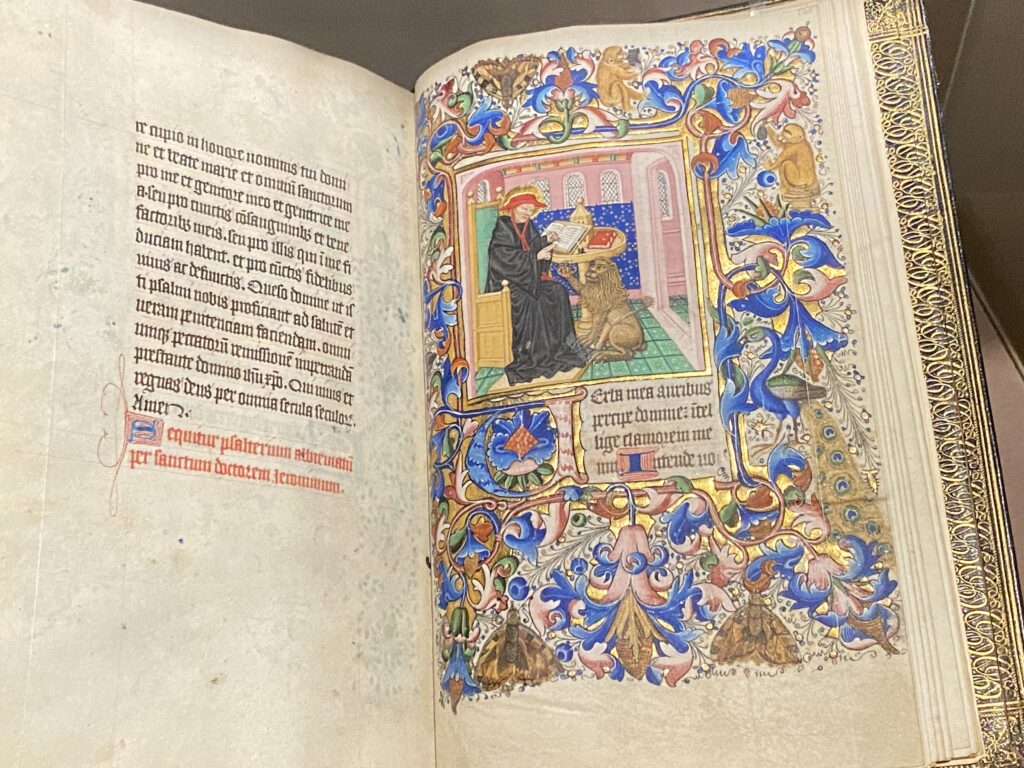
“[St.] Jerome in His Study,” Book of Hours, in Latin, ca. 1440-50, Fastolf Master, England
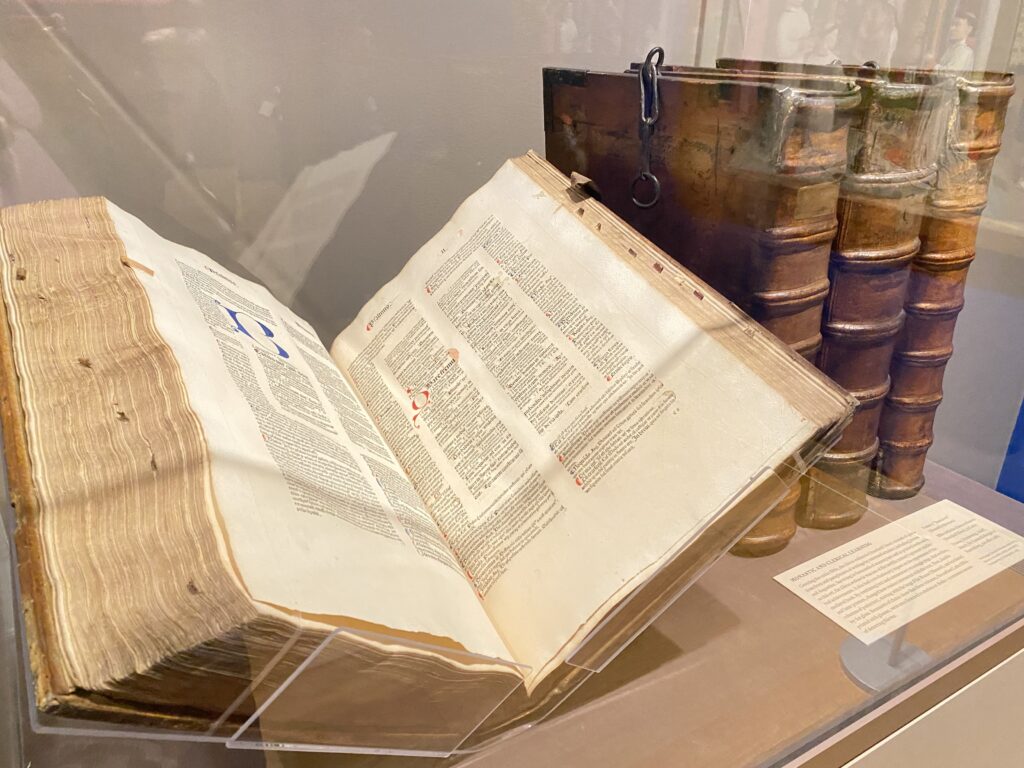
Glossa ordinaria (Standard Gloss), the complete Bible with the writings of Saints Jerome and Augustine, intellectuals and scholars of the Church, before 1480, The Morgan Library, open to Psalm I: “Blessed is the man.”
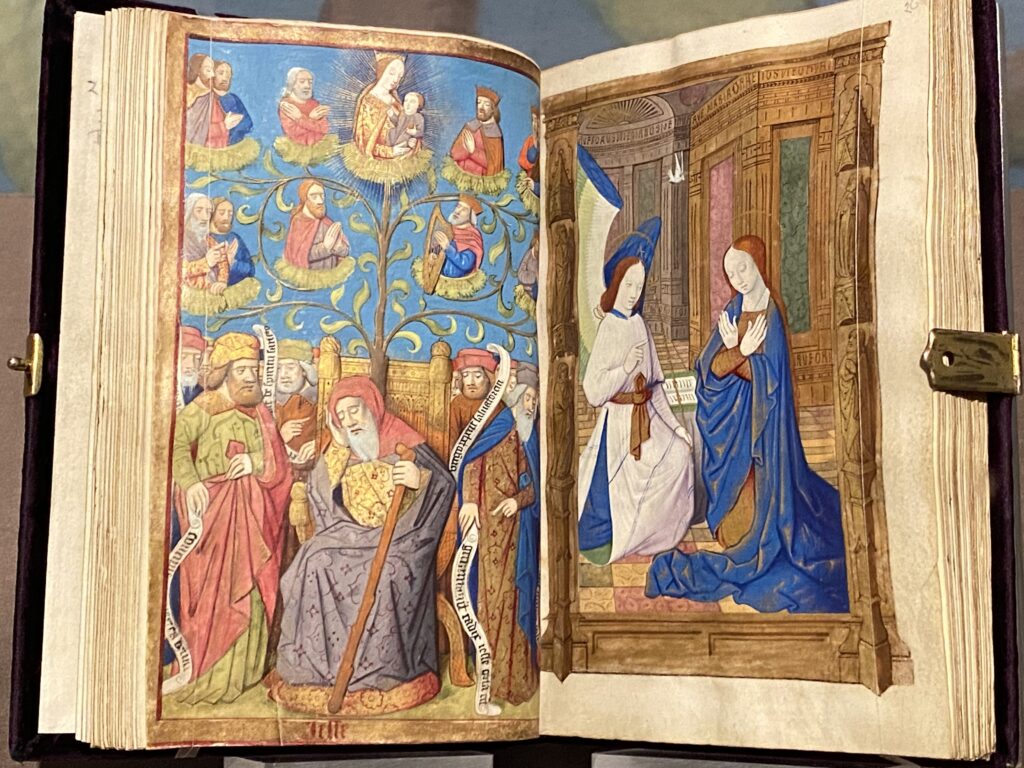
“Tree of Jesse” and “Annunciation,” depicting “David as Ancestor of Christ,” Book of Hours in Latin and French, Robert Boyvin, ca. 1495-1593, France
The exhibition concludes with Sir Thomas More’s Book of Hours and Psalter. Visitors can see his handwritten notes in Latin, which are moving to see. As a brief historical note, Sir Thomas More, the respected and beloved clergyman, lawyer, statesman, and humanist, served as the Lord Chancellor to King Henry VIII. Sir Thomas refused to recognize Henry as Head of the Church, a move intended to facilitate the king’s annulment from Catherine of Aragon, and to break with the Roman Catholic Church and Pope Clement VII. Imprisoned in the Tower of London for well over a year, Sir Thomas was executed and later canonized as a saint. Today, some people may know him from the word “utopia,” which came from his sociological and political satire of the same name; this writing was somewhat out of character, though his motives were always honorable. Below: “To think my most enemies my best friends….,” final verses of “A Godly Meditation,” Francois Regnualt, Book of Hours. 1530, Paris/Franz Birckman, Psalter, 1522, noted below.
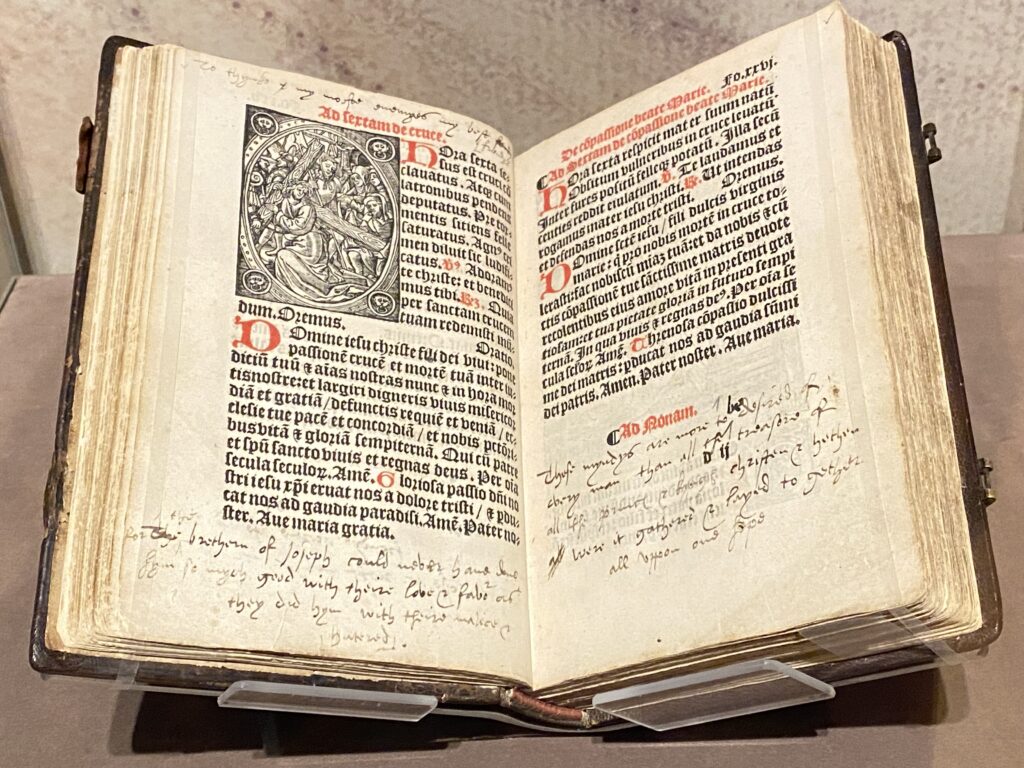
For more detail on this period and the beautiful exhibition, enjoy visiting upstairs in the Engelhard Gallery through January 4th, or finding the book in the gift shop.
Other treasures on exhibit are:
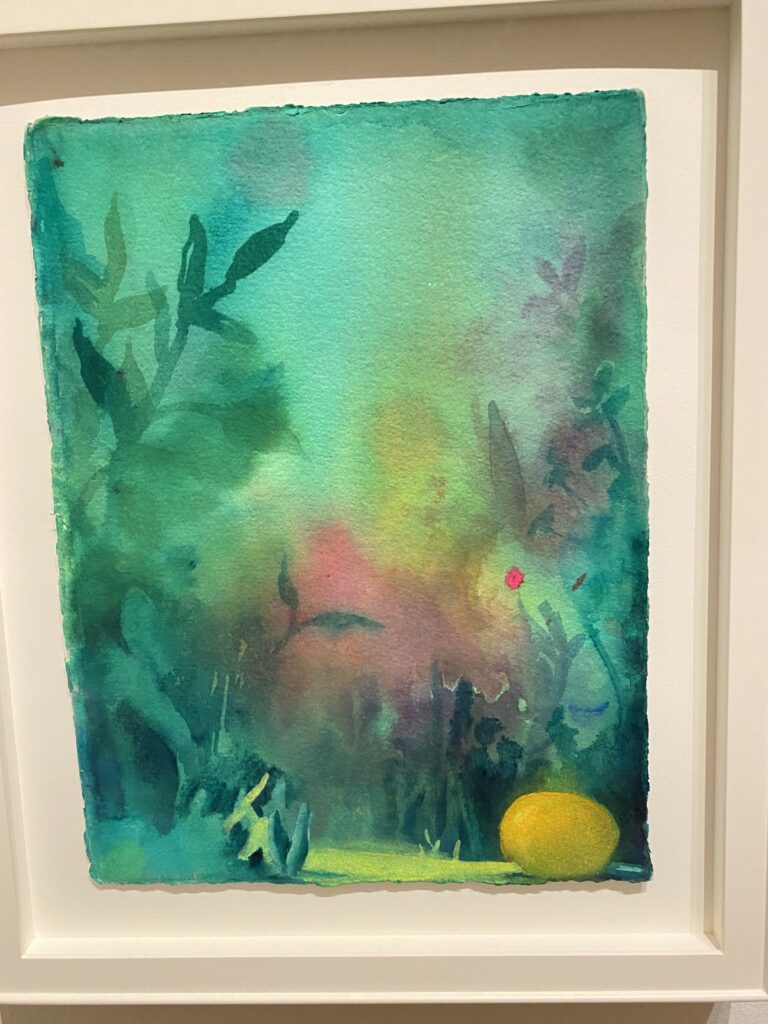
From “Lisa Yuskavage: Drawings”
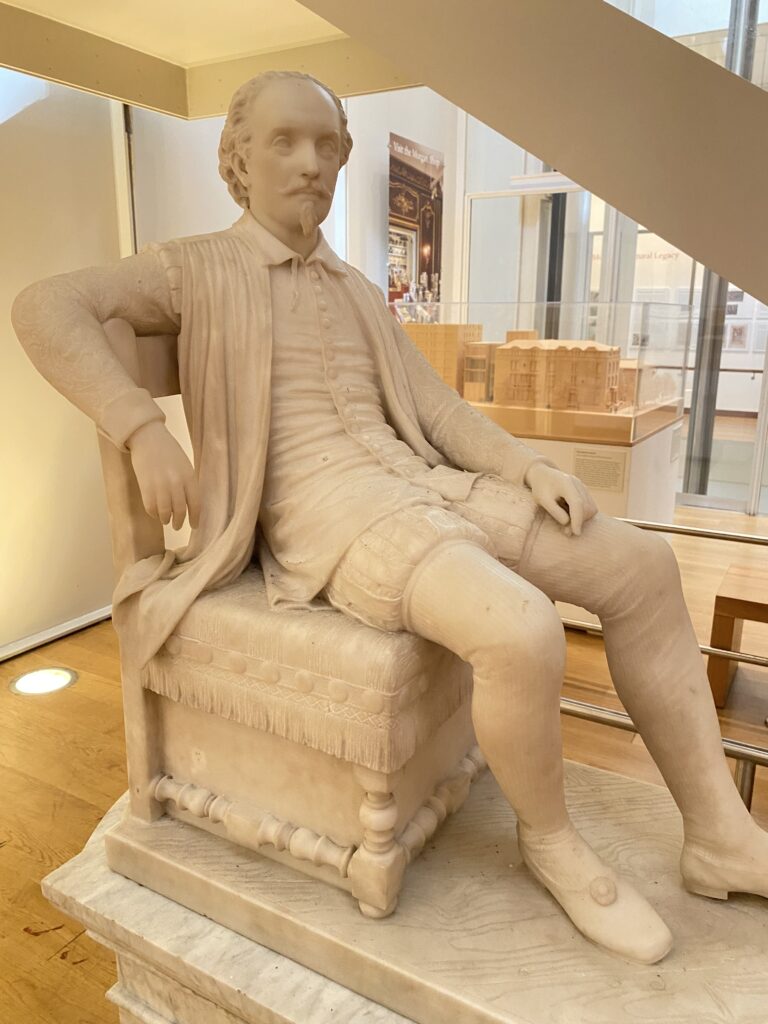
“William Shakespeare, Seated,” 1881, marble, William Wetmore Story, permanent collection
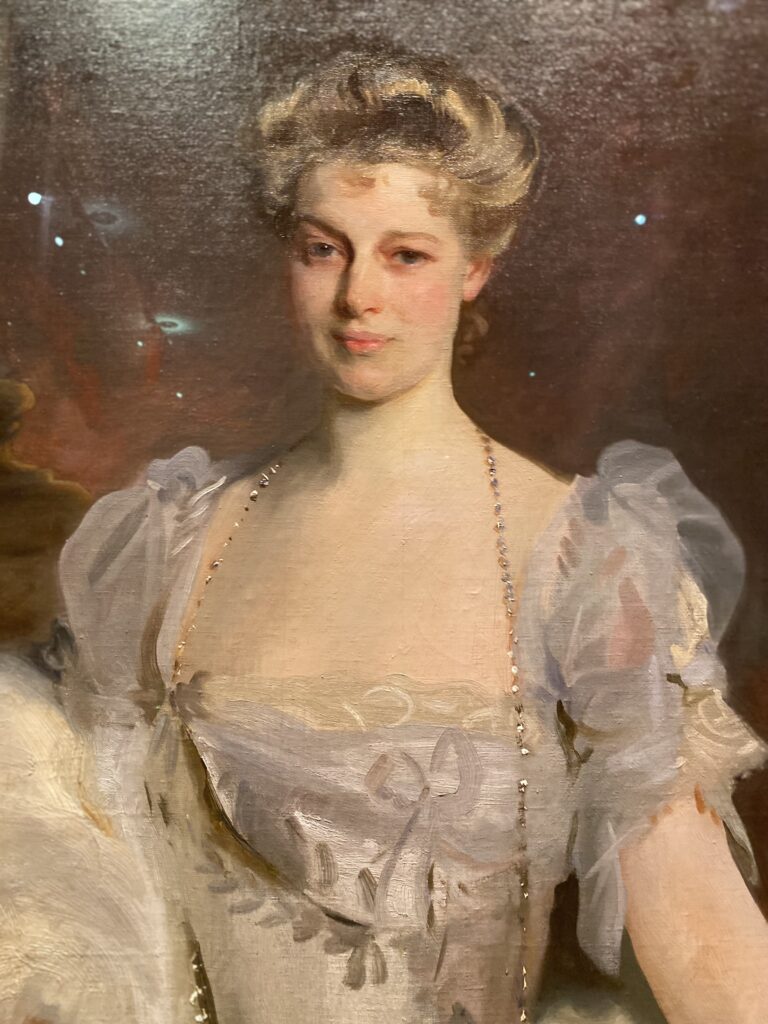
“Jane Norton Grew Morgan,” ca. 1905, oil, by John Singer Sargent, permanent collection. Enjoy another visit to his work via “Travel with John Singer Sargent at the Metropolitan Museum of Art”.
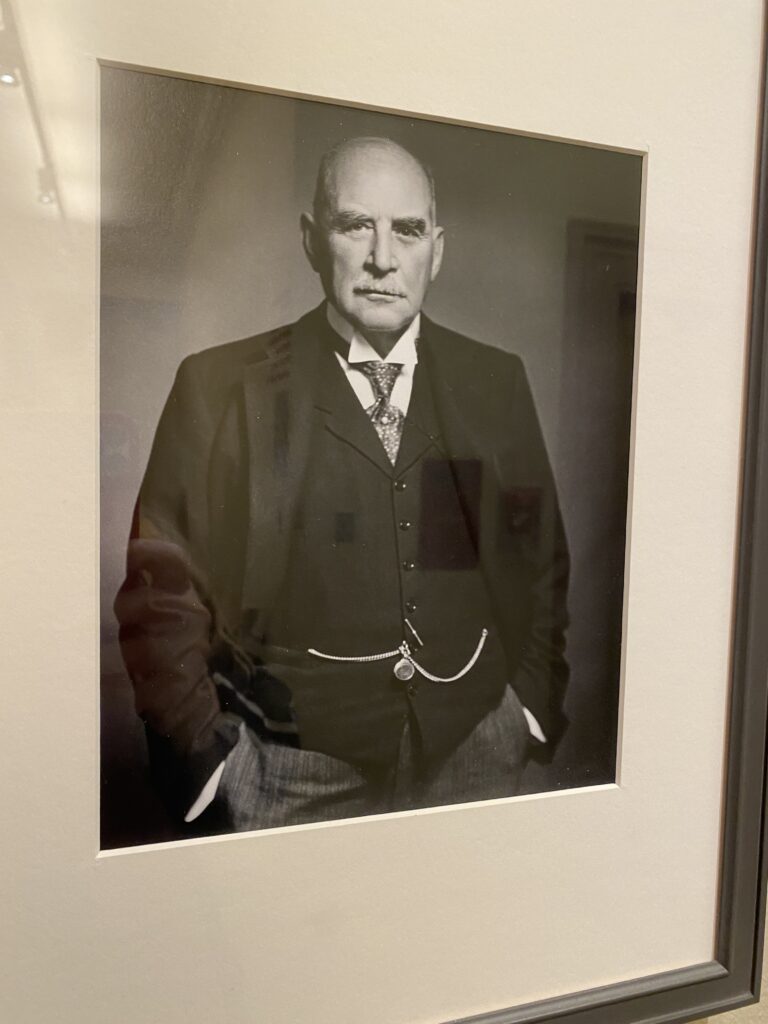
John Pierpont “Jack” Morgan, Jr., ca. 1930 by Fayer of London and Vienna, permanent collection
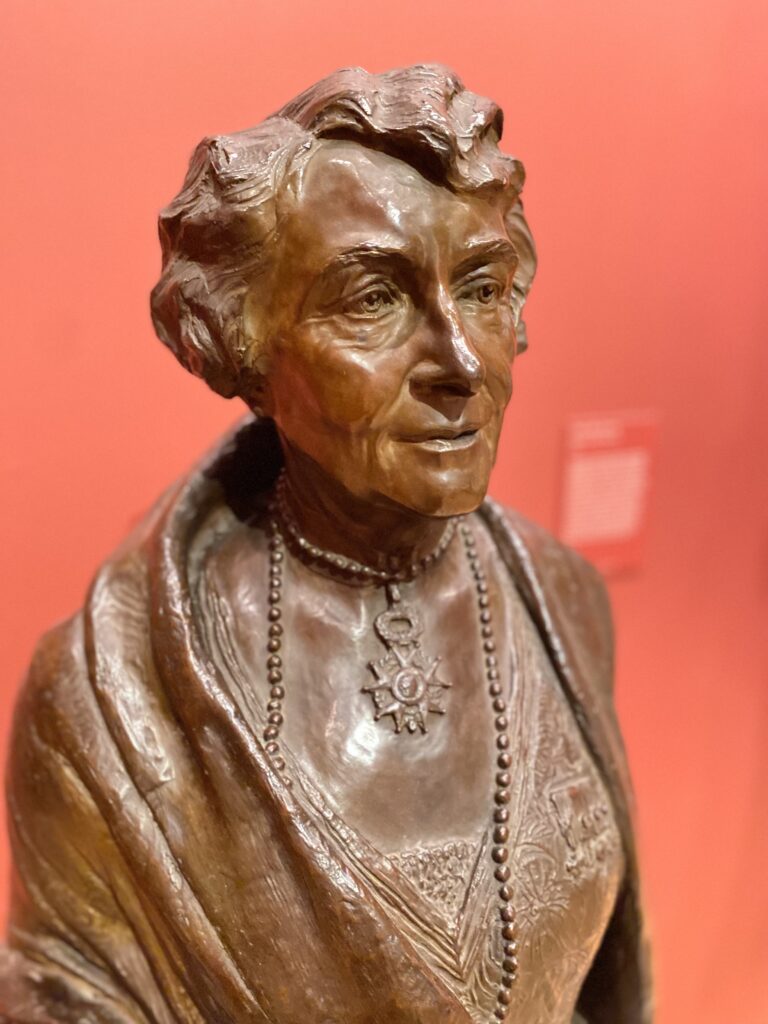
“Bust of Anne Tracy Morgan,” philanthropist and youngest daughter of J.P. Morgan, bronze, 1937, by Malvina Hoffman, permanent collection
Enjoy seeing the beautiful Gilded Age mansion, designed by premier architect Charles McKim of McKim, Mead & White, and appreciating the breathtaking library. Time did not allow for a revisit this time, but that will be the perfect excuse to return and fully appreciate the 2024 renovations, which everyone can appreciate. Free admission for everyone is available Friday evenings from 5-7 p.m.. College students with IDs may enjoy free admission the first Sunday of each month with a reservation. Fellowships and internships are available at times for college students, and for NYC university students, there is a college ambassador program. There are a a number of teen programs (writing challenge, summer reading, and drawing) and teacher resources.
The Morgan is wheelchair accessible and offers wheelchairs and walkers. Additionally, discounted tickets are available. (Kindly call (212) 685-0008 or email visitorservices@themorgan.org with questions regarding any accommodations.) If visitors plan a longer day at the library, there is an inviting café.
(Sources: The Morgan Library, musee-orsay.com, metmuseum.org, britannica.com, goodreads.com, artinsociety.com, clarkart.edu, openculture.com, 19thc-artworldwide.org, medium.com, nytimes, nationalgallery.org.uk, 19thc-artworldwide.org, apollo-magazine.com, thephilipscollection.org, getty.edu, dailyartmagazine.com, art-renoir.com, adventuresintheprinttrade.blogspot.com, pmc.ncbi.nlm.nih.gov, latimes.org, bbc.co.uk, harvardartmuseums.org, pasonlinelectures.com, galeriemagazine.com, theatlantic.com, theparisreview.org, shop.themorgan.org, amazon.com, legendarte.shop, Wiki)
“Renoir and the Psalms at The Morgan Library” All Rights Reserved ©2025 Kathleen Helen Levey