Writing New Jersey Life

People and places of New Jersey…with some travels.

22bet oder Conquestador – wer zahlt 2026 schneller aus?

22bet oder Conquestador – wer zahlt 2026 schneller aus?

Bei 22bet oder Conquestador – steht für viele Einsteiger eine ganz praktische Frage im Mittelpunkt: Wie schnell kommt eine Auszahlung an? Wer gerade erst mit Online-Casinos beginnt, trifft hier auf Begriffe wie „Auszahlungsdauer”, „Verifizierung” und „Bearbeitungszeit”. Das klingt trocken, entscheidet aber im Alltag darüber, ob Gewinne in Minuten, Stunden oder erst nach ein paar Tagen auf dem Konto landen.

Der Vergleich ist auch deshalb spannend, weil sich der Markt stark entwickelt hat. Früher waren Auszahlungen oft ein Geduldsspiel, heute prägen E-Wallets, Kartenzahlungen und Banküberweisungen den Ablauf. Anbieter wie Evolution Gaming oder Nolimit City stehen für moderne Spieltechnik; bei der Auszahlung zählt dann aber vor allem, wie sauber ein Casino Prozesse, Identitätsprüfung und Zahlungswege organisiert. Für Spieler aus dem Vereinigten Königreich gilt zusätzlich: Nur Angebote mit UKGC-Lizenz sind der sichere Maßstab für verantwortungsvolles Spiel und klare Regeln.

Was „schnelle Auszahlung” eigentlich bedeutet

Eine Auszahlung ist die Überweisung von Guthaben vom Spielerkonto auf ein persönliches Zahlungsinstrument. Schnell bedeutet dabei nicht nur „ohne lange Wartezeit”, sondern meist zwei getrennte Schritte: Erst prüft das Casino den Antrag, danach verarbeitet der Zahlungsdienst die Überweisung. Die erste Phase heißt Bearbeitungszeit, die zweite Transferzeit.

Die Bearbeitungszeit ist der Punkt, an dem sich 22bet und Conquestador am stärksten unterscheiden können. Manche Buchmacher- und Casino-Marken bearbeiten Auszahlungen rund um die Uhr automatisch, andere nur innerhalb bestimmter Bürozeiten. Für Anfänger ist das wichtig, weil ein Freitagabend-Antrag bei einem langsamen Prozess leicht bis Montag liegen bleibt.

22bet gegen Conquestador: typische Auszahlungswege im Vergleich

Anbieter Typische Wege Was die Geschwindigkeit beeinflusst
22bet Karte, Banküberweisung, E-Wallet Verifizierungsstatus, gewählter Weg, interne Freigabe
Conquestador Karte, Überweisung, teils digitale Wallets Bearbeitungsfenster, KYC-Prüfung, Banklaufzeiten

Im direkten Alltag haben E-Wallets oft den Vorteil, dass sie nach Freigabe schneller beim Spieler ankommen als klassische Banküberweisungen. KYC steht für „Know Your Customer” und meint die Identitätsprüfung. Ohne abgeschlossene KYC-Prüfung verzögert sich fast jede Auszahlung, ganz gleich, ob der Anbieter 22bet oder Conquestador heißt.

Ein typischer Anfängerfehler: Erst auszahlen wollen und dann die Ausweisprüfung erledigen. Wer Dokumente wie Ausweis, Adressnachweis und Zahlungsnachweis früh hochlädt, spart oft Tage.

Warum die Verifizierung über den Zeitvorteil entscheidet

Die schnellste Zahlungsoption hilft wenig, wenn das Konto noch nicht vollständig geprüft ist. Unter Verifizierung versteht man die Bestätigung, dass Name, Alter und Zahlungsdaten wirklich zum Spieler gehören. Das ist auch aus UKGC-Sicht zentral, weil regulierte Casinos Jugendschutz, Geldwäscheprävention und Spielerschutz ernst nehmen müssen.

Historisch gesehen sind genau diese Prüfungen mit dem Wachstum des Online-Glücksspiels strenger geworden. Früher reichte oft eine einfache Anmeldung. Heute erwarten seriöse Betreiber klare Dokumente, und das ist für Anfänger sogar hilfreich: Wer von Anfang an sauber registriert, erlebt später weniger Überraschungen.

  • Schnell: E-Wallet-Auszahlung nach Freigabe oft sehr zügig.
  • Mittelschnell: Kartenauszahlung kann je nach Bank variieren.
  • Eher langsam: klassische Überweisung, besonders an Wochenenden.

Wer zahlt 2026 schneller aus?

Eine pauschale Siegerantwort wäre unseriös, denn die reale Geschwindigkeit hängt vom Zahlungsweg ab. In vielen Fällen wirkt 22bet etwas flexibler bei modernen Zahlungsarten, während Conquestador bei klassischen Wegen solide, aber nicht immer schneller ist. Für Spieler bedeutet das: Wer auf Tempo setzt, sollte zuerst den Auszahlungsweg prüfen und erst dann das Casino vergleichen.

Faustregel: Das schnellste Casino ist meist dasjenige, bei dem Konto, Dokumente und Zahlungsmethode bereits verifiziert sind. Danach folgen interne Bearbeitung und Bankgeschwindigkeit. Genau hier können sich Unterschiede von wenigen Stunden bis zu mehreren Tagen ergeben.

So wählen Einsteiger ein UKGC-konformes Casino mit zügiger Auszahlung

Wer in Grossbritannien oder nach britischen Standards spielt, sollte immer die Lizenz prüfen. Eine UKGC-Lizenz bedeutet, dass das Casino unter Aufsicht der britischen Glücksspielkommission steht. Das schützt nicht nur, sondern sorgt oft auch für transparentere Regeln bei Einzahlungen, Limits und Auszahlungen.

Für die Praxis hilft diese einfache Reihenfolge:

  1. Lizenz prüfen und nur regulierte Anbieter wählen.
  2. Verifizierung direkt nach der Registrierung abschliessen.
  3. Einen schnellen Auszahlungsweg wählen, wenn verfügbar.
  4. Bonusbedingungen lesen, bevor Gewinne ausgezahlt werden.

Wer diese Punkte beachtet, reduziert Wartezeiten spürbar. Zwischen 22bet und Conquestador entscheidet 2026 also weniger der Name als die Kombination aus Zahlungsweg, KYC und interner Bearbeitung. Genau darin liegt für Einsteiger die wichtigste Erkenntnis: Schnelligkeit ist planbar, wenn man die Begriffe kennt und die richtigen Schritte früh erledigt.

Estratégia Dream Catcher para caçadores de bónus

Estratégia Dream Catcher para caçadores de bónus

Já perdi dinheiro suficiente no Dream Catcher para parar de acreditar em “sensações” e começar a olhar para o jogo como ele é: um roda de bónus com volatilidade alta, pagamentos curtos e muita tentação de entrar em momentos errados. Fiz a minha própria análise sessão a sessão, com registos de apostas, frequência de entrada nos multiplicadores e tamanho das perdas por sequência, e foi aí que percebi que a maior armadilha não é o jogo — é a leitura apressada dele (há uma referência útil aqui).

O padrão que me fez parar de perseguir rodadas “quentes”

O Dream Catcher não recompensa teimosia. O disco gira rápido, o bónus aparece com frequência razoável, mas o valor esperado continua a ser puxado para baixo pela estrutura do jogo. O erro clássico é pensar que uma sequência de resultados baixos “prepara” um multiplicador alto. Não prepara. Cada giro mantém a mesma lógica de probabilidade, e essa é a parte que custa aceitar quando já levamos três ou quatro entradas falhadas seguidas.

O que eu passei a observar foi mais simples:

  • entrada no 2x e 5x acontece muito mais do que a maioria dos jogadores sente na mesa;
  • o 10x já começa a exigir paciência real;
  • o 20x e o 40x são os multiplicadores que distorcem a memória do jogador, porque uma única captura boa apaga várias perdas pequenas;
  • o 200x existe para chamar atenção, não para ser base de plano.

Se o objetivo é caçar bónus, a disciplina vale mais do que a excitação. Eu passei a entrar só com banca definida e uma meta de saída curta. Parece banal, mas a maioria das perdas vinha de insistir depois de um bom pagamento, convencido de que o próximo giro “tinha de” compensar o resto.

O que a minha amostra mostrou sobre risco e banca

Montei uma amostra de sessões curtas, sempre com o mesmo valor por aposta, e registei o resultado final. O padrão foi claro: sessões longas punem mais do que sessões curtas, porque o jogo consome banca em pequenos passos até que um multiplicador médio apareça tarde demais. A estratégia mais eficiente para mim não foi “aguentar até sair o grande prémio”; foi definir um limite de perdas e sair quando ele fosse atingido.

Abordagem Entrada típica Risco prático
Caça agressiva Muitas rodadas seguidas Queima banca depressa
Entrada controlada Sessões curtas e pausadas Perdas mais previsíveis
Perseguição ao 40x Esperar “o momento certo” Ilusão estatística

O RTP divulgado pelo fornecedor é de 96,21%, mas isso não significa retorno estável numa sessão curta. Em jogo ao vivo, o que conta é o desvio de curto prazo. A mesma matemática que permite uma captura de 40x também permite vinte giros quase vazios. E aí entra a parte desconfortável: o jogador que não aceita variação acaba a interpretar ruído como sinal.

Onde o Dream Catcher engana quem procura bónus

Há uma suposição muito comum de que o melhor momento para entrar é logo depois de uma sequência fraca. Eu testei isso várias vezes e falhei mais do que ganhei. O jogo não “deve” nada a ninguém. O disco não guarda memória útil para o jogador, só para quem quer transformar coincidência em método.

“A maior perda não foi quando saí sem lucro. Foi quando confundi uma captura de 10x com prova de que a mesa estava a aquecer e dobrei a aposta logo a seguir.”

O outro engano é achar que uma aposta maior melhora a probabilidade de apanhar o bónus. Não melhora. Só aumenta a exposição. Se o teu foco é bónus, o que muda o jogo é o controlo de sessão: quanto entras, quanto toleras, quando paras. Simples, mas difícil de executar quando o ecrã está a prometer multiplicadores grandes.

Leitura prática da mesa para quem joga com cabeça

Se eu tivesse de resumir a minha forma de jogar hoje, seria esta: entrar pouco, observar muito, sair cedo. Não é sexy, mas funciona melhor do que o impulso de “recuperar” tudo numa única sequência. O Dream Catcher recompensa mais quem trata cada sessão como um teste do que quem o encara como uma corrida ao jackpot.

Os meus pontos de controlo são estes:

  • definir banca antes de começar;
  • aceitar que o 2x e o 5x são parte do percurso, não sinal de falhanço;
  • não aumentar aposta depois de uma captura boa;
  • parar após um alvo modesto, mesmo quando a sessão está a correr bem;
  • usar apenas operadores e fornecedores auditados, com certificação de testes independentes como os da iTech Labs.

Também vale olhar para o ecossistema do jogo. A Push Gaming continua a ser um nome forte no segmento de casino ao vivo e jogos de roda, precisamente porque sabe combinar apresentação limpa com mecânicas que prendem atenção sem complicar a leitura do risco. Essa clareza ajuda o jogador a perceber o que está realmente a comprar quando entra numa mesa com este perfil.

No fim, a estratégia para caçadores de bónus não é procurar uma fórmula mágica. É cortar perdas desnecessárias, respeitar a volatilidade e não deixar que uma boa captura apague o resto da sessão da memória. No Dream Catcher, quem sobrevive mais tempo costuma ser quem joga menos por impulso e mais por método.

“Monet and Venice” at the Brooklyn Museum

“The real subject of every painting is light.”

                                      Claude Monet

Step out of grey skies and bitter cold into the luminous world of Claude Monet and Venice before it ends this Sunday, February 1st.  Venice, also known as “La Serenissima (‘The Most Serene’),” casts its spell on visitors as they gaze in quiet joy at the beautiful works. 
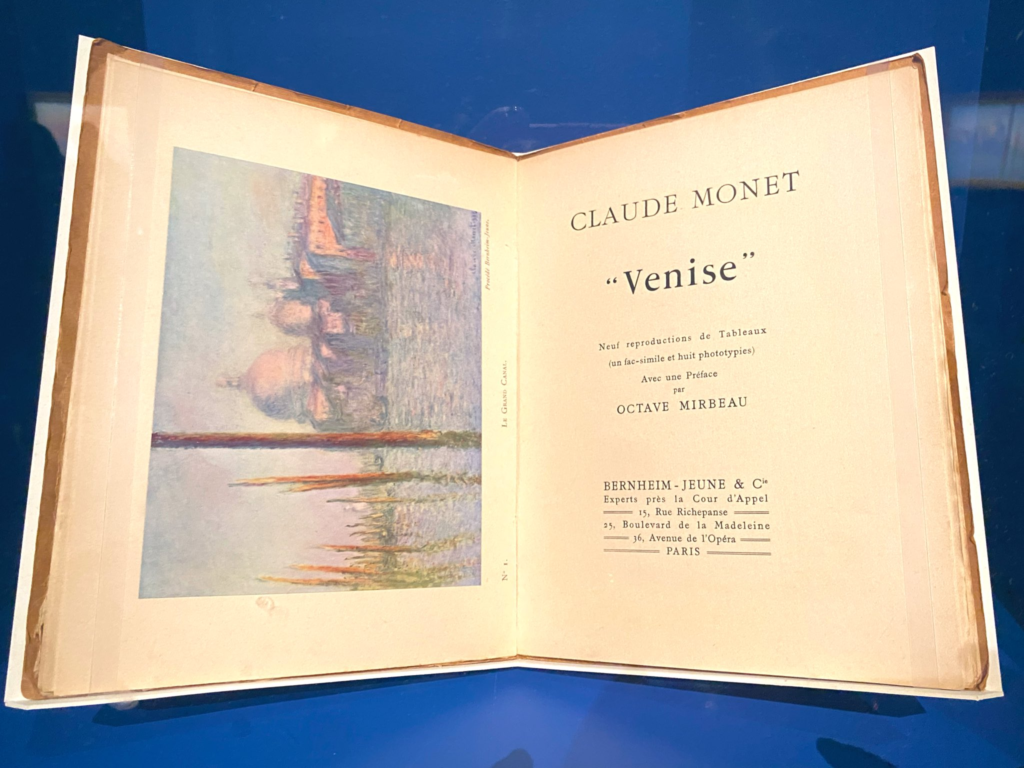
At the invitation of friends, Monet visited Venice with his wife Alice during the fall of 1908.  Claude did not want to leave his beloved gardens at their home in Giverny, but the 68-year-old artist, who painted prolifically until his passing at 86 in 1926, became captivated by the city. Monet spent a lifetime trying to capture light, essentially trying to depict the elusive, as the exhibition notes, which often left him unsettled.  By painting an exact moment of light, he was capturing time.  His series of paintings, such as those of Venice’s island of San Giorgio Maggiore (“Saint George the Greater”), with its beautiful church, show both an eternal view and a “symphonic” passing of time as Jackie Wullschläger, one of his biographers, notes. The museum underscores this with serene, classical music. One might think Monet’s quest was unattainable, but 115 years later, each of his works in this beautifully curated exhibition continues to transfix museum-goers by transporting them to those moments in Venice.  Visitors can hear the soothing lapping of the Grand Canal.  Part of the beauty is seeing the faces of captivated viewers of different generations, lit by the luminous light that emanates from Monet’s canvases.
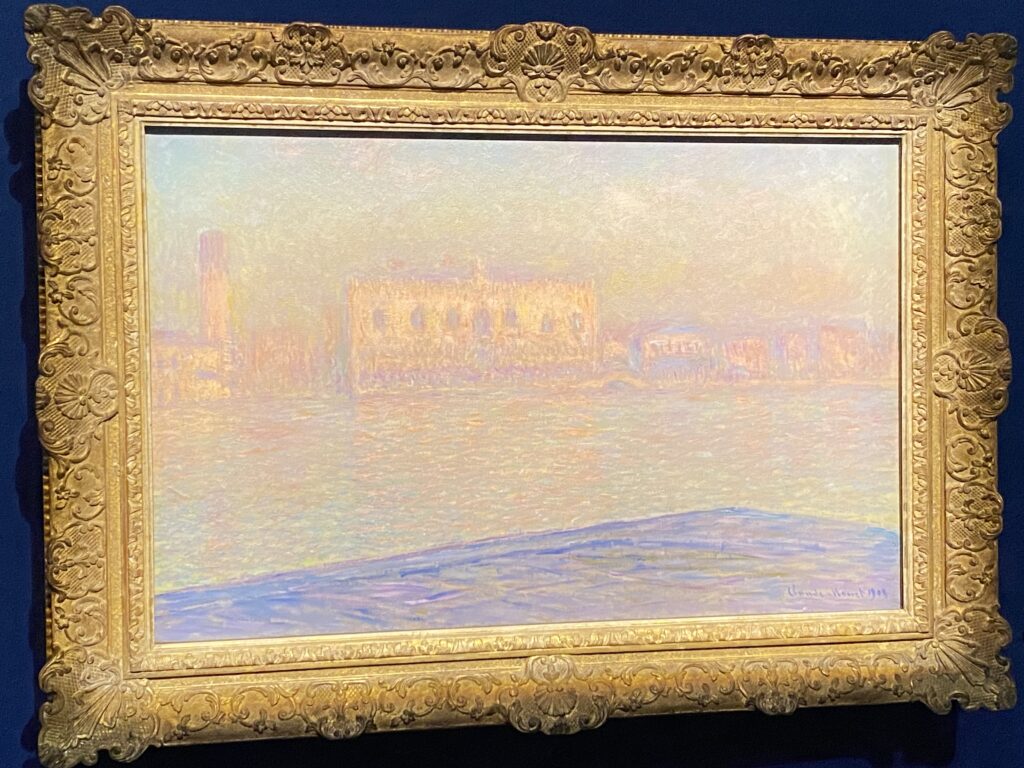
The Palazzo Ducale (“The Doge’s Palace,” below) represents the Venice that stands outside of time:
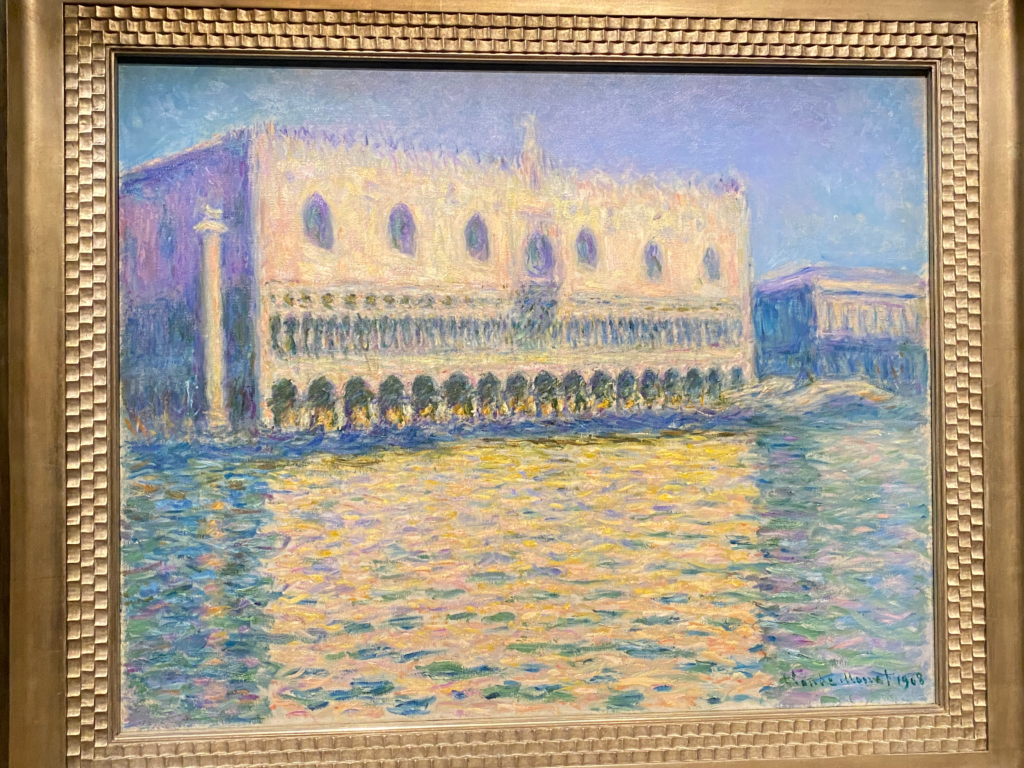

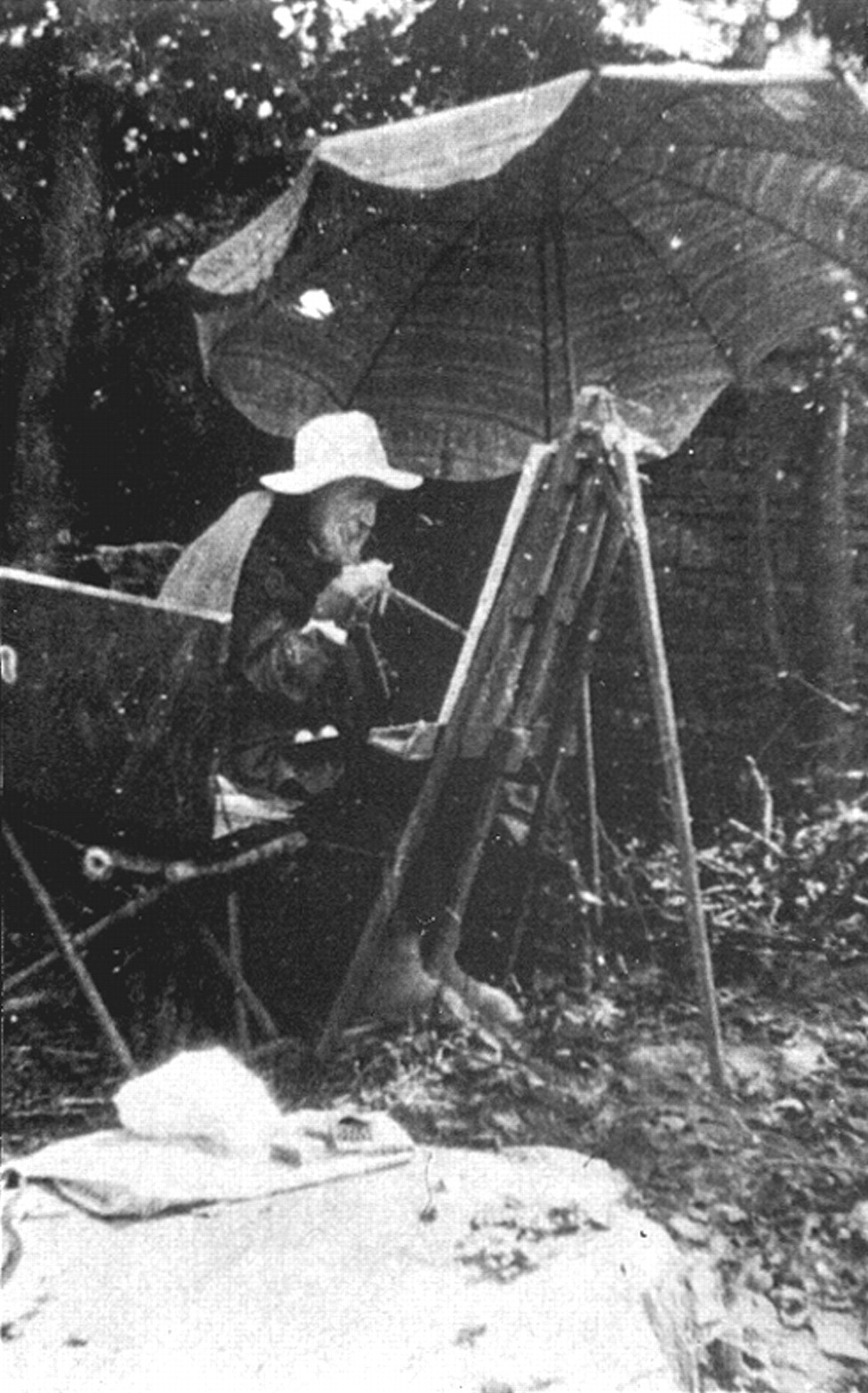
Monet was a proponent of painting en plein air (“in the open air/outdoors”), introduced to him by Eugene Boudin, his instructor at the Academie Suisse, who was also a mentor of Monet’s classmate and friend Jean Renoir.  So taken with Venice, Monet began more paintings than he anticipated, working each morning with Alice beside him, but he had to complete them back in France. They planned to return to Venice together, but his wife Alice passed away, a second profound loss for Monet whose first wife Camille had also died. Grief kept him from returning to the paintings until 1911, when he completed them in Alice’s memory. What is incredible about Monet’s accomplishment is that cataracts had begun to cloud his eyesight, but he managed around this until finally acquiescing to surgery on one eye at the age of 82.
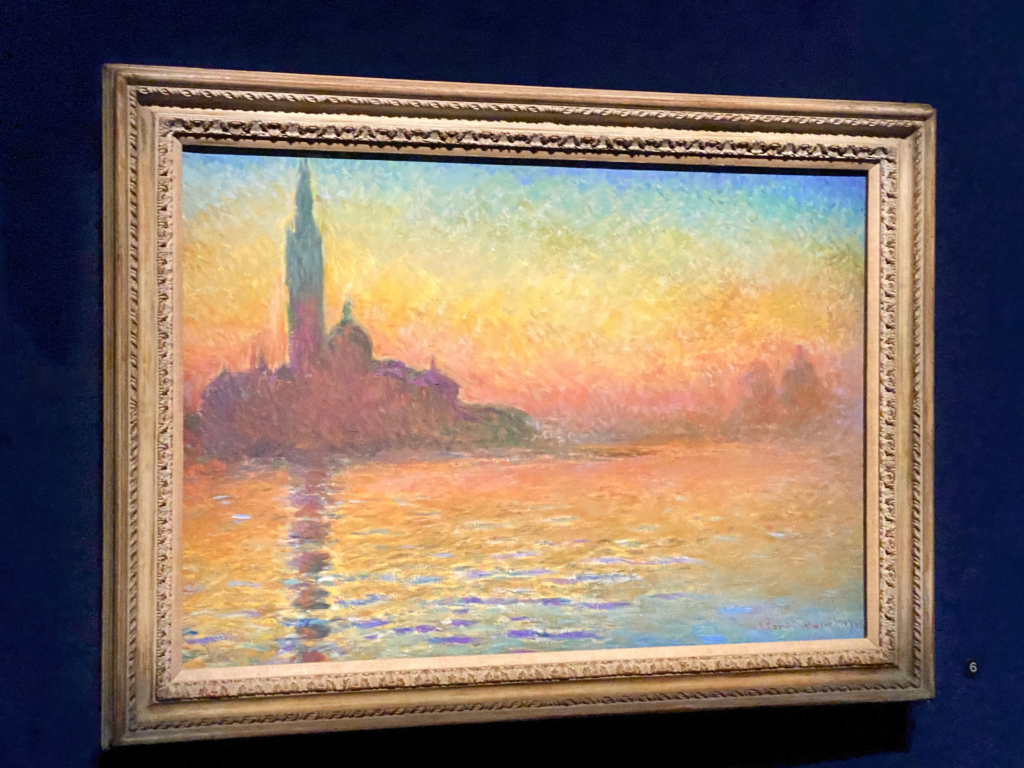
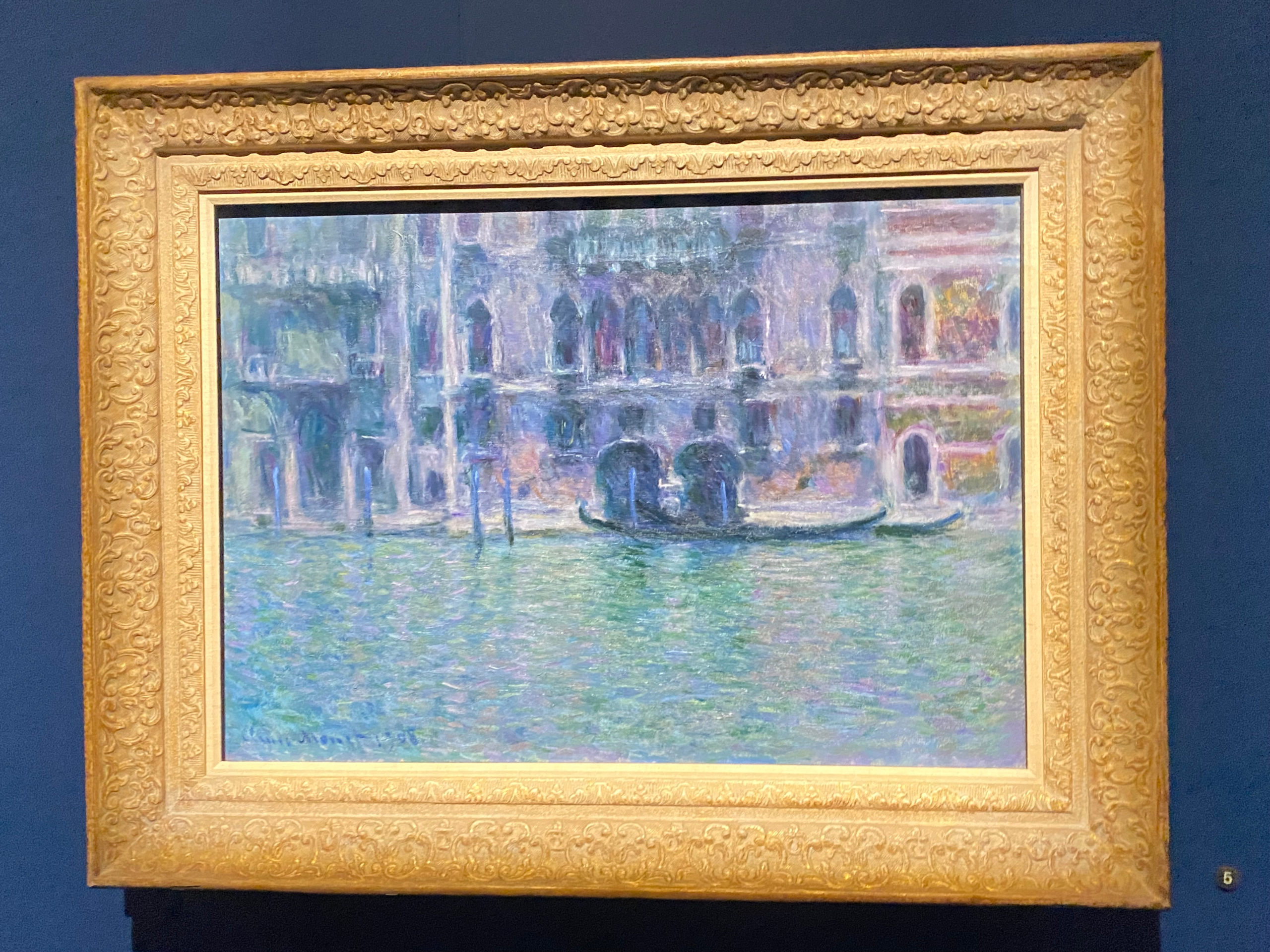
Though it is difficult to believe now, the Paris Salon often rejected Monet’s early art for exhibition, as did London’s Royal Academy, both deeming it too radical.  Monet struggled for years. Art critics ridiculed the works of the first exhibition by Monet and his peers in 1874. Louis Leroy noted that Monet’s “Impression, Sunrise (1872)” was just an impression, a work left unfinished like those of the other artists.  This painting, which launched Impressionism and abstract art, did not sell. Ultimately, it was the first sales of his art in the United States that led to Monet’s financial stability. By the time of his trip to Venice, Monet had achieved critical and commercial success.
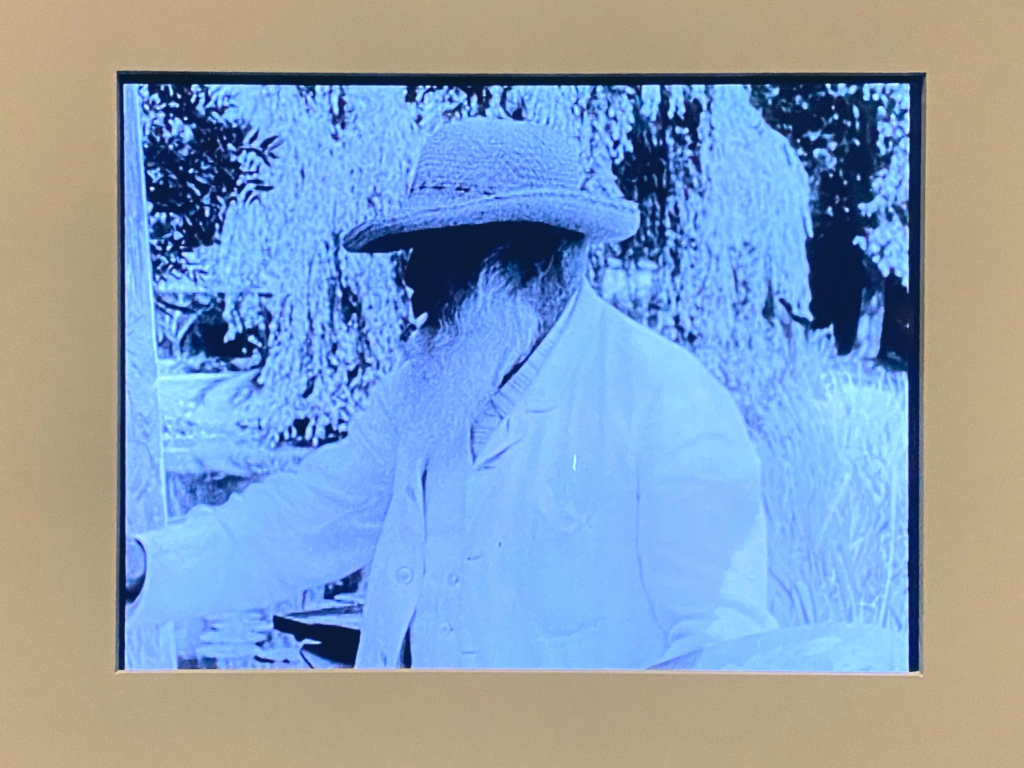
Monet, 75, at work in the gardens of Giverny from Sacha Gurtie’s 1915 film “Those of Our Land,” which included Renoir, Degas, and Rodin.
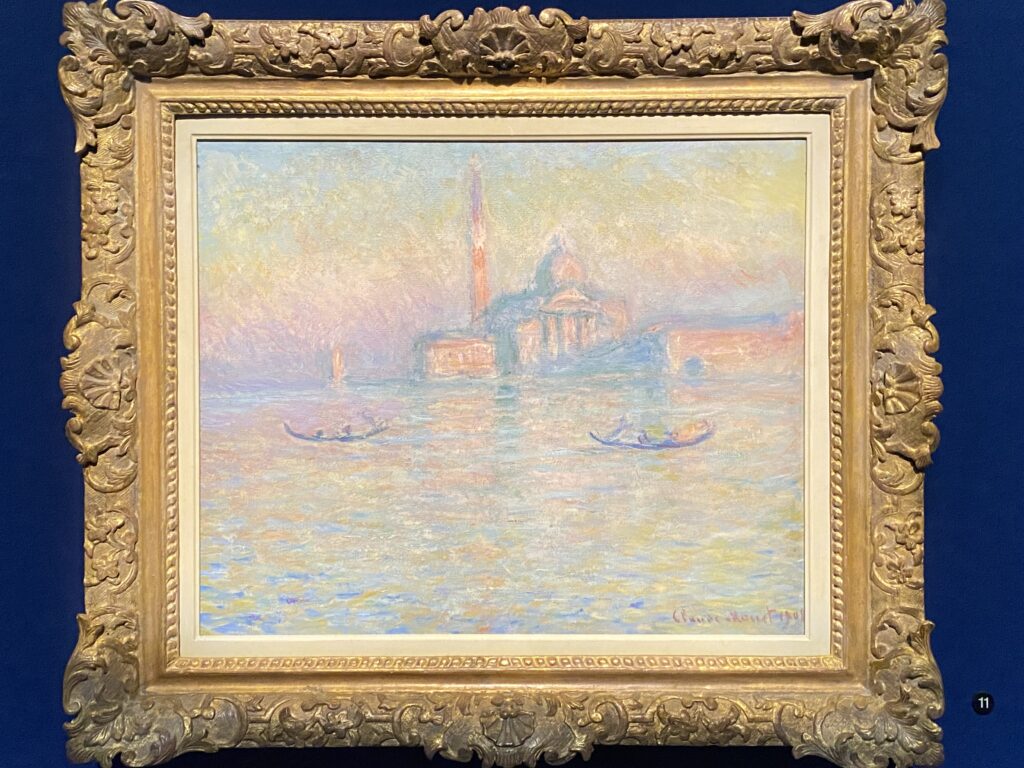
A sublime treat in the exhibition, a Monet water lily painting:
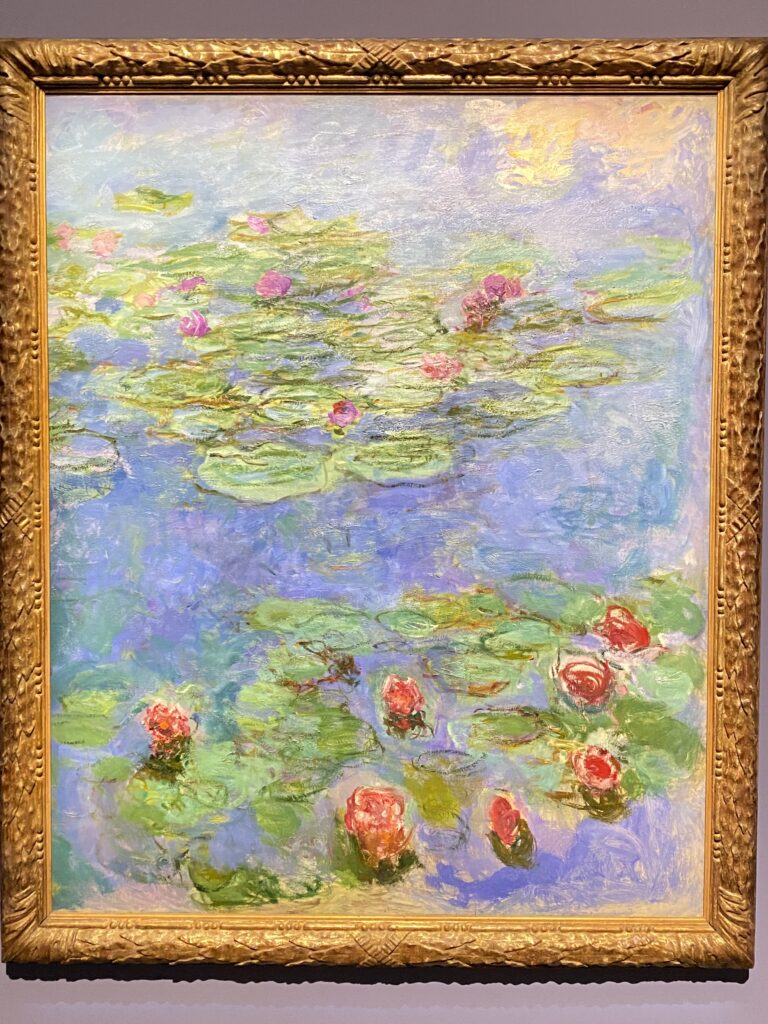
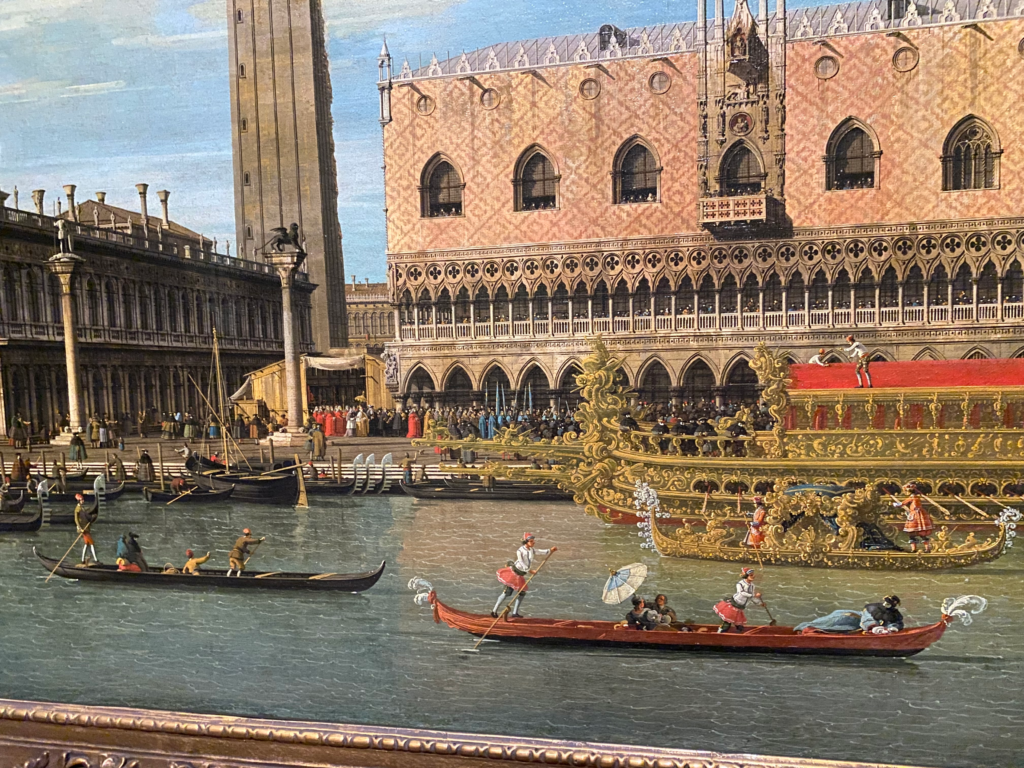
Just when one might think life couldn’t get any better, there is the incredible surprise of Canaletto. Canaletto (Giovanni Antonio Canal), also painted en plein air in the 1700’s, which distinguished his work from the studio-based art of the time:
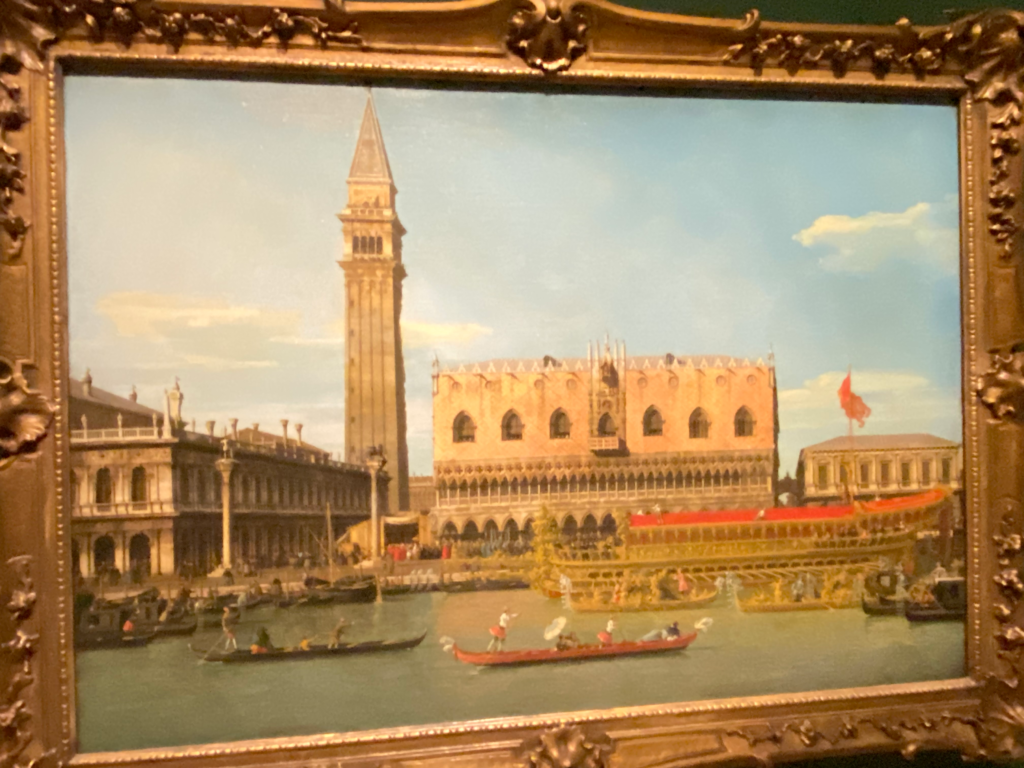
“The Bucintoro at the Molo on Ascension Day,” Canaletto, 1745, and some details (below), created using a camera obscura, a precursor to the modern-day camera.
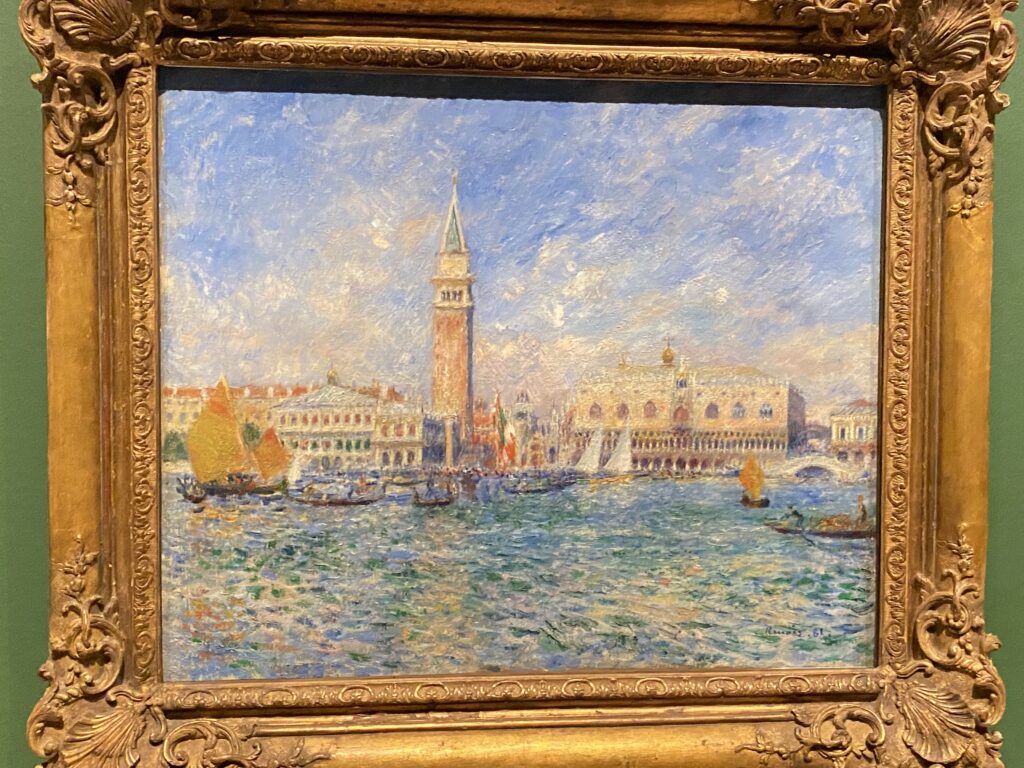
The exhibition includes the Venice-inspired work of other renowned artists like Jean Renoir, Monet’s friend, classmate at the Academie Suisse, and co-founder of Impressionism, who suffuses his paintings with warmer light and greater detail. (An exhibition of Renoir’s drawings was recently at The Morgan Library.) To enhance Venice’s serenity, Monet included few people despite the crowds of tourists, while Renoir depicted more vibrant scenes. Renoir noted that sometimes as many as six other painters were working alongside him. Each artist may have had the same view, but made it his or her own.
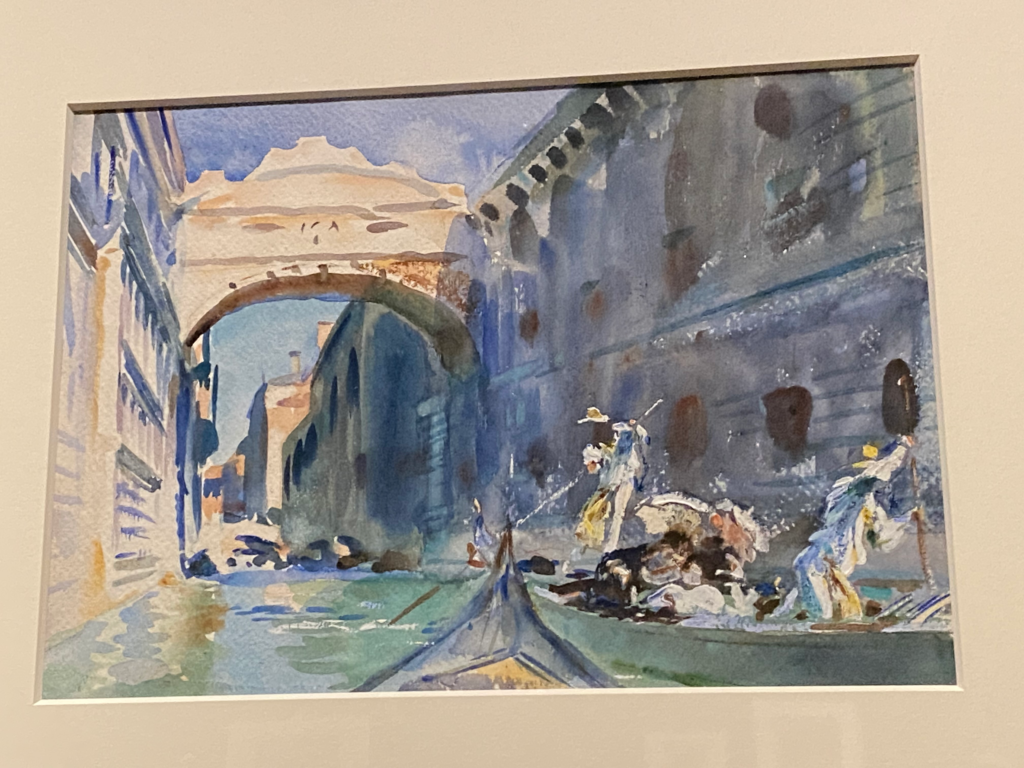
John Singer Sargent, whose works are in the museum’s own impressive collection, had a recent exhibition at The Met. He shared everyday scenes of Venice in watercolor paintings such as “The Bridge of Sighs,” 1903-1904:
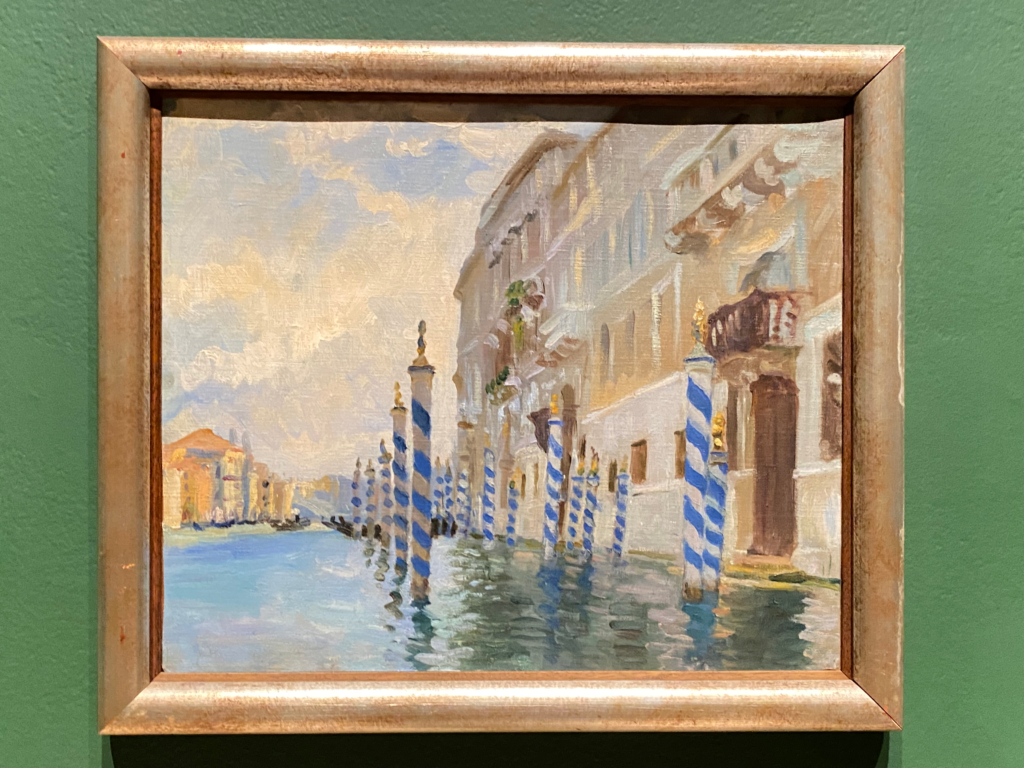
“Canal View, Venice,” Jane Emmet de Glehn, ca. early 1900s; the artist was a friend of John Singer Sargent:
Paul Signac, a younger artist whom Monet encouraged:
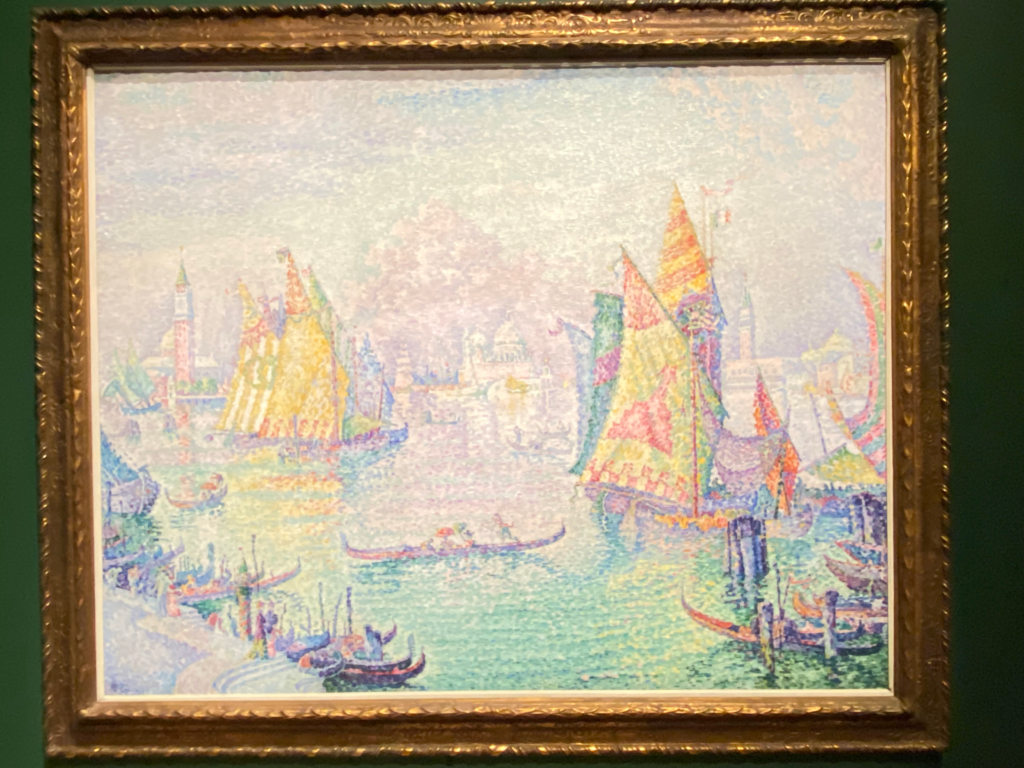
“The Lagoon of Saint Mark, Venice,” Paul Signac, 1905
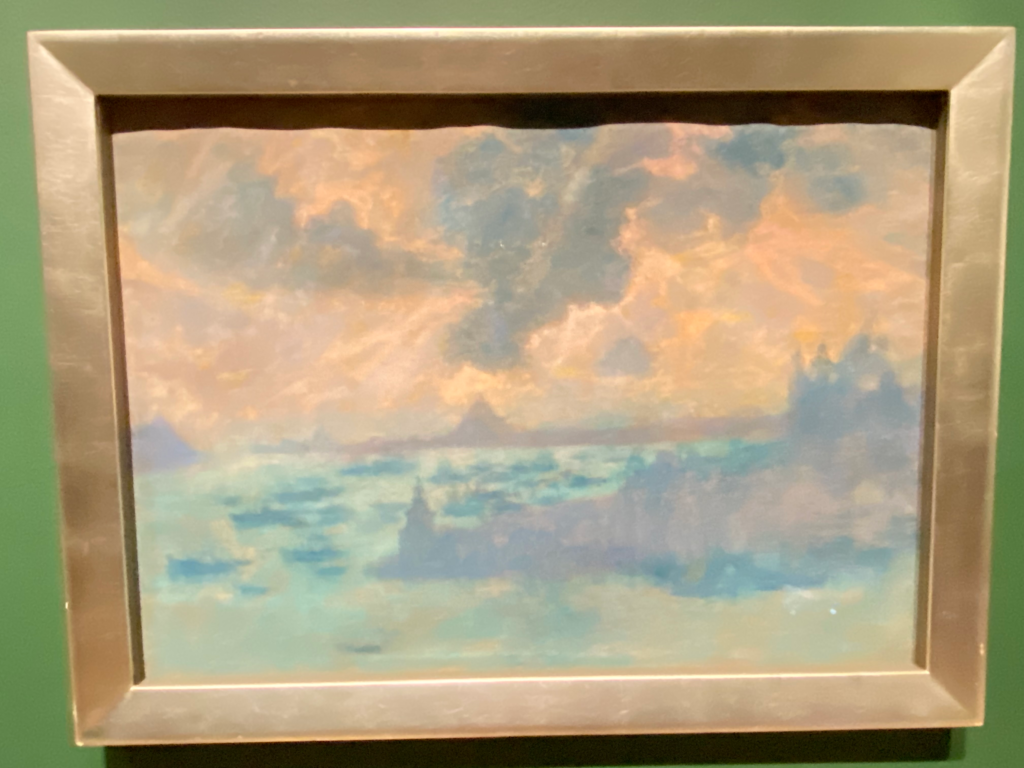
“The Grand Canal at Night,” Lucien Levy-Dhurmer, 1895, Symbolist style
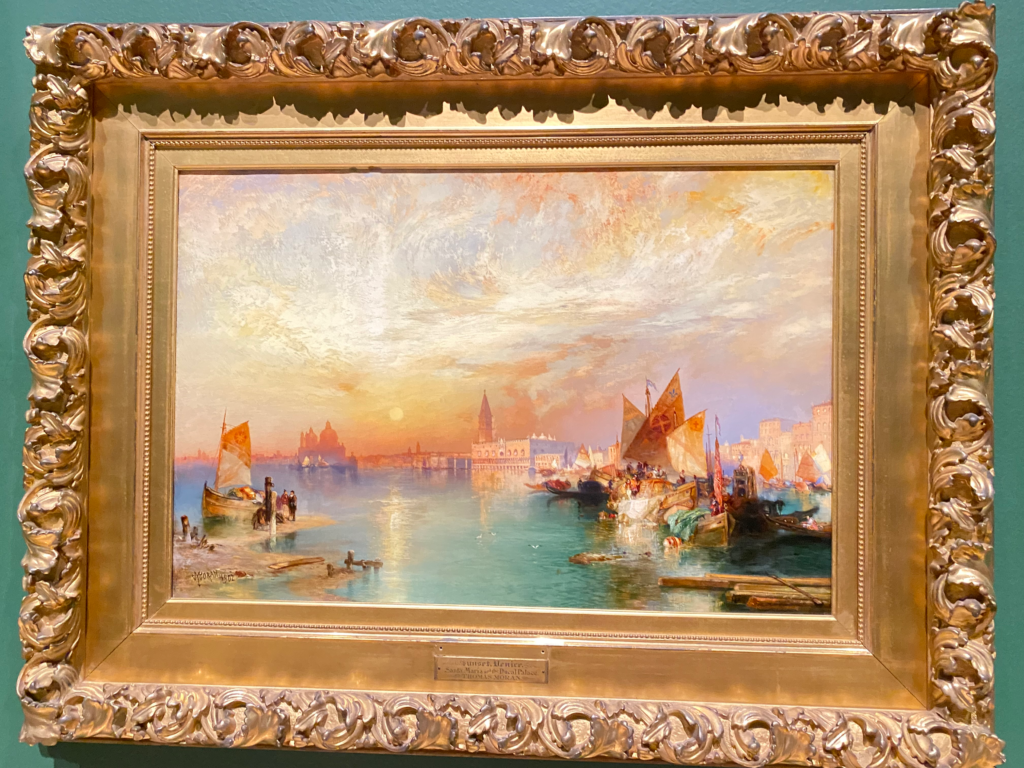
“Venice, Sunset behind Santa Maria,” Thomas Moran (American), 1898

In a rotunda-like room and alcove towards the end of the exhibition, a few children were sketching on the carpeted floor.  Parents proudly toted adorable newborns in baby carriers, which added to the overall charm. Monet drew visitors from the Metro area, and internationally, including his native France. 
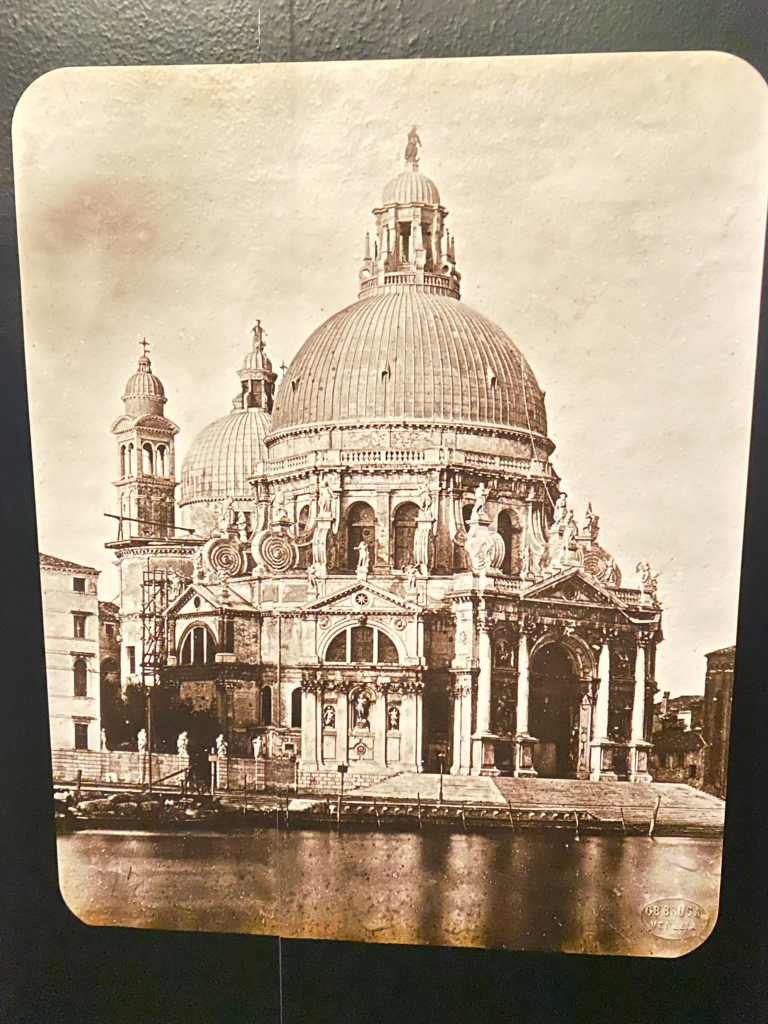
The Church of San Giorgio Maggiore of the same era from the Brooklyn Museum’s noteworthy and extensive lantern-slide collection

As an aside, one of the perks of visiting NYC museums is enjoying the stylish clothing of international visitors, though the city that hosts Fashion Week each February touts its own inestimable style. Such style is notable in the American gallery next to Monet on the museum’s fifth and top floor.
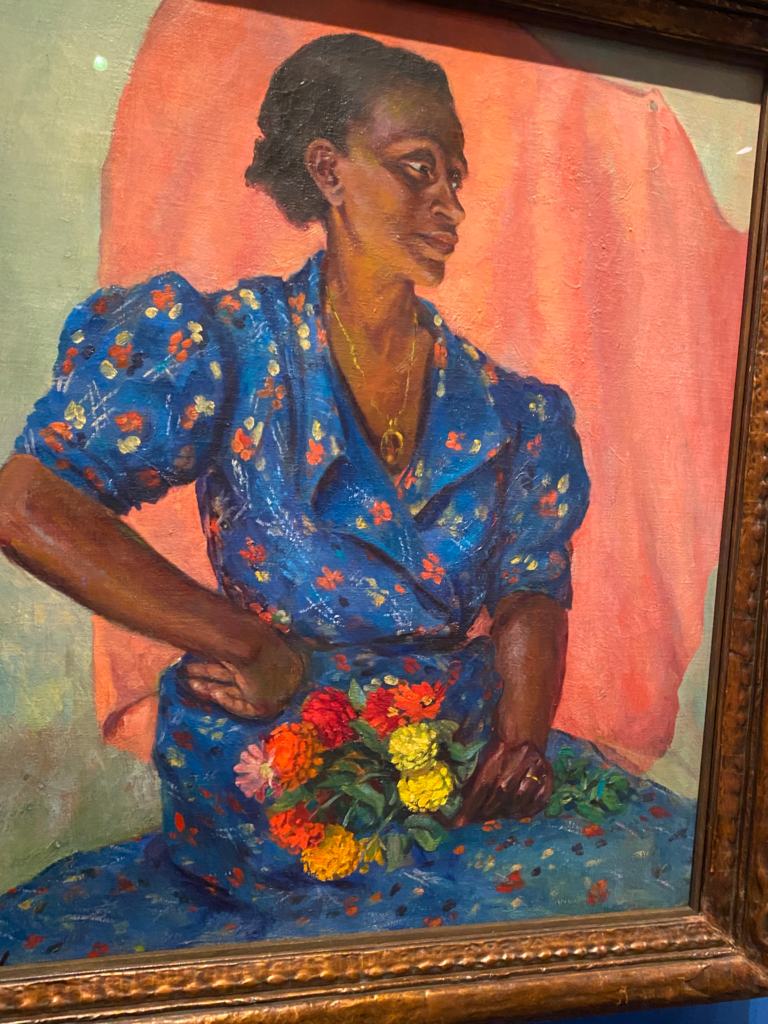
“Woman with a Bouquet,” Laura Wheeler Waring, 1940
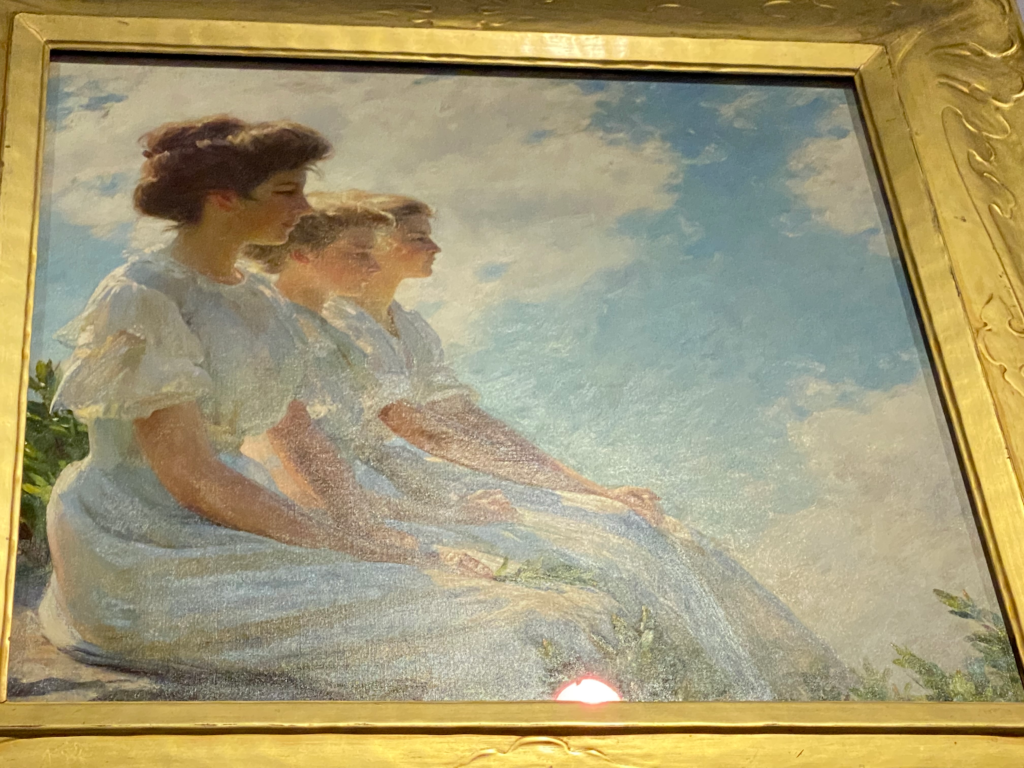
”On the Heights,” Charles Courtney Curran, 1909, oil on canvas
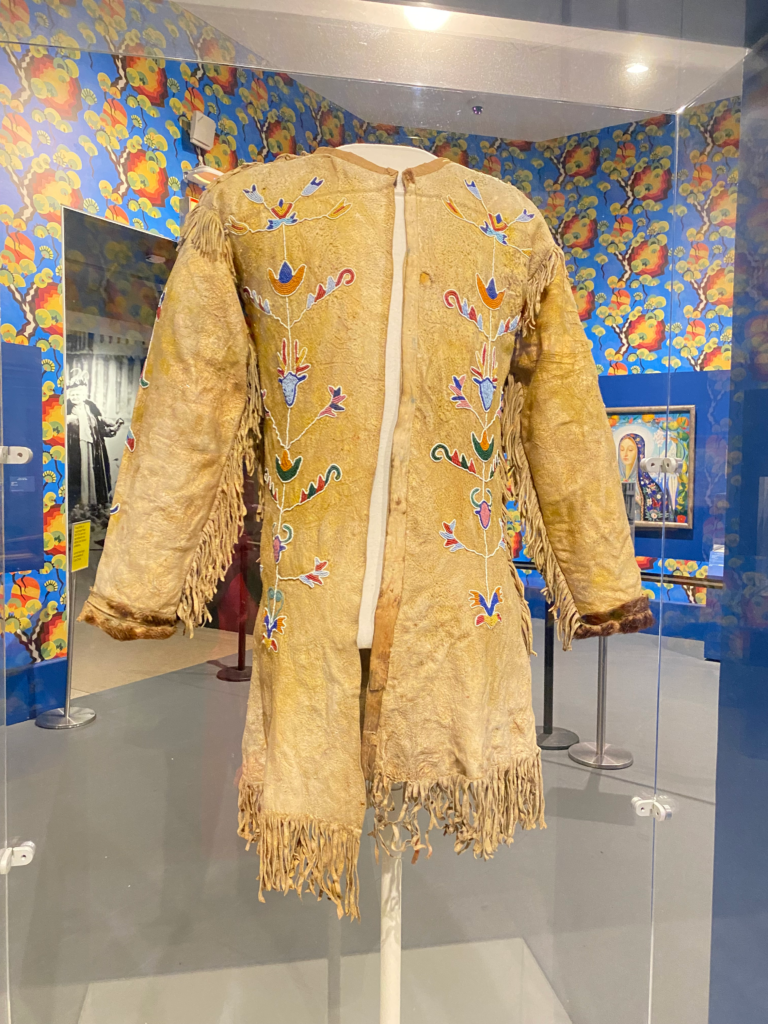
“Man’s Shirt Cut in European Style”, late 19th century, Red River Metis Artist or Eastern Dakota Artist (Manitoba Plains, Canada, or Northern Plains, Dakota) (North America)
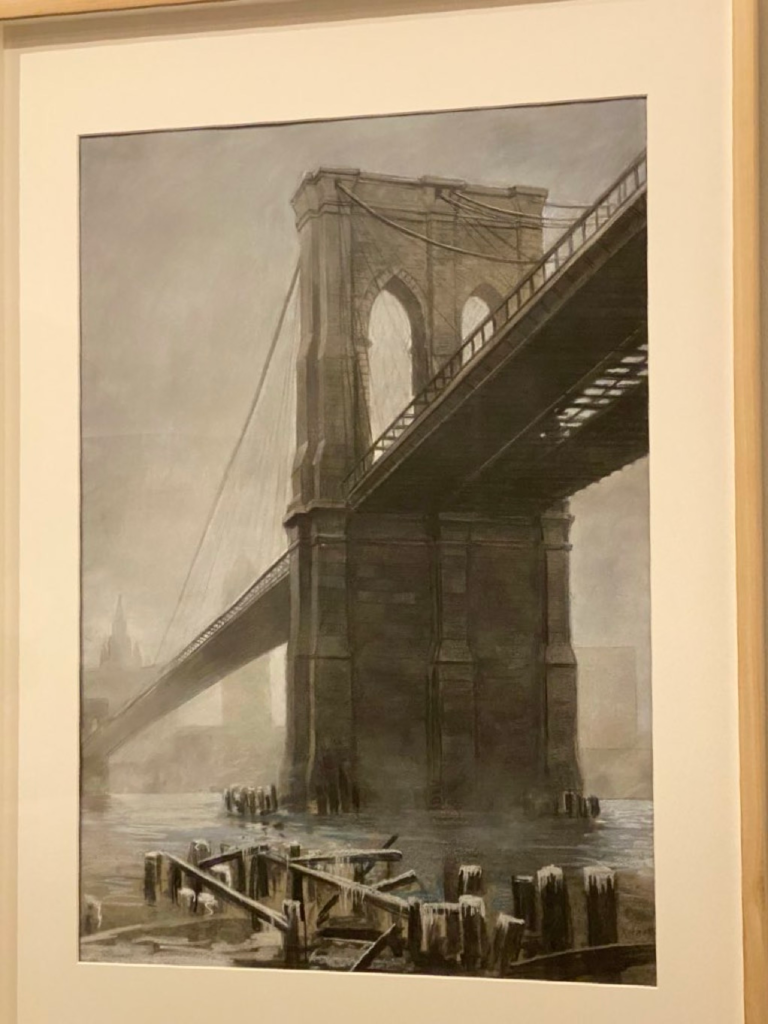
“Brooklyn Bridge,” Richard Haas, 1985, charcoal and pastel; iconic bridge designed by John A. Roebling

Also in the American gallery is Christian Marclay’s “Doors,” a film created with movie clips of characters going in and out of doors, which was thought-provoking and fun. (Having only seconds to “name that film” was an unexpected delight. Spotted Ocean City-Philadelphia’s Grace Kelly several times.)
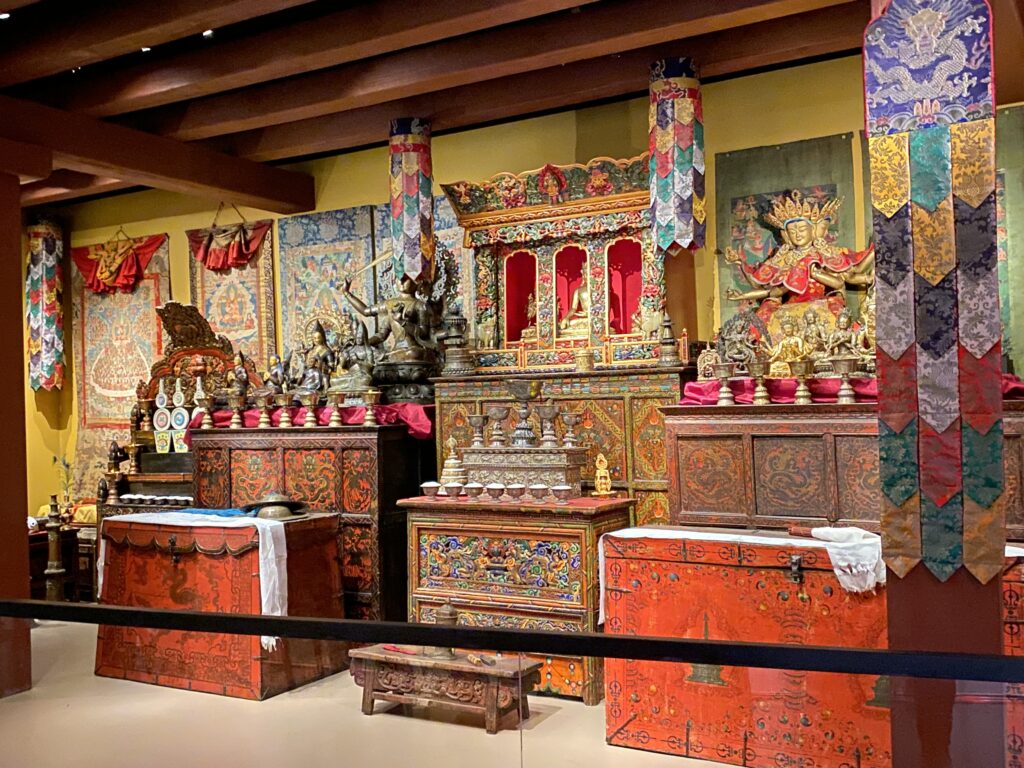
Partial view of the Rubin Museum Tibetan Buddhist Shrine Room

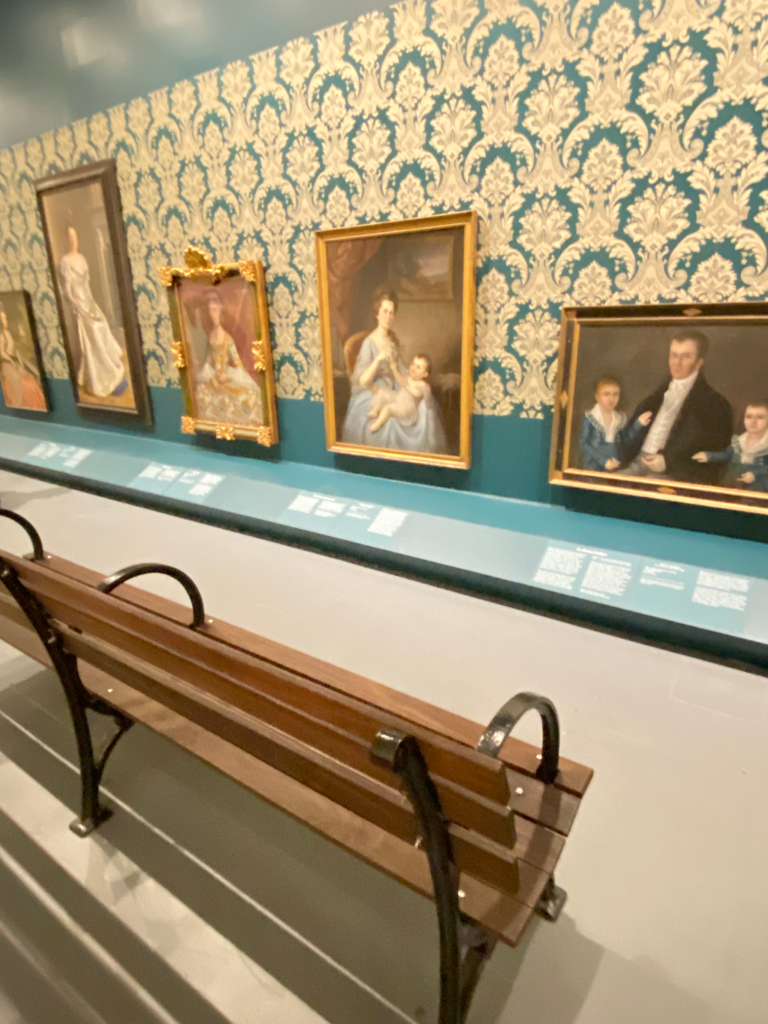
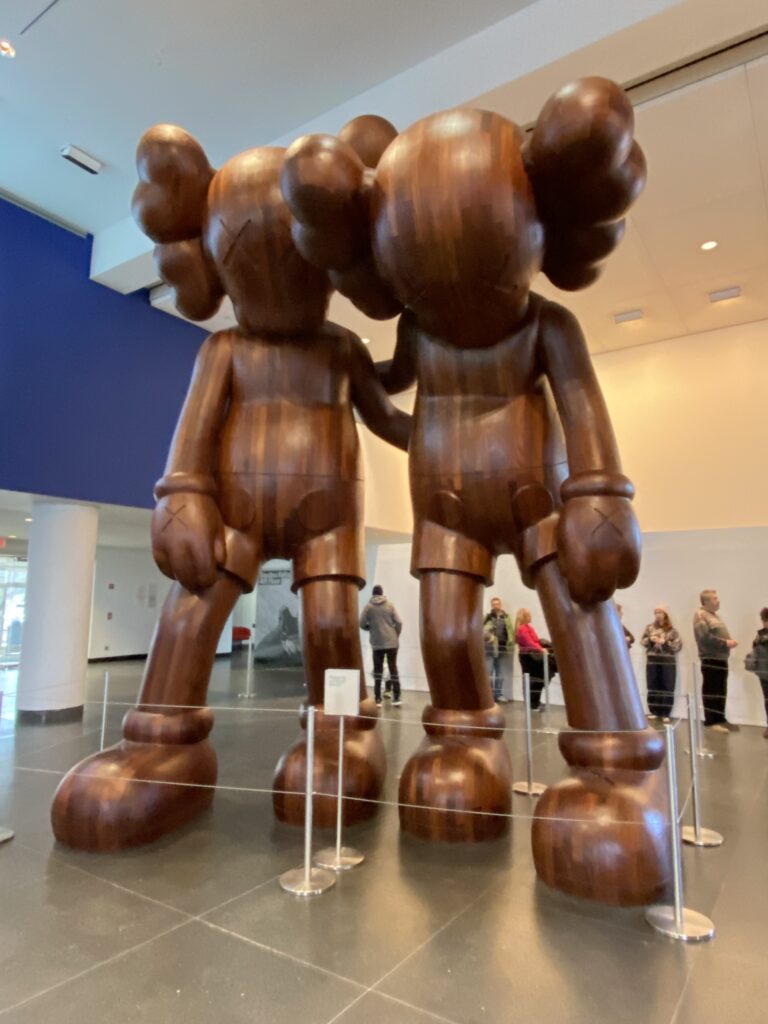
From the get-go, visitors know that the museum is fun.  The wooden pals in the Rubin Pavilion by Brooklyn-based artist KAWS (Brian Donnelly), originally from Jersey City, serve as hosts in the sunny atrium.  Visitors are greeted with smiles by courteous and helpful staff members. The museum is meant for enjoyment and is not just a checklist of cultural must-sees. Floral wallpaper, park benches, and interactive exhibitions underscore this. The Beaux-Arts style building, now being refurbished, is a work of art, designed by the renowned architectural firm McKim, Mead & White, 1895-1897.  
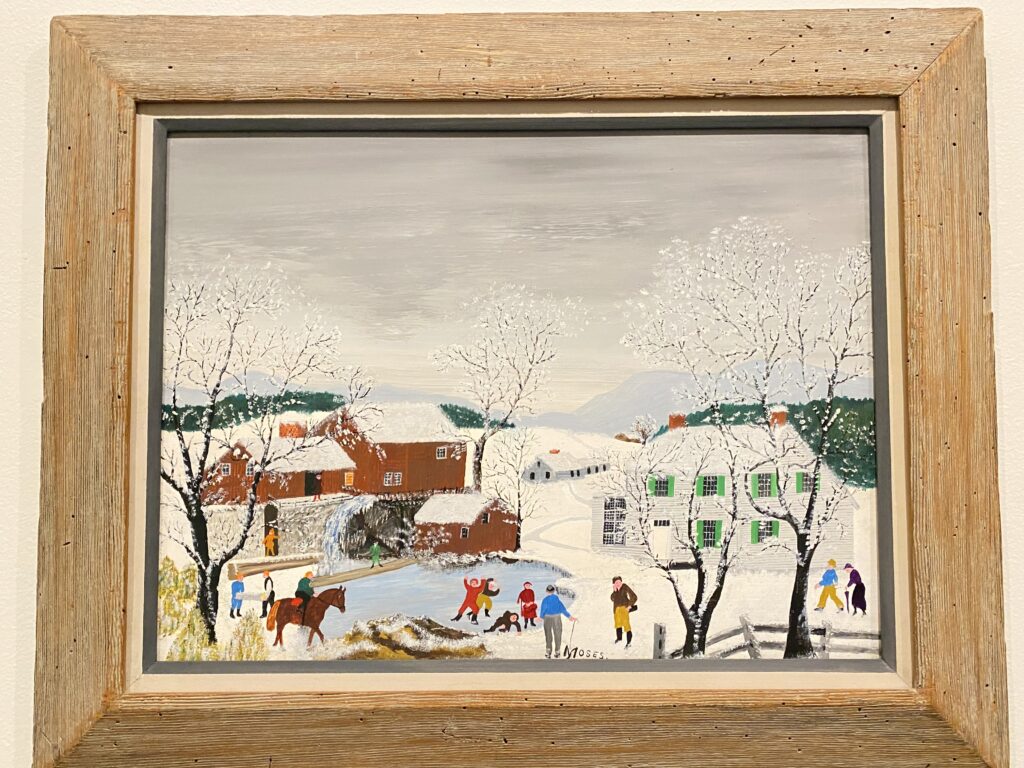
A charming greeting warms the wait of those in the coat check line who have come in from a wintry cold like that depicted in ‘Early Skating,” Anna Mary Robertson Moses (Grandma Moses), 1951:
Must tempt the crash of WordPress with so many beautiful works (!):
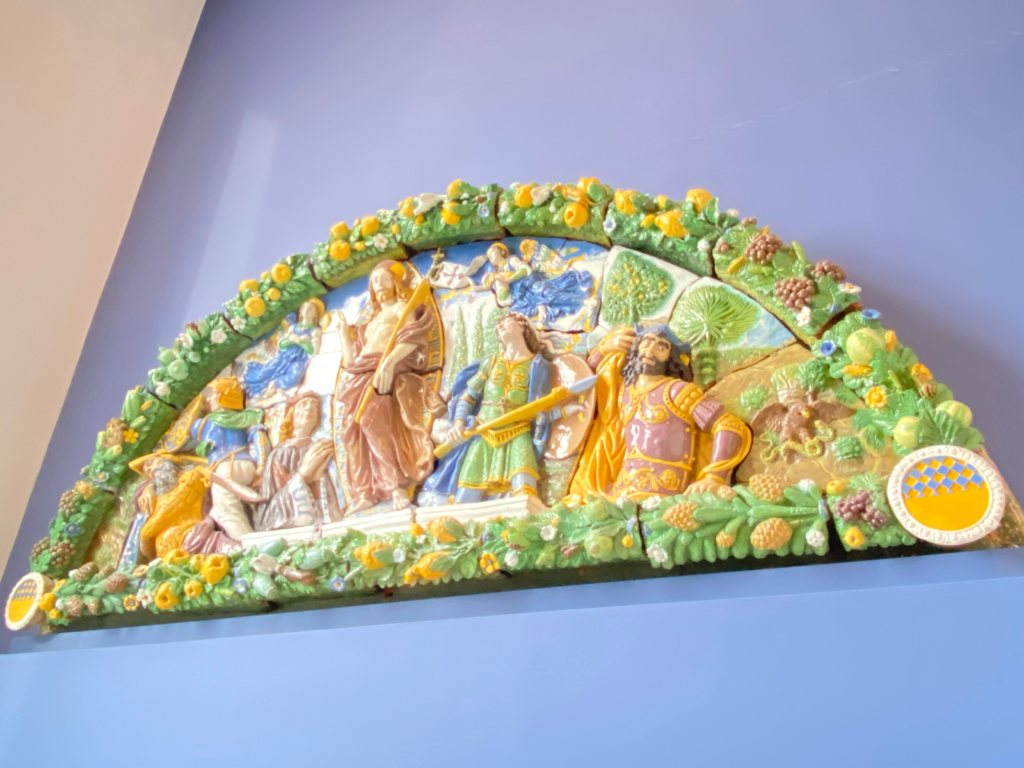
“The Brooklyn Della Robbia” or “The Resurrection of Christ,” Giovanni della Robbia (Italian), 1520, glazed terra cotta, restored by the museum in 2015
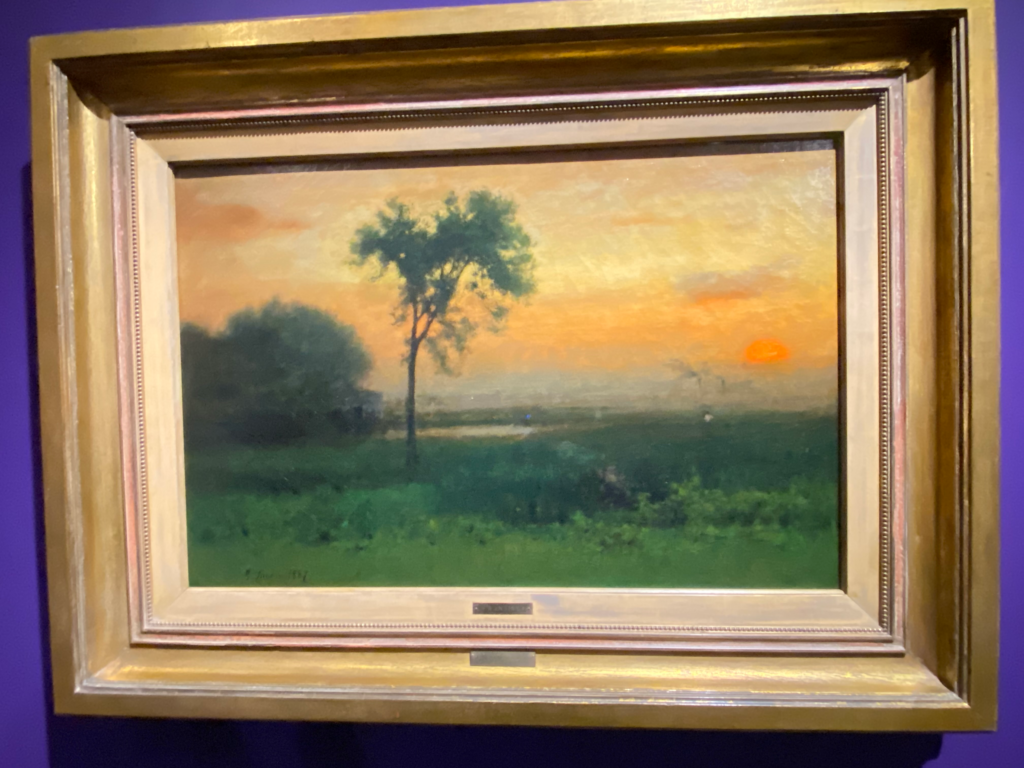
George Inness, “Sunrise,” 1887, Montclair, NJ; his paintings are also on view at the Montclair Art Museum and The Clark Institute with a visit to the latter to see his works described in “Clicking at the Clark”.
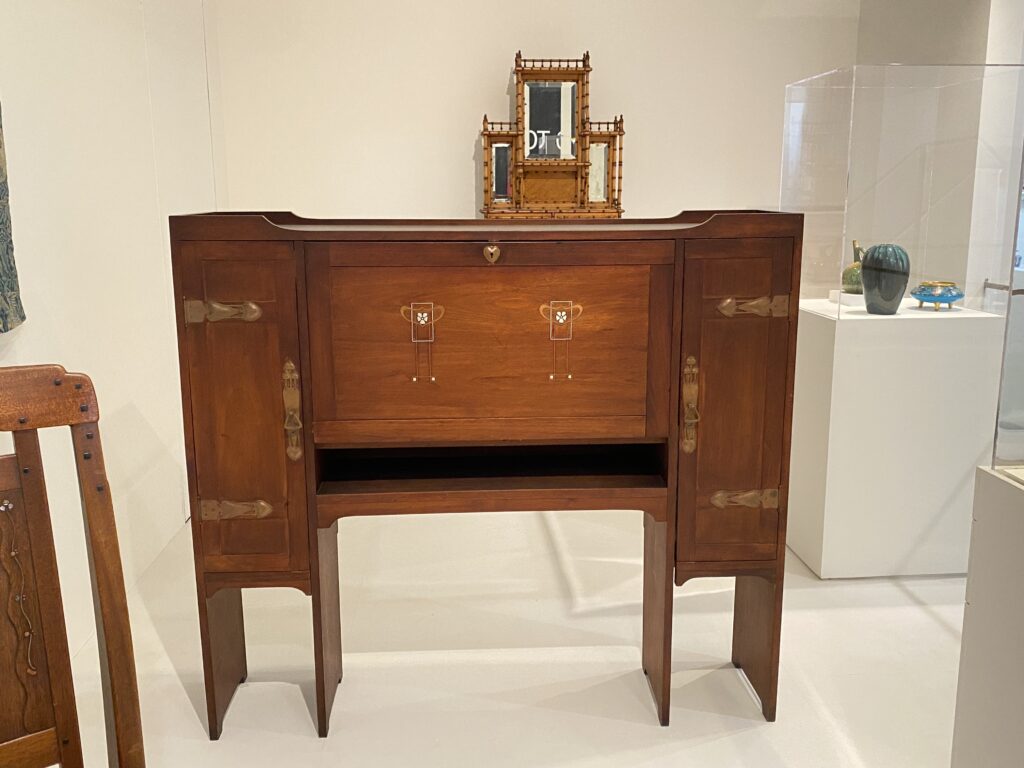
Walnut desk, Gustav Stickley, 1904, whose works are also on view at The Stickley Museum at Craftsman Farms, Parsippany-Troy Hills, NJ
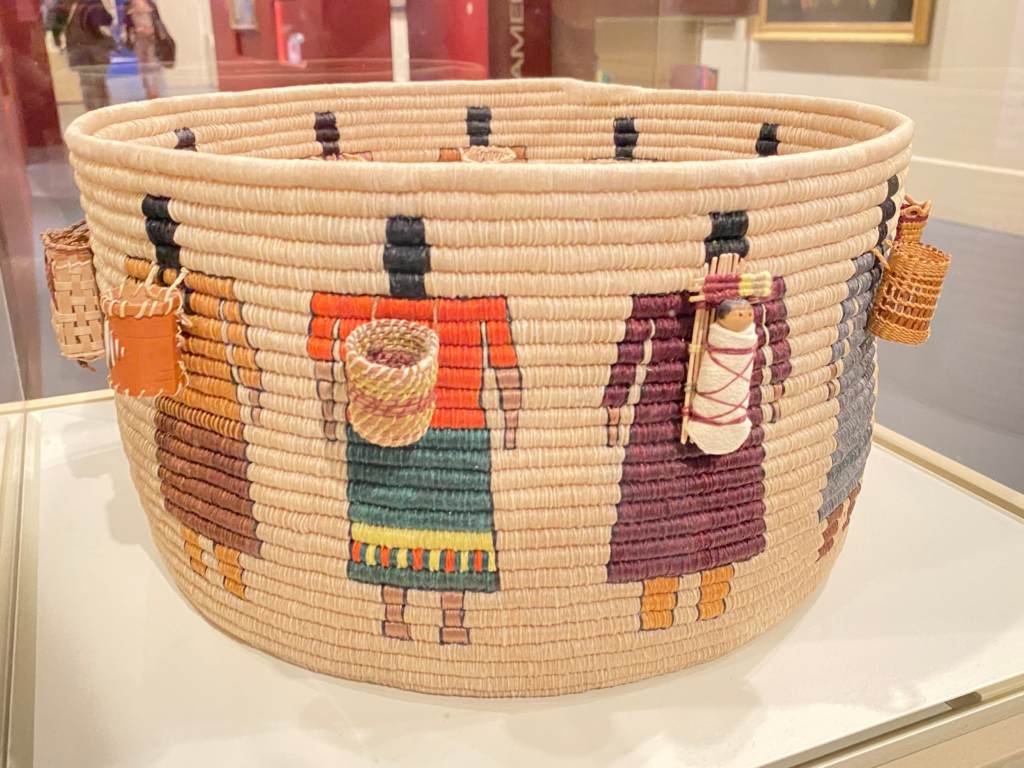
Cultural Burdens Basket, Carol Emarthle-Douglas, 2016, hemp, waxed linen thread, reed, hickory
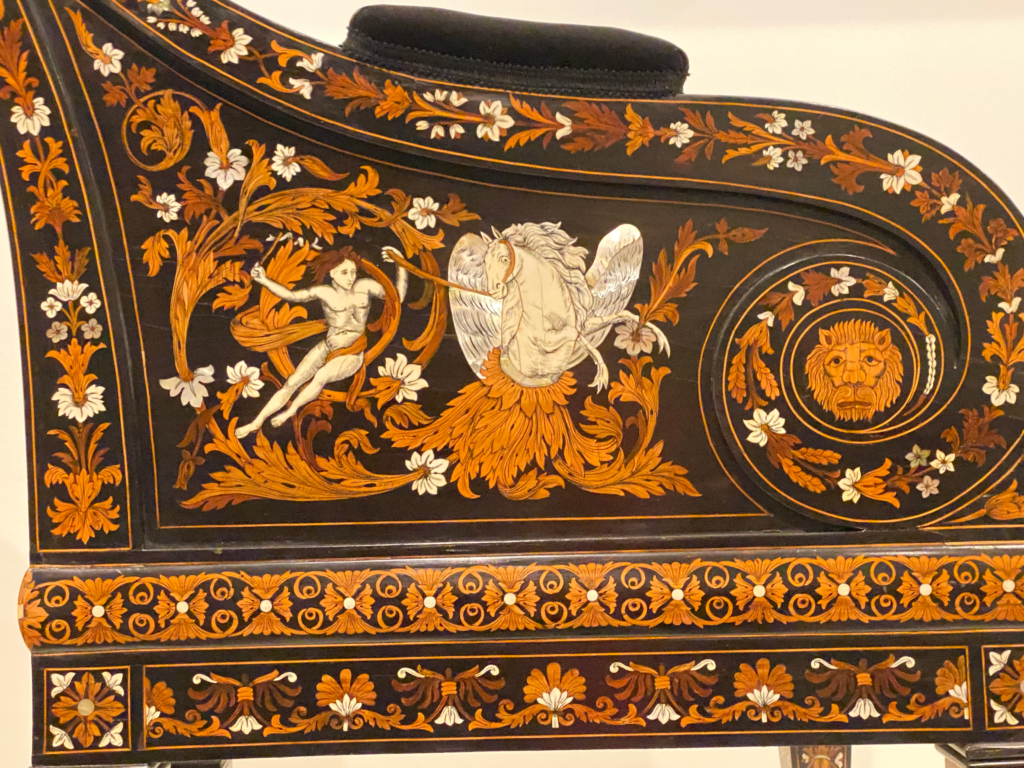
Mahogany chair, Charles-Honore Lannuier, 1700’s, with shimmering details, inspired by Ancient Greek klismos chair
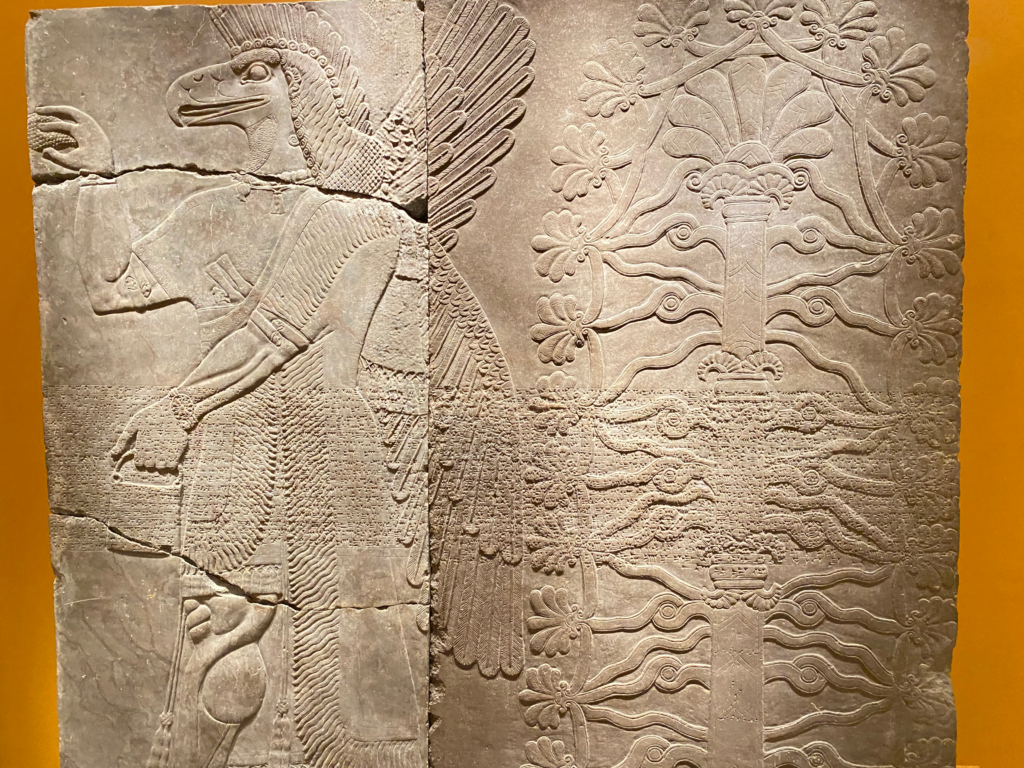
Apkallu-figure (a Mesopotamian demi-god) between Two Sacred Trees, Neo-Assyrian Period, circa 883-859 B.C.E., from the palace of Ashur-nasir-pal II at Nimrud; the reliefs were “meant to awe” visitors.
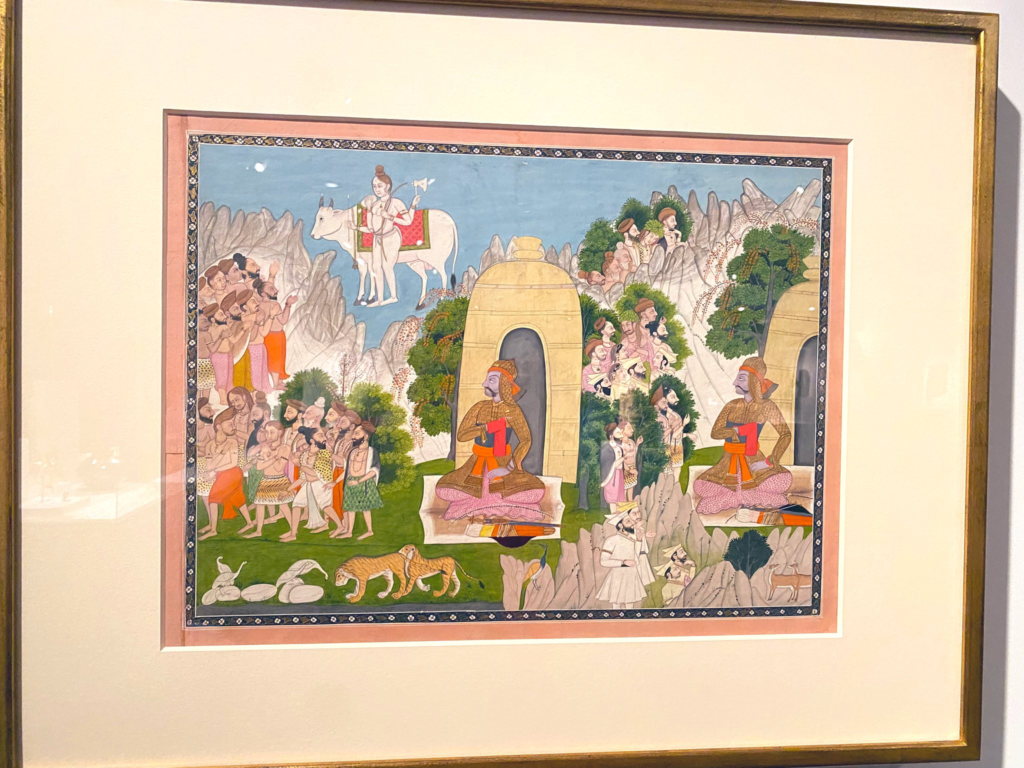
“Ajuna’s Penance” from the “Muhabharata,” ca. 1825-40, India
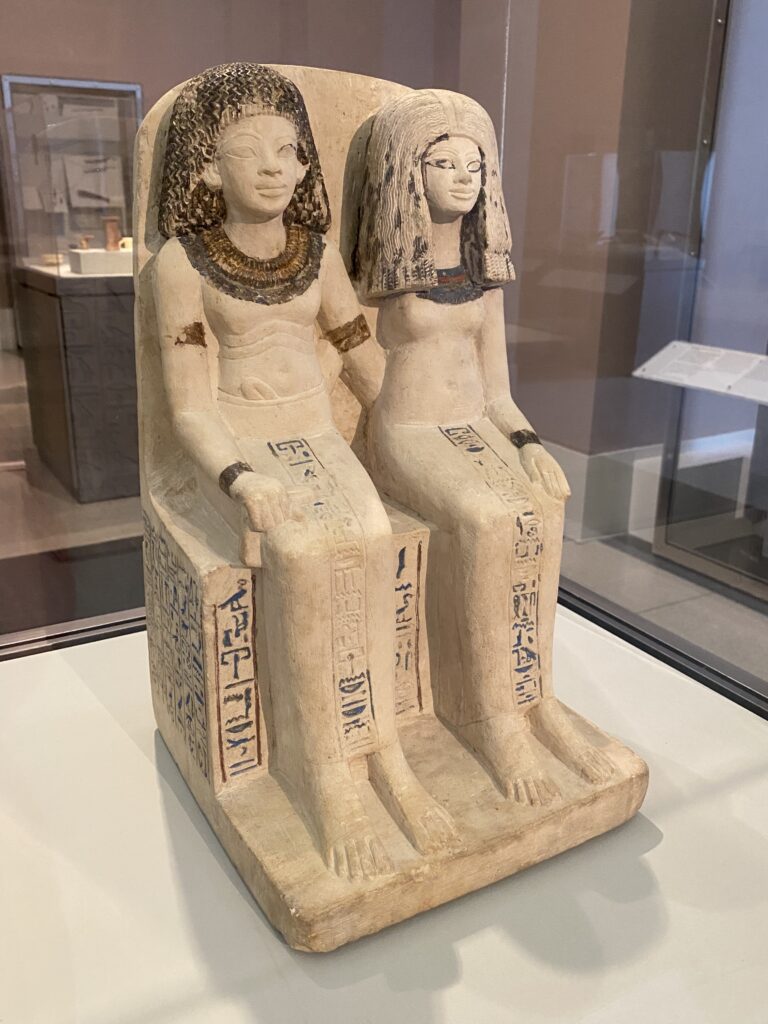
Pair Statue of Nebsen and Nabet-ta, New Kingdom, Dynasty 18, reign of Thutmose IV or Amunhotep III, circa 1400-1352 B.C.E. (The label notes that Nebsen was “a scribe in the royal treasury” and Nebet-ta was “a singer in the temple of the goddess Isis”.)
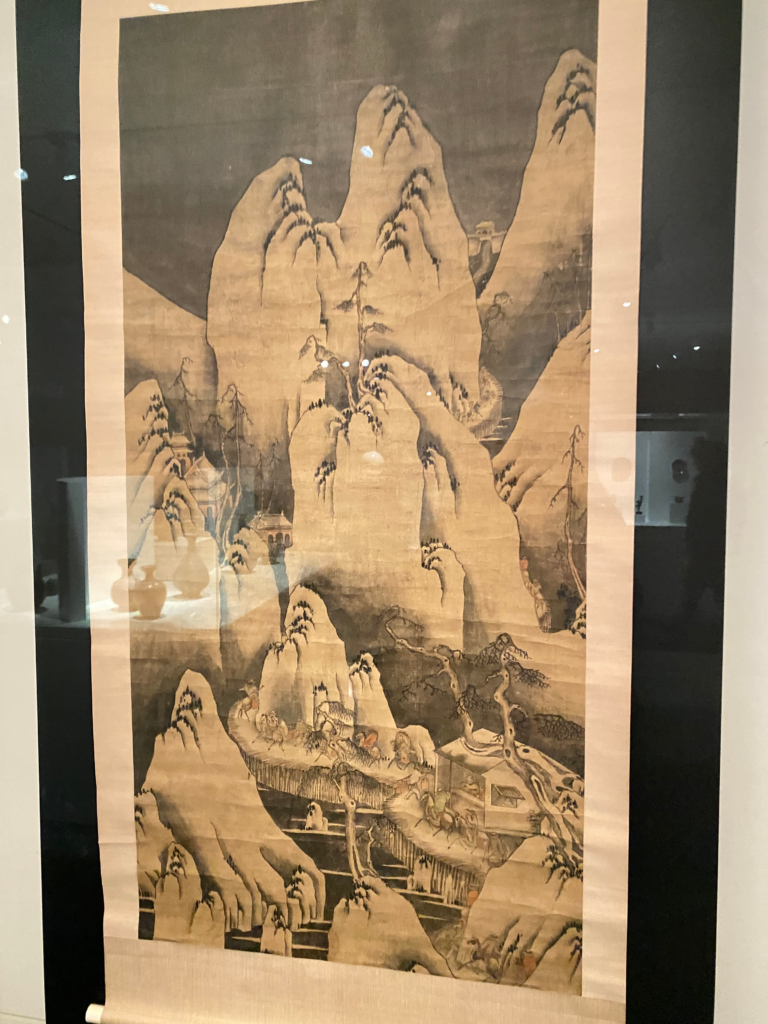
Ancient scroll, Arts of Korea

Not to be missed are the mesmerizing portraits of “Seydou Keïta: A Tactile Lens” through May 17th.  The Malian photographer Seydou Keita (1921/1923-2001), “the father of African photography,” worked primarily in his studio in the nation’s capital of Bamako.  He produced beautiful portraits that reflected the country’s history from the 1950s through the 1970s, a period which saw national independence, a coup, and a famine.  The sweet account of Seydou’s start is that his uncle gifted him a Kodak Brownie camera. Photography was a curiosity at the time in Mali.  People flocked to have their photos taken by Keita, who had a mentor in French photographer Pierre Garnier, but was largely self-taught and initially supported himself as a carpenter.  The compelling portraits reveal his subjects’ trust in him.  What is remarkable is that due to costs, he only took a single shot of each person. 
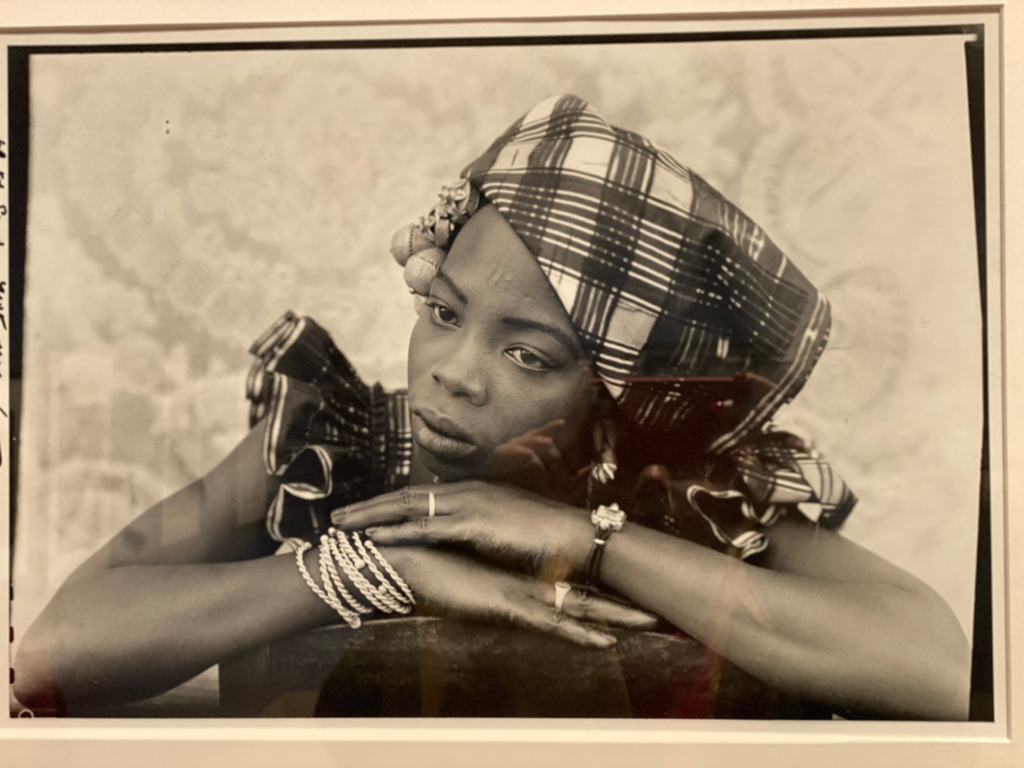
Eventually, a government job and the theft of his equipment in the 1970’s took the artist-photographer from his studio; however, as he remarked, he retired once color photography became the fashion.  In the 1990s, his work was discovered in Europe and the United States. (Seydou Keita’s portraits are also on exhibition at MOMA through July.)
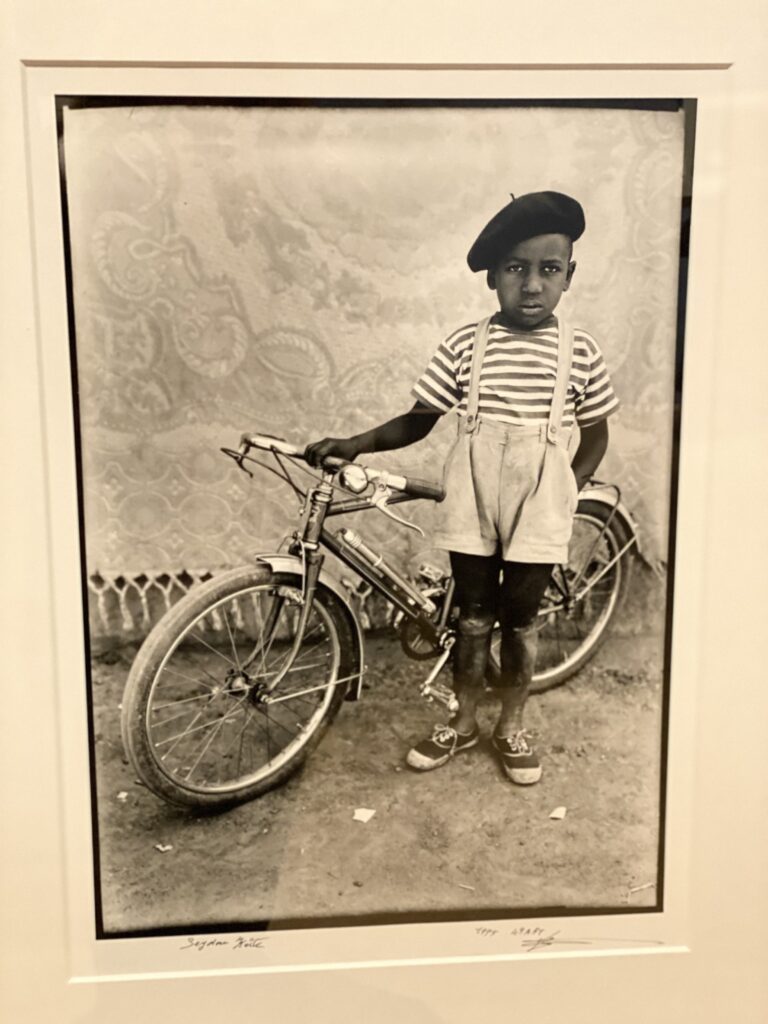
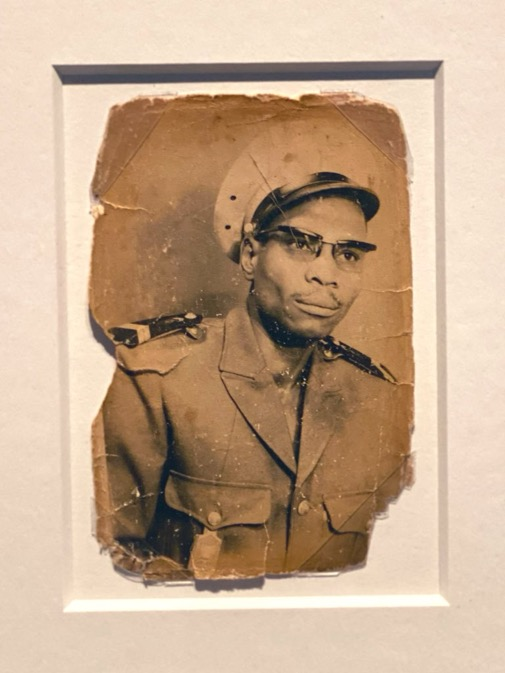
Seydou Keita, 1963, when he served as official state photographer (1962-1977)
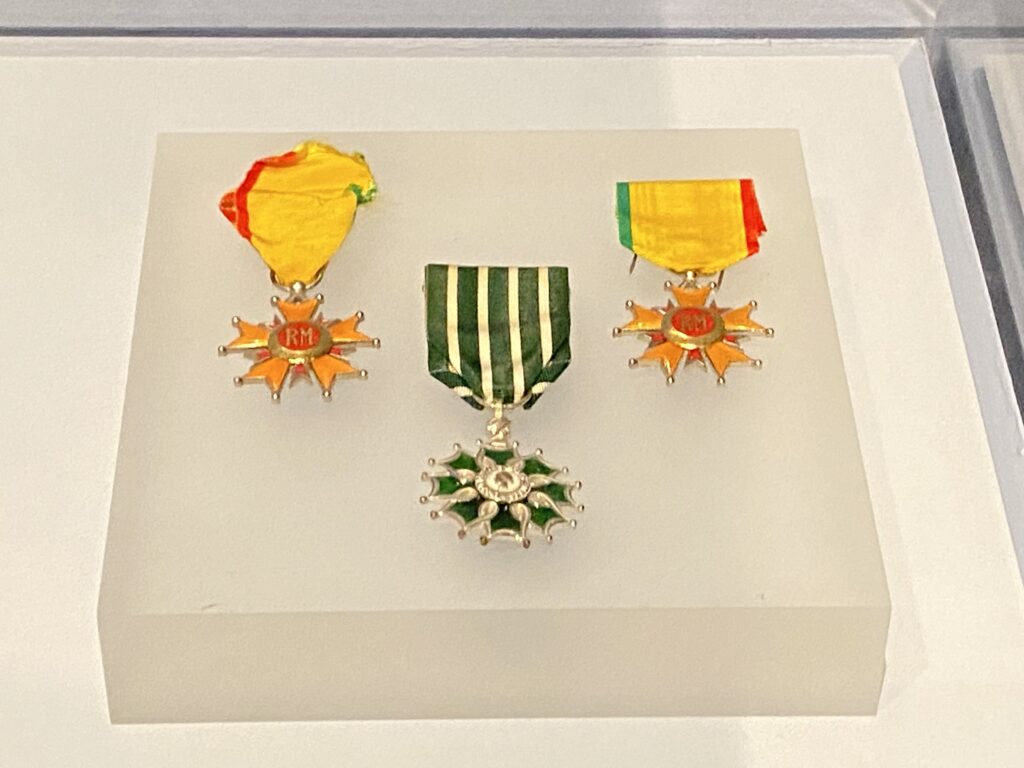
Mr. Keita’s National Order of Mali Medals and a Silver Order of Arts and Letters Chevalier Medal from the French government for his “significant contribution to the arts”.
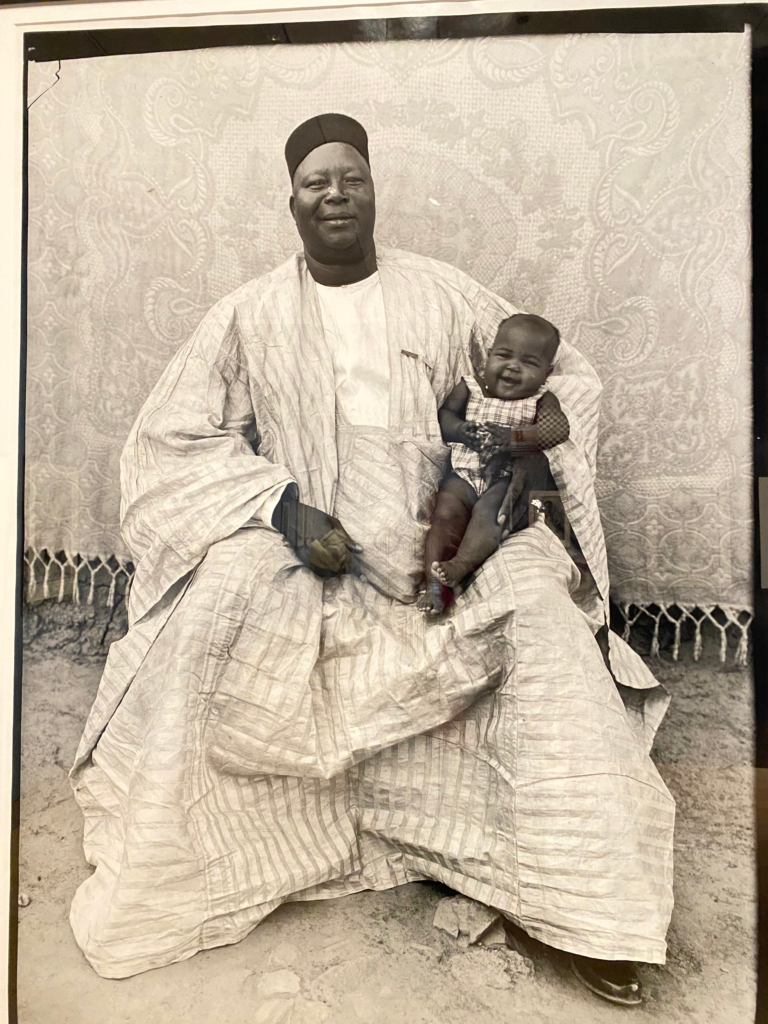
There is still so much more to see at the Brooklyn Museum including, “Breaking the Mold: Brooklyn Museum at 200,” commemorating the history of art in the borough.  “Unrolling Eternity: The Brooklyn Books of the Dead” opens January 30th. Went back a couple times, but kept missing, “The Dinner Party” (the invitation must be in the mail) and the Feminist Exhibition (mea culpa from a Seven Sisters graduate), and Norman Rockwell’s “The Tattoo Artist,” which was in storage on this visit.  On that note, the Visible Storage and Study Center was an innovative way to enjoy some of the collection not currently on view.
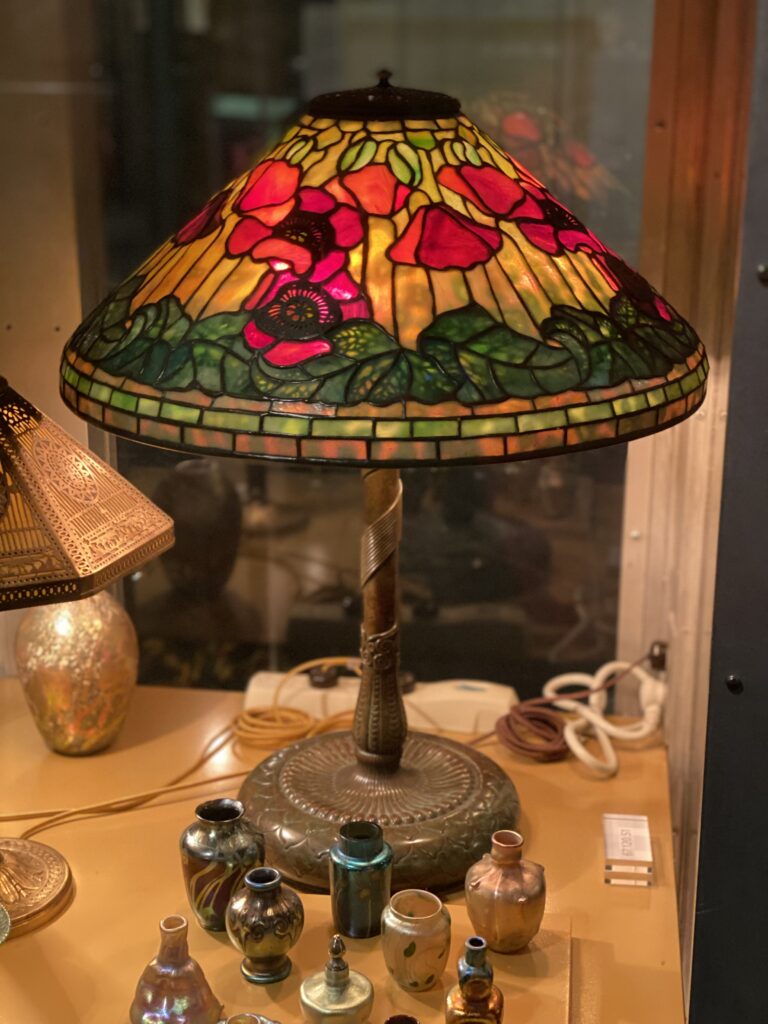
Tiffany Studios Leaded Glass Red Poppy Bronze Table Lamp, early 1900’s. Historical trivia: While a student at Eagleswood Military Academy in Perth Amboy, NJ, Louis Comfort Tiffany studied art with George Inness.

An inviting Education Center with Oliver Jefferies’, “Life at Sea,” 2025, on view through April 26th. The museum offers activities for children and teens, Kids Club memberships, and university memberships.
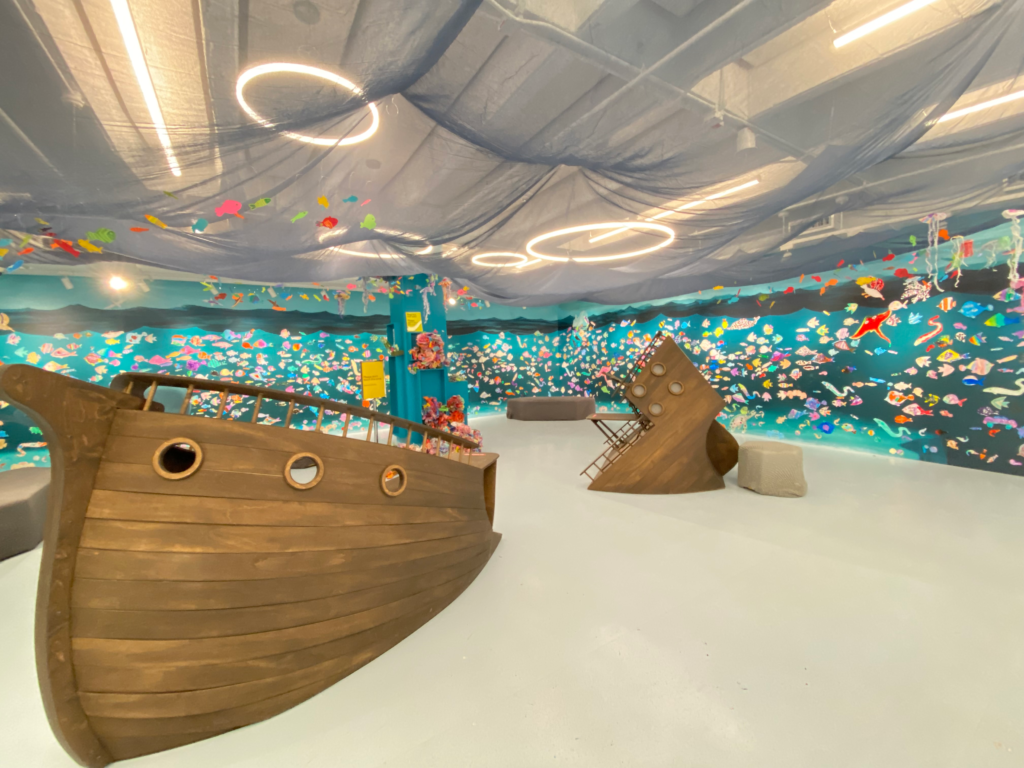
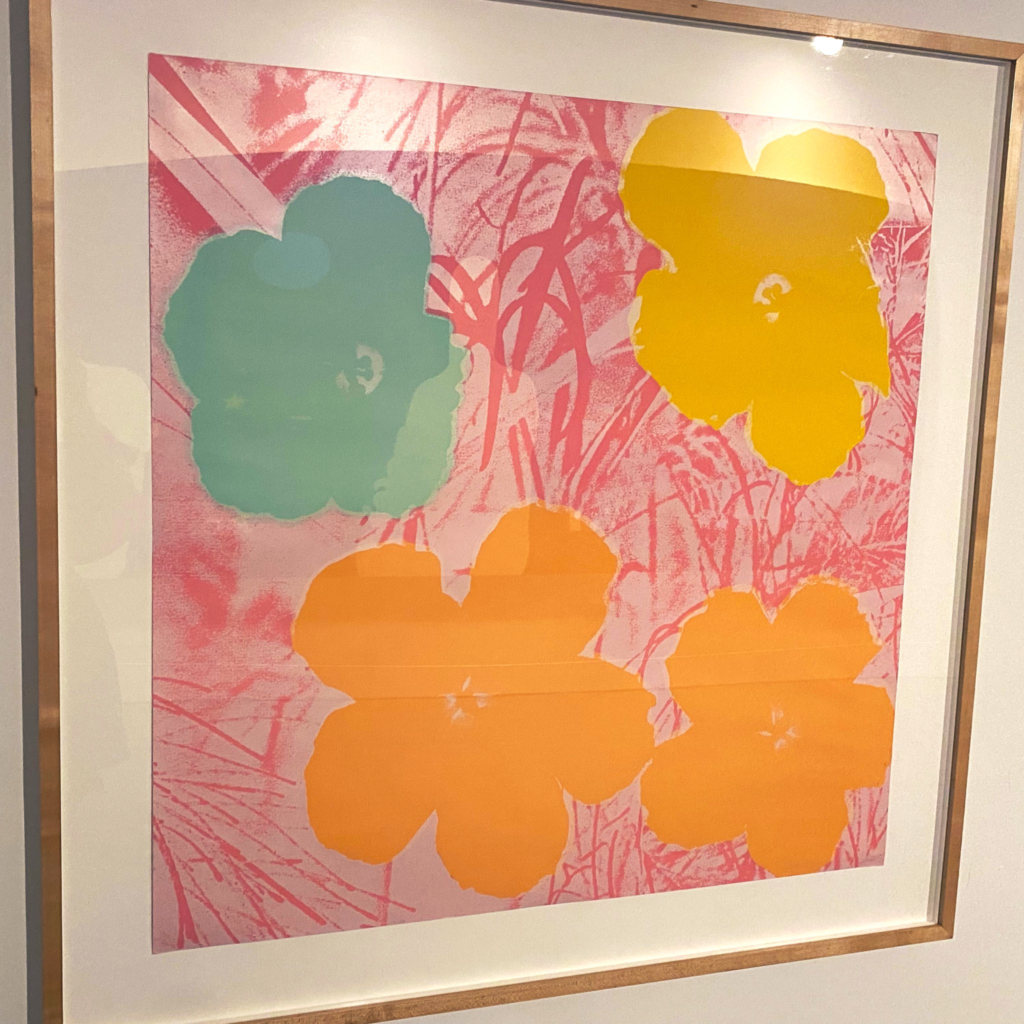
“Flowers,” Andy Warhol, 1970, screenprint
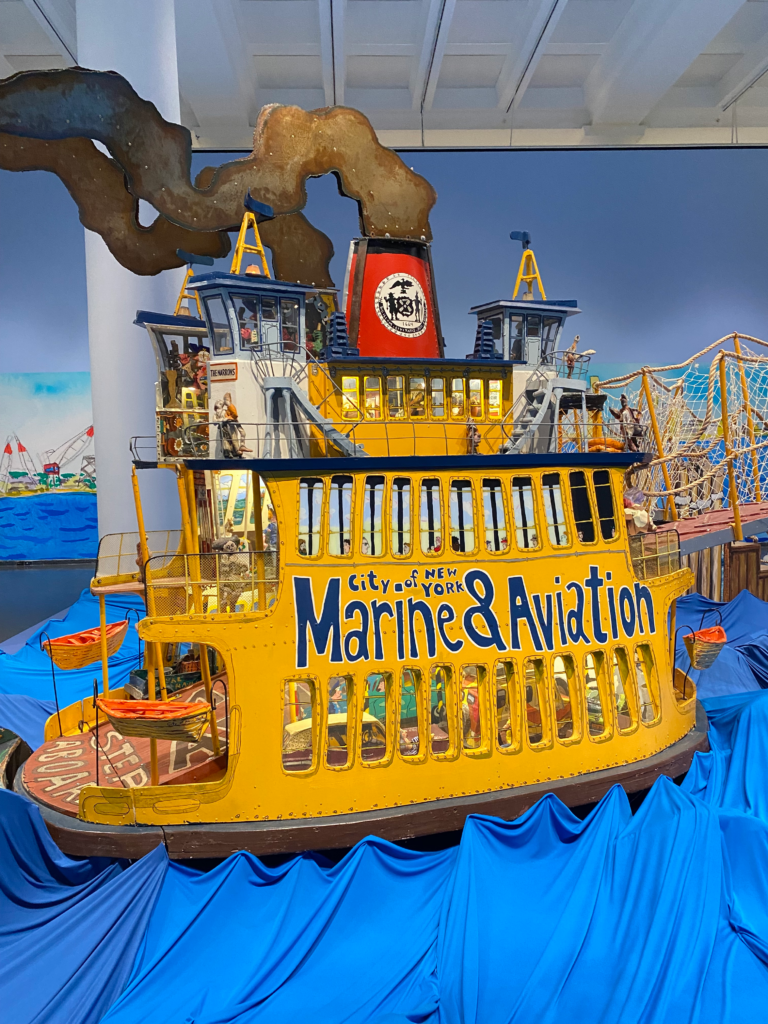
Excerpt from “Ruckus Manhattan” by Red Groom, Mimi Gross, and “The Ruckus Construction Co.”

Practical, random tidbits: Timed tickets for “Monet and Venice” kept things moving, though not rushed. Ticketed parking is convenient, as was public transportation on a visit some years ago; the 2/3 subway lets visitors out on Eastern Parkway–Brooklyn Museum, which is wheelchair accessible.  (In a neighborly fashion, there are directions from Long Island, Westchester, New Jersey, and Connecticut on the museum website.) Bike racks are available for cyclists.  The museum allows standard-size strollers, which flow smoothly in museum traffic.  Most galleries include live captioning.  Trained service animals are permitted; there was one beautiful and impeccably well-behaved tall, white poodle or a labradoodle on a leash, which looked like it stepped out of a painting.  If anyone wants to avoid the coat check, which takes a while, consider wearing a lightweight coat and a wristlet or the like; purses and bags will need to be checked for security.
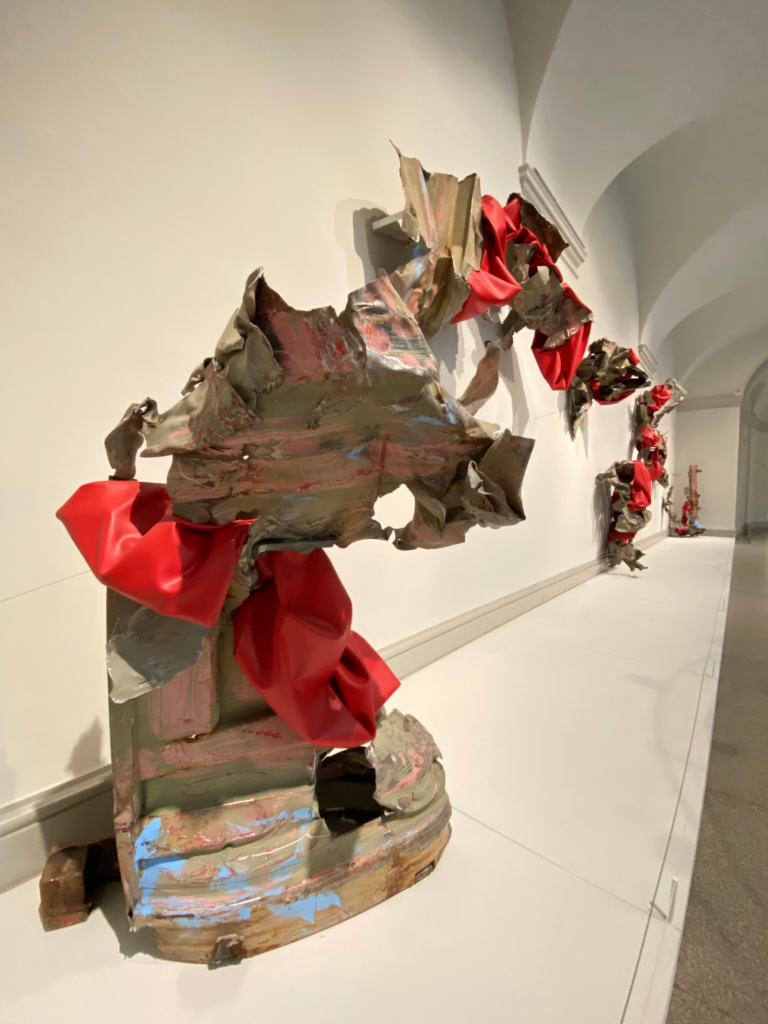
Side view of “No More Drama,” Kennedy Yanko, 2022, Brooklyn-based artist via St. Louis, Missouri

The light and airy café features friendly staff and healthful options.  Though it is not overly expensive for a museum café, it could be costly for a family. The profit, however, supports the museum. (Members receive a 10% discount.) In warmer weather, food trucks are outside.
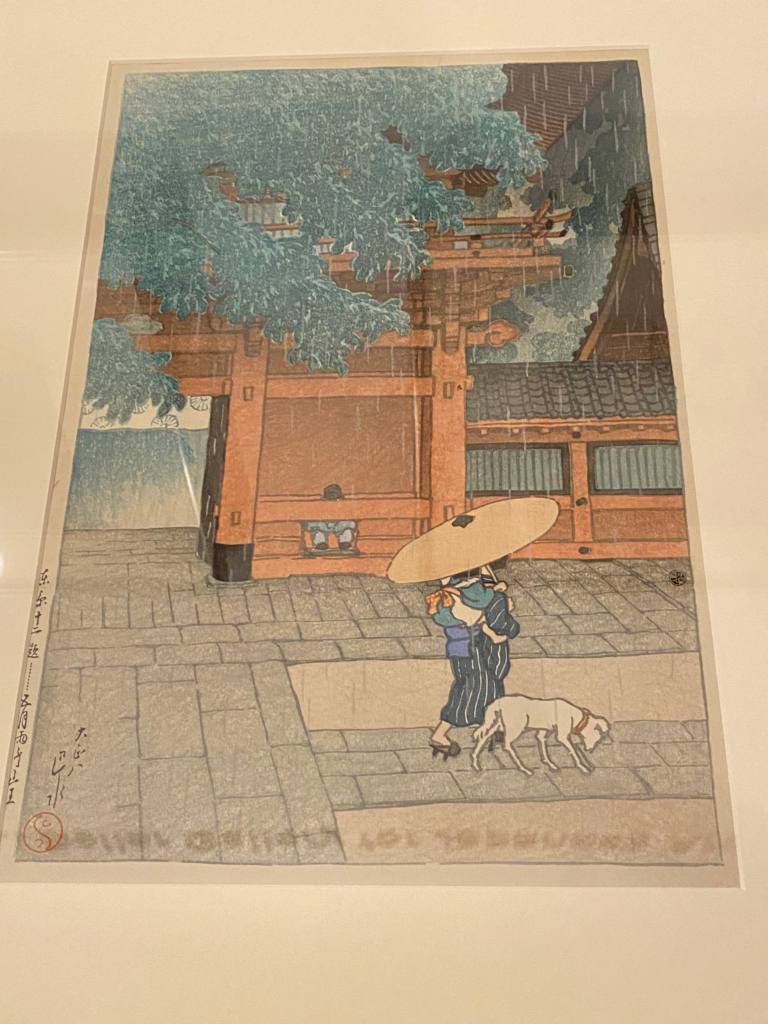
“Early Summer Rain at the Sanno Shrine” from the series “Twelve Scenes of Tokyo,” Kawase Hasui, 1919, woodblock print on paper
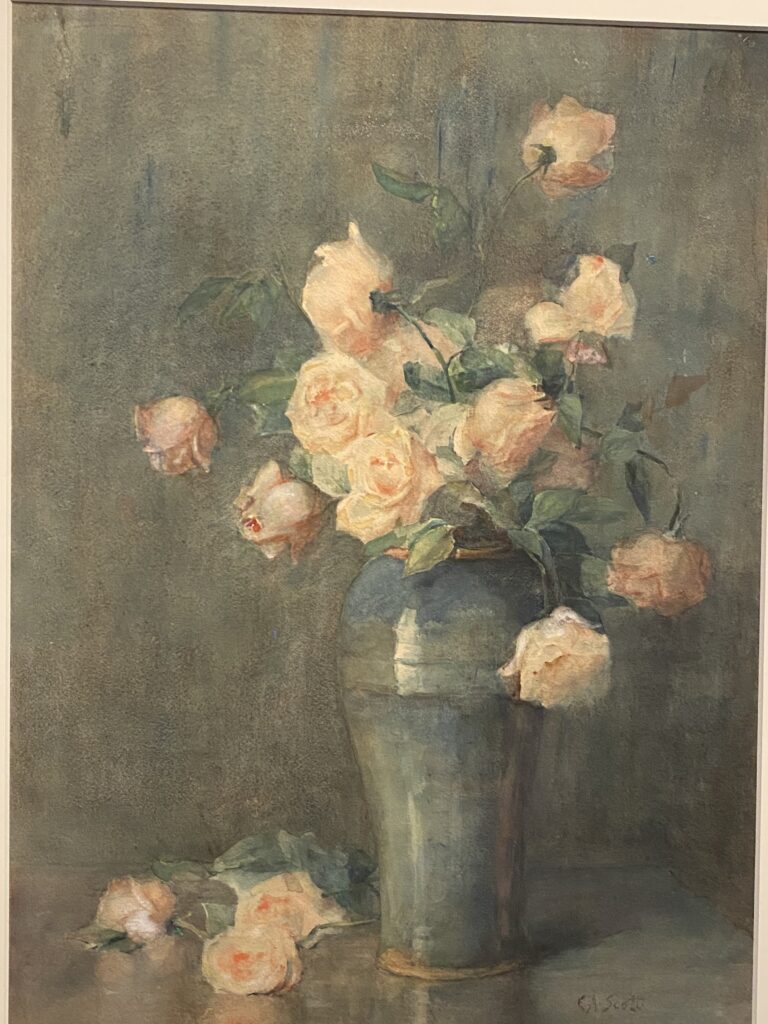
“Tea Roses,” Emily Maria Spaford Scott, aka “Lady of the Roses,” late 19th-early 20th century, watercolor
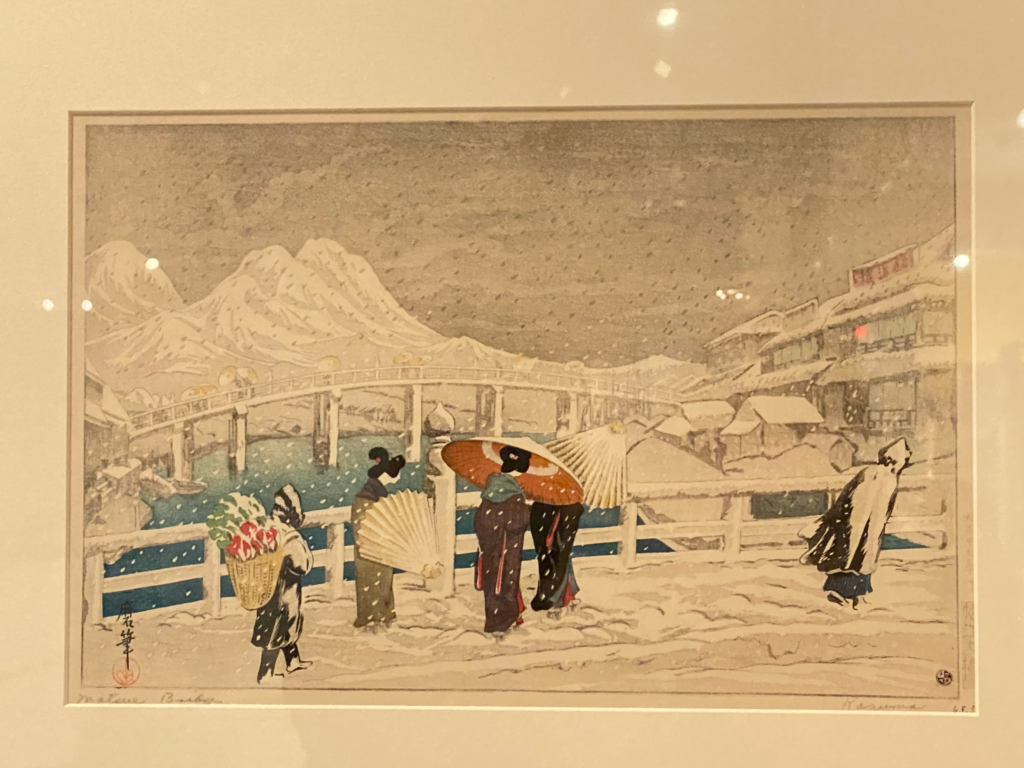
Winter scene by Kawase Hasui

Select First Saturdays, which start February 7th, welcome visitors free of charge.  Enjoy upcoming programs like the Lunar New Year celebration.
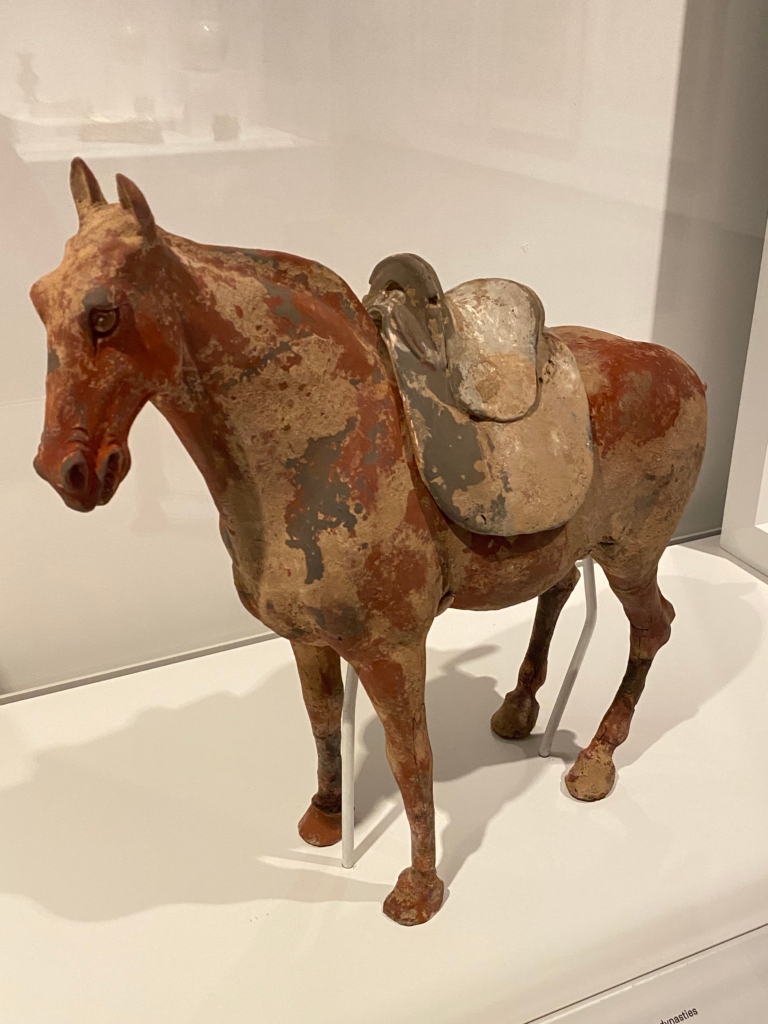
Year of the Horse 2026, Horse with Saddle, late 6th century, China, earthenware

Travel sites note that a visit to the Brooklyn Museum takes between 2-4 hours.  Reserve a day to enjoy all that it has to offer!
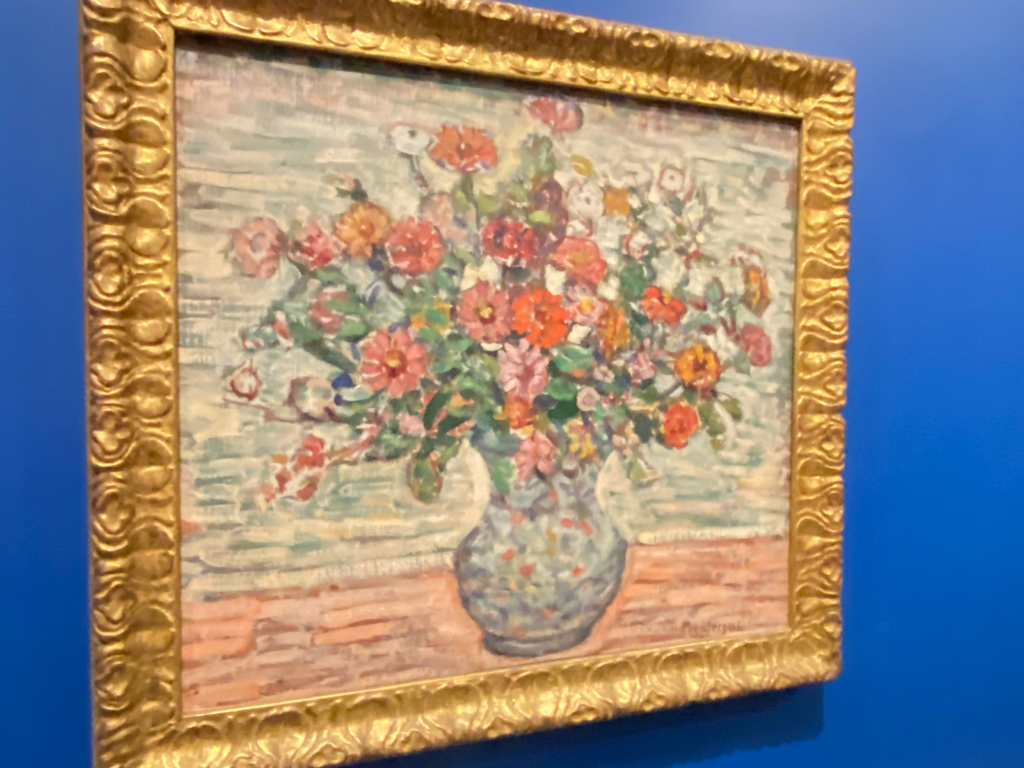
“Flowers in a Vase (Zinnias),” Maurice Brazil Prendergast, ca. 1910-1914, presented with a note on zinnias from the Brooklyn Botanic Garden
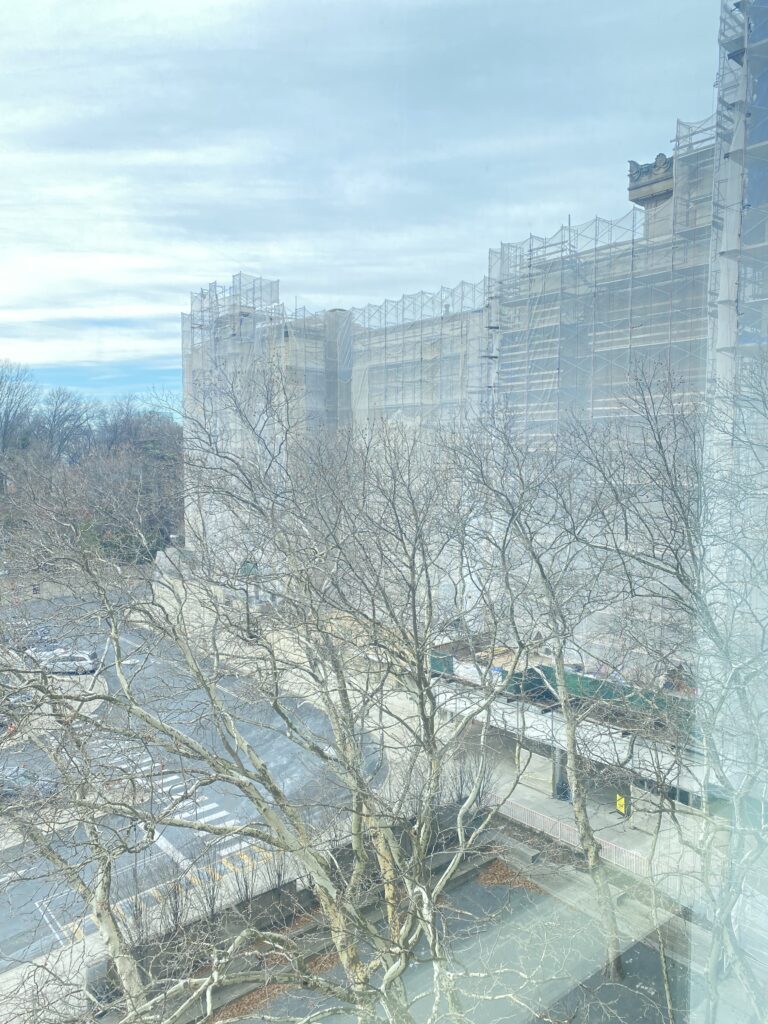
Brooklyn Museum’s refurbishment in Monet’s blue light

(Sources: brooklynmuseum.org, theartnewspaper.com (interview with Jackie Wullschläger, author of Monet: The Restless Vision), claudemonetgiverny.fr, dailyartmagazine.net, seydoukeitaphotographer.com, artnet.com, all-about-photo.com, traveladvisor.com, reverse image app, YouTube, Wiki)

“’Monet and Venice‘ at the Brooklyn Museum” All Rights Reserved ©2026 Kathleen Helen Levey

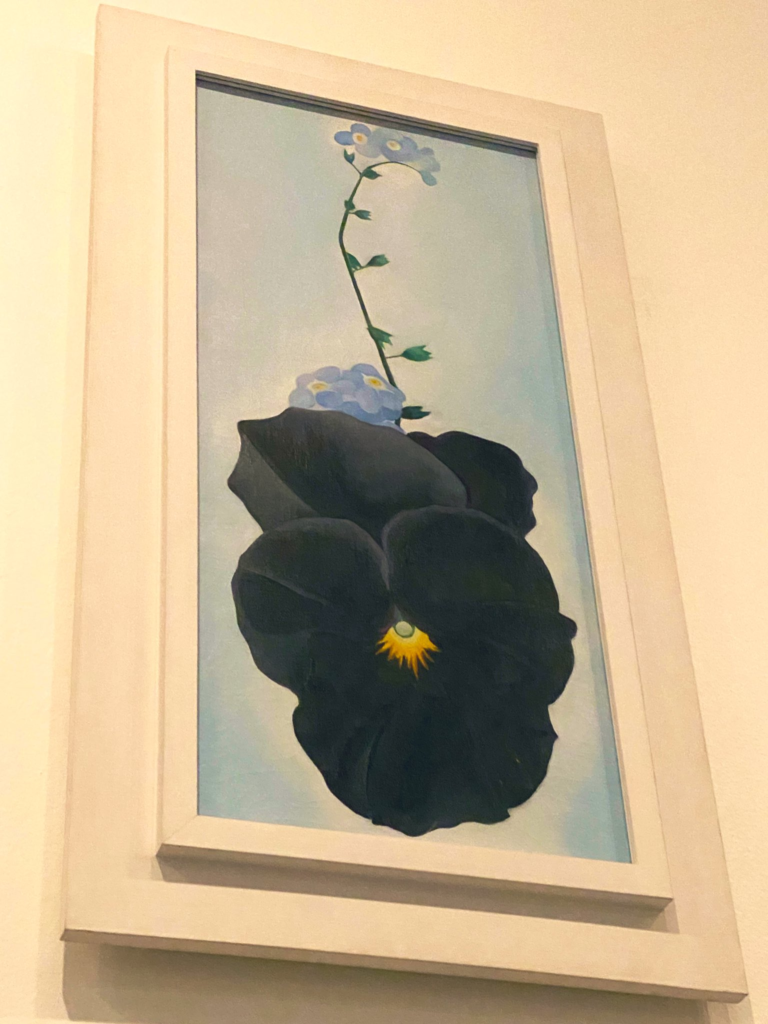
Georgia O’Keefe has the final word with “Black Pansy & Forget-Me-Nots,” 1926, oil on canvas
A Golden New Year at Longwood Gardens

“Write it on your heart that every day is the best day in your life.”

Ralph Waldo Emerson

As the days get shorter towards the Winter Solstice, we all await that moment when the spirit of Christmas fills our hearts.  Sometimes we wonder if it will ever arrive.  If it does not accompany the music, now starting at Halloween, or the decorating, now beginning on Thanksgiving before half-time, then when?

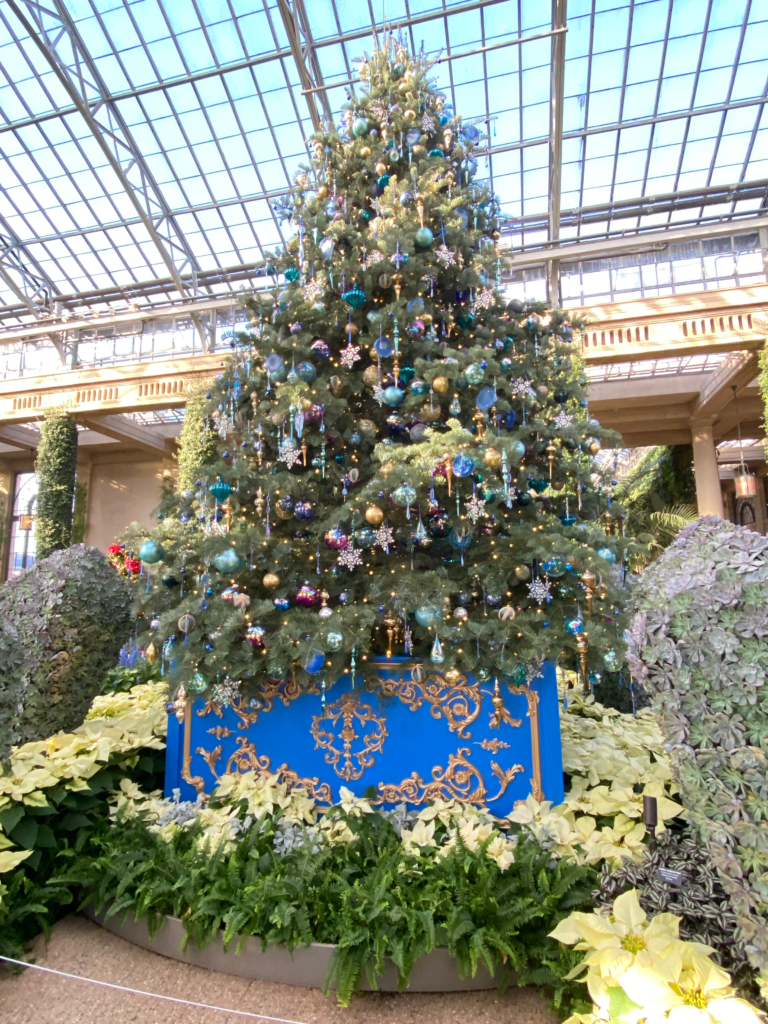
Beautiful jewel tree

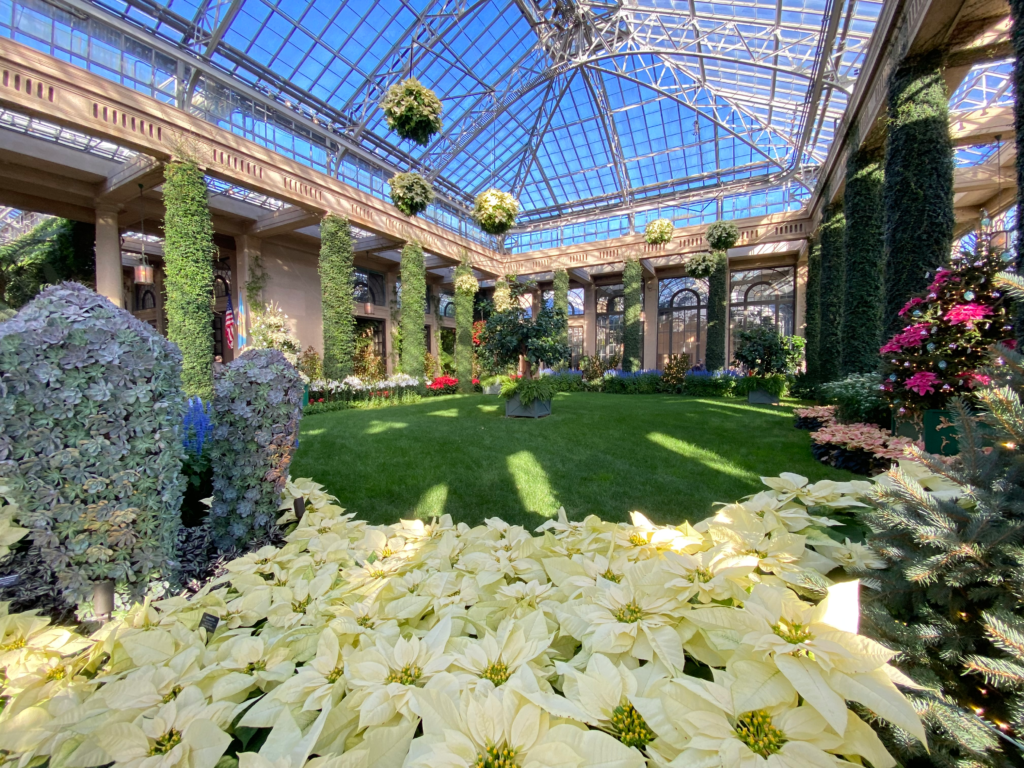
Poinsettias in Exhibition Hall of the Main Conservatory

Yet it does arrive – sometimes inconceivably, improbably, and often unexpectedly, through a kind act, a heartfelt note on a Christmas card, or a loved one’s laughter.  These small things can flip the Christmas switch, bringing that warm, glowing, holiday feeling.  Grand gestures aren’t too grand to bring the magic either.  Someone conjuring up a big Christmas surprise is as joyful as a starry sleigh ride with Santa.

“A Longwood Christmas” has both the small and grand gestures – the unseen hours of dedication bring the splendor.  A literal switch may light up the Longwood night, but the gift of beauty brings the feeling.  Look around while visiting.  There are smiles everywhere, reflecting spirits lifted by the magic of nature meeting art.

Amaryllis

Words fail when walking into the Main Conservatory with its splendid floral Christmas trees, now mirrored by those in the incredible new West Conservatory. 

Splendid fountain greeting at the Main Conservatory entrance

Beautiful camellias were in bloom

Don’t miss the exquisite Orchid House, the original vision of founder Pierre Samuel du Pont and his wife Alice, in the Main Conservatory near the exit to the Waterlily Court, Cascade Garden, and West Conservatory.

Waterlily Court

The Longwood holiday tradition, which has delighted its Kennett Square neighbors and world travelers, was a gift from Pierre du Pont.  In 1906, Pierre saved Peirce’s Park, a former family farm beloved by locals that featured two beautiful allées of trees, which visitors to Longwood Gardens can still enjoy today. Inspired by his travels to gardens in France, Italy, and England, and visits to great exhibitions, Pierre gradually created beautiful gardens on the grounds. Pierre was a generous philanthropist who paid for the construction of nearly half of the public schools in Delaware at the time. Du Pont cousins Henry and Alfred, donated the incredible Winterthur Museum, Garden, & Library, magnificent year-round and especially during the holidays, and the Nemours Estate, in Wilmington, also festive at holiday time.  These generous gifts are gems of the scenic Brandywine Valley.

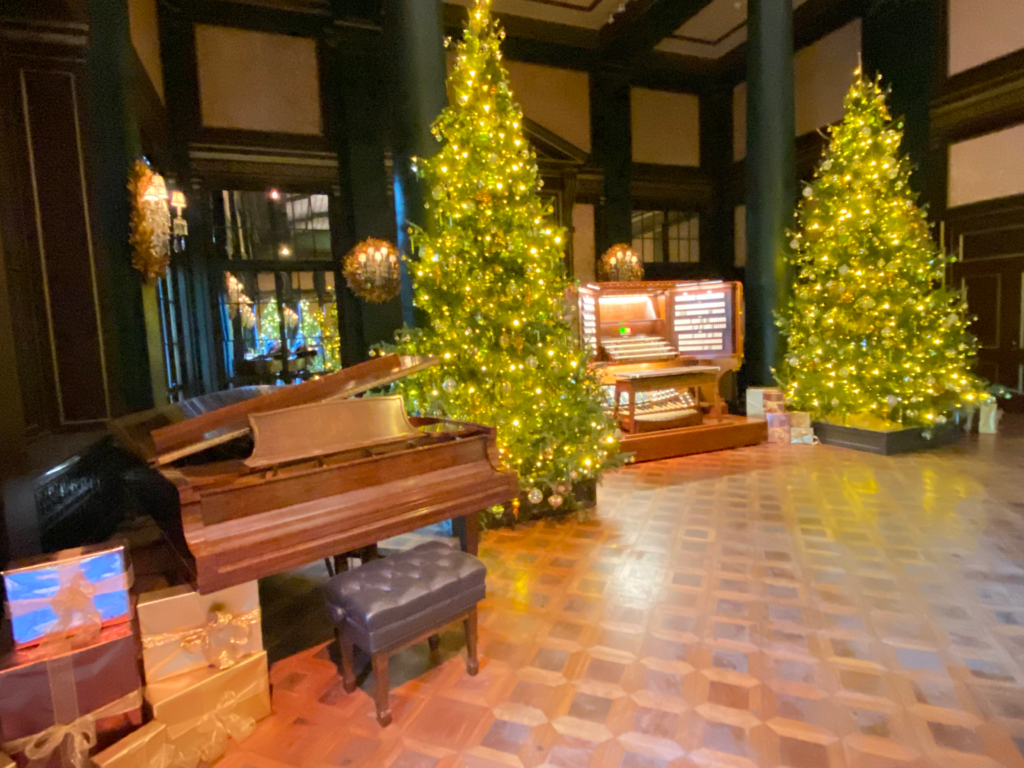
Christmas trees amidst the Steinway piano and organ console in the Ballroom celebrate the accomplishments and creativity of local arts organizations:

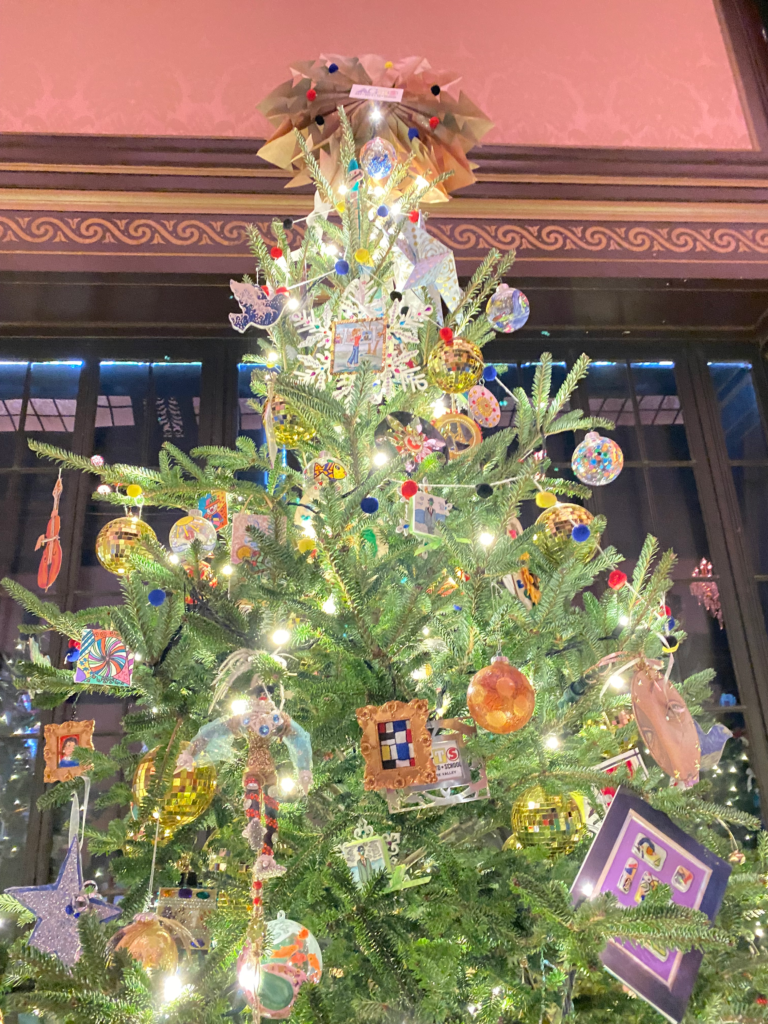
Handmade felt ornaments

Stunning floral trees and blooms in the West Conservatory:

What’s wonderful about Longwood Gardens, and bears repeating at Christmas, is that generations of family members can visit together.  “A Longwood Christmas” will delight everyone – couples, families, and solo travelers who won’t feel alone with a cup of warm cocoa on a merrily lit winter night.  Thank you, as always, to the dedicated staff.

Snapdragon charm

Magnificent trees in the Music Room:

Enjoy “Winter Wonder,” which began January 16th and spring ahead with “Longwood Gardens: Spring Symphony”. Save the date for “A Longwood Christmas,” starting on November 21st.

(Sources: longwoodgardens.org, mainlinetoday.com, Wiki)

“A Golden New Year at Longwood Gardens” All Rights Reserved ©2026 Kathleen Helen Levey

“A Christmas Carol” with Gerald Charles Dickens, The Historic Village of Allaire, and Two River Theater

“I will honour Christmas in my heart, and try to keep it all the year. I will live in the Past, the Present, and the Future. The Spirits of all Three shall strive within me. I will not shut out the lessons that they teach.”                 

A Christmas Carol, Charles Dickens

Often, we experience and hear similar stories from others that children enjoy playing with the embellishments of Christmas – making art with bows, creating collages, and stacking present boxes -more so than exploring the more costly gifts.  Their playfulness is a celebration.


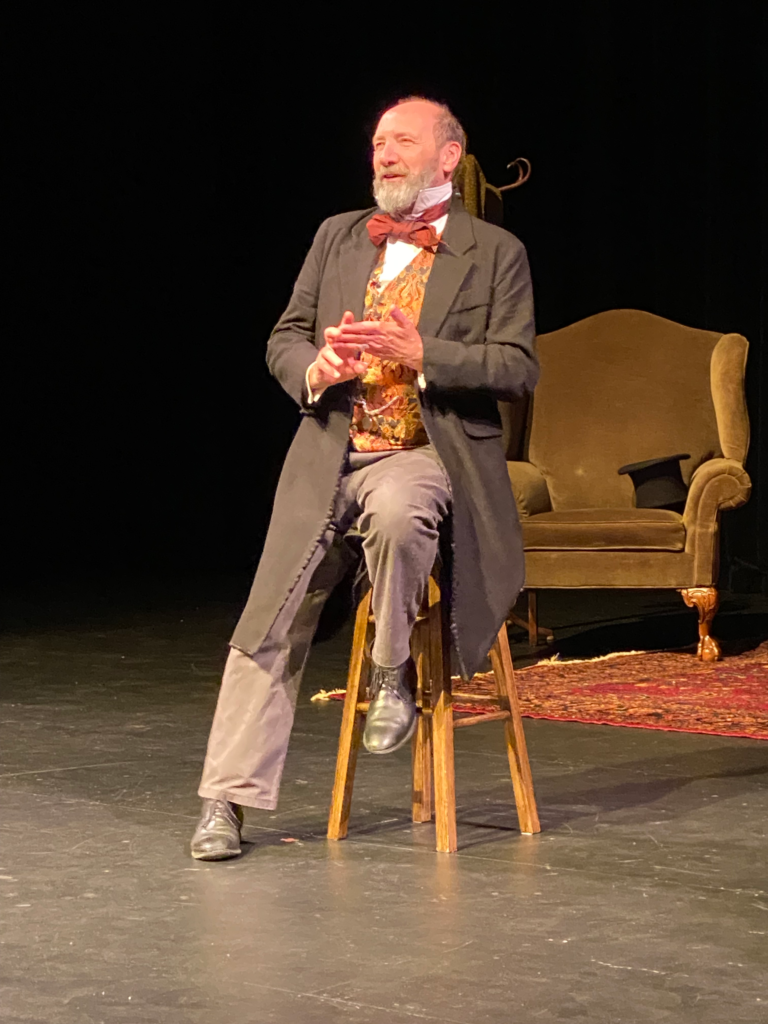
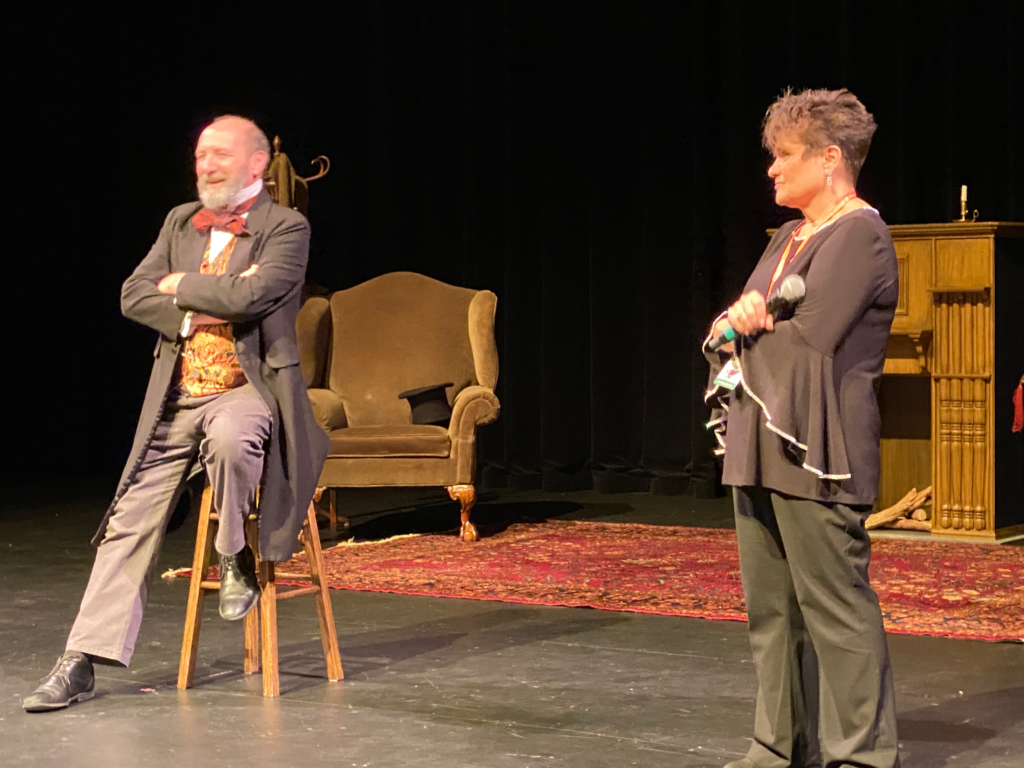
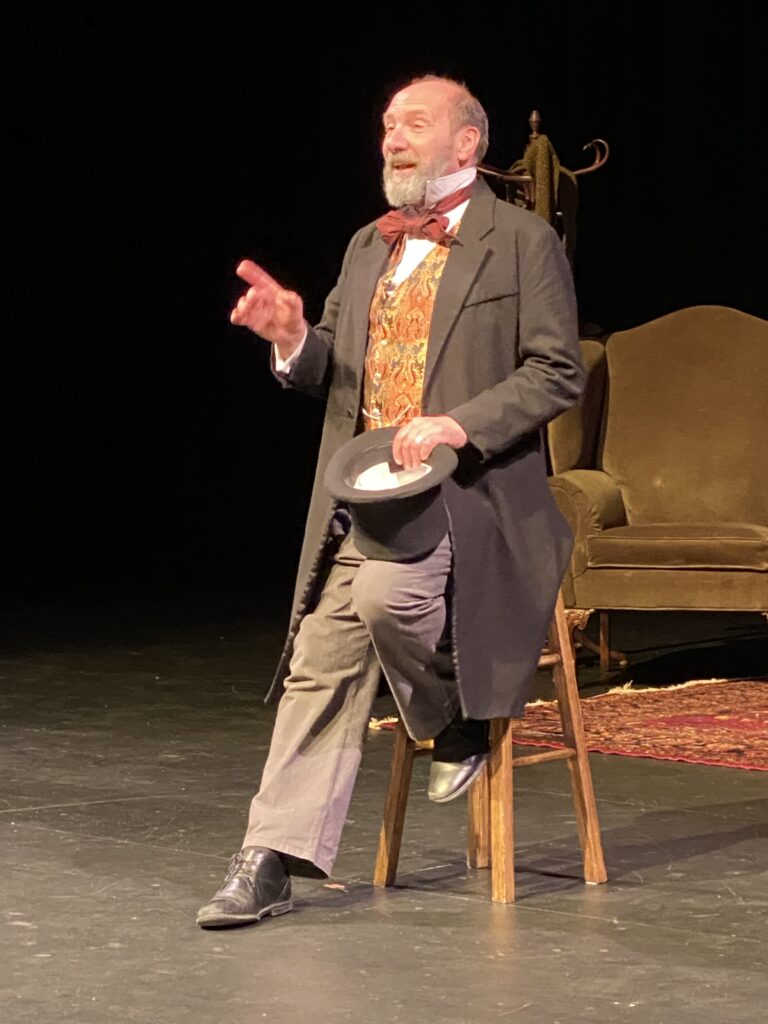
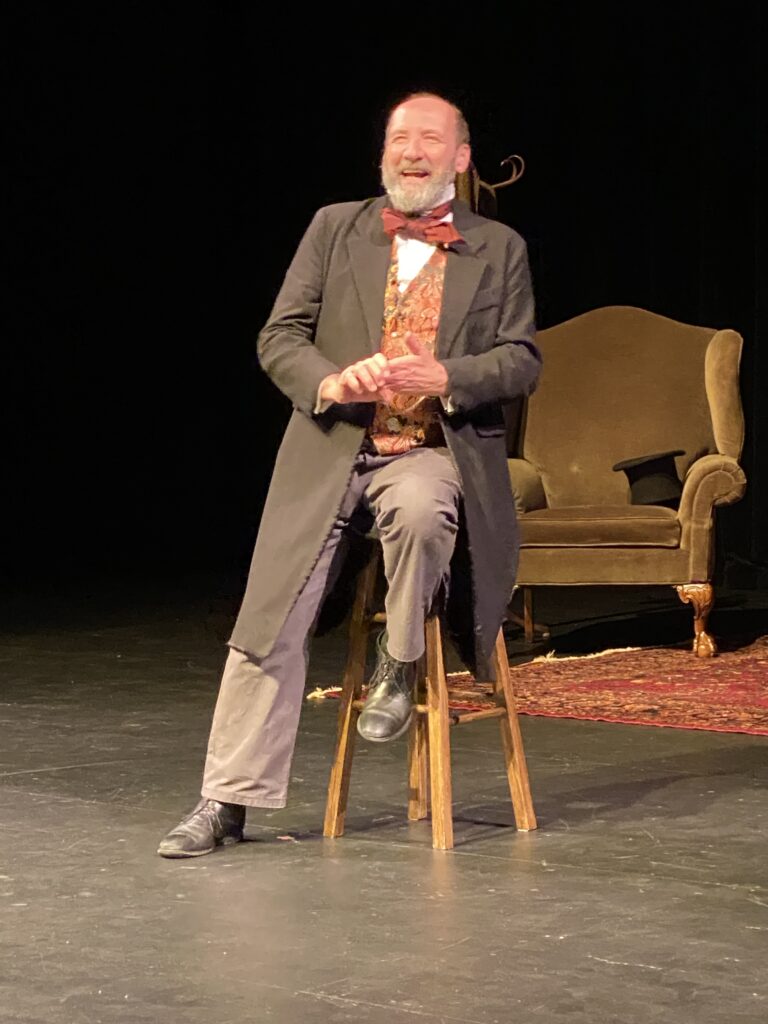
In Gerald Charles Dickens’ performance of A Christmas Carol, his pared-down, one-man interpretation of the beloved story reminds the audience that his great-great-grandfather’s words are a gift.  There are no lavish stage settings or fancy props. Instead, Mr. Dickens plays with the gift, reinventing it to present it anew to the audience. In early December of 2025, on his USA Farewell Tour at Two River Theater, sponsored by The Historic Village at Allaire, in a Q&A Gerald warmly shared that he “feels a theatrical connection with Dickens, which allows for versatility and interpretation…”  After being on the road performing this and other Dickens works for thirty-two years, Mr. Dickens wants to spend more time with family, but his cousin’s son may pick up the mantle. 

Mr. Dickens conveys the warmth and charm of the kindest and best of Dickens characters.

A heartwarming anecdote is Gerald’s sweet memory of the first time that he discovered A Christmas Carol. In a scene straight out of a Dickens novel, five-year-old Gerald was celebrating Christmas with all his family.  The little cousins got into a big bed to listen while a family member read the story to them. 

Mr. Dickens explained some historical context of the novella. Charles Dickens wrote A Christmas Carol at the height of the Industrial Revolution.  Once a child worker himself after his father was sent to debtors’ prison, and as a man of deep faith, Charles Dickens was concerned that the workers’ children would have no education and become a lost generation.  Rather than lecture people, Dickens hoped that his moving tale would connect with audiences and convince them to care about England’s many Tiny Tims.  


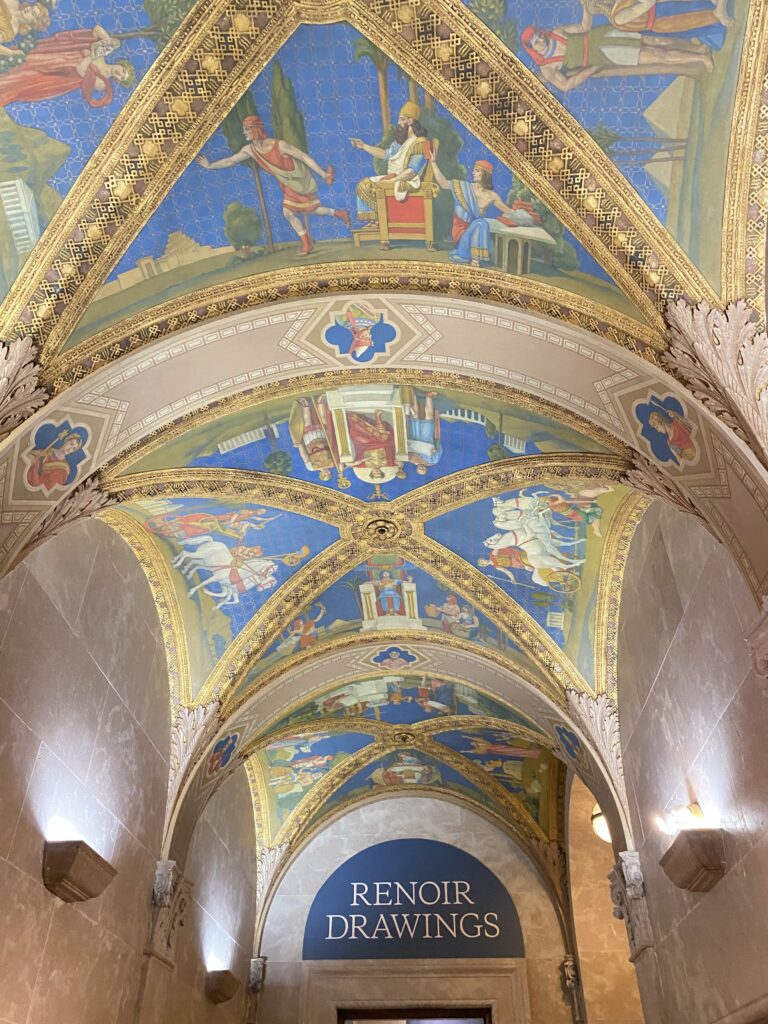
Charles Dickens created the beloved novella in six weeks of intensive writing. Published on December 19, 1843, the first edition sold out by Christmas Eve.  Meticulous about the book cover’s quality and illustrations, Dickens did not make as much money as he might have, but his message of “reformation and redemption,” as Gerald described it in a YouTube interview, resonated. By 1844, the novella had gone through 13 printings and is still a bestseller.  His original handwritten copy is at The Morgan Library & Museum, where the Renoir drawings are on exhibit until February 8th.

Regarding films of the story, Mr. Dickens enjoys the Muppets version with Michael Caine, because it uses more of the narration as does his play; he also favors the George C. Scott and Alistair Sims films. Regarding Charles Dickens’ biographers, Gerald prefers the books of Clair Tomalin, Edgar Johnson, and the biography by his great-great-grandfather’s friend John Foster.  Those interested in more may follow Gerald’s charming blog, On the Road with Gerald Dickens.  Gerald Charles Dickens is also the author of two books My Life on the Road with A Christmas Carol and Dickens and Staplehurst: A Biography of a Rail Crash. (What was refreshing and likable is that Mr. Dickens only mentioned his books once in passing.) Everyone can also enjoy interviews with him via YouTube.

The elegant, state-of-the-art Two River Theater from Facebook, which notes events like Shakespeare’s As You Like It, with student performers, premiering January 24th.

Gerald’s great-great-grandfather, with whom he also shares a family resemblance, toured across the United States twice and received warm welcomes.  His first trip was for writing inspiration and to promote the idea of an international copyright, because his books were routinely published outside of England without credit.  On the second trip, he read from his works, which included A Christmas Carol, and acted some of its roles.

Daryl O’Connell, Allaire Director of Development, served as emcee

A Christmas Carol festivals are held throughout England. Here in the US, Mr. Dickens has performed A Christmas Carol in fundraisers for The Historic Village at Allaire, in Farmingdale, New Jersey. (Industrialist and philanthropist James Allaire, a contemporary of Charles Dickens, founded the village, now a nonprofit living history museum, in 1822.) Further south, for fifty-two years, the Galveston Historical Foundation has hosted “Dickens on the Strand” on the first weekend in December (4th-6th in 2026). This Texan celebration of A Christmas Carol has always had a Dickens family member present; it may be possible to see Gerald Charles Dickens as a speaker, though his US performances ended December 15th.  Hearing the inside story of family members warmly exchanging thoughts on their “Dickens on the Strand” experiences was fun to hear.

For upcoming events, kindly visit the The Historic Village at Allaire on social media.

The scenic village grounds host events from April through December – visitors and new members are welcome!

Charles Dickens’ words have passed through the generations in his family and created the bond of a unique, shared experience. For those traveling to, or living in the UK, Mr. Dickens and his brother Ian are starting a “Dickens House Party Weekend” at The Royal, where Dickens stayed in 1838 while writing “David Copperfield,” on the Isle of Wight, February 27th-March 1st. The Dickens Fellowship, which is supported by Gerald and other family members, has chapters around the world and offers a connection for admirers of Charles Dickens. With the Dickens family’s dedication, A Christmas Carol is a gift from the past that delights us in the present and will continue to do so in the future.

Thank you to the Historic Village at Allaire for the wonderful experience! 

Ms. O’Connell and two members of the dedicated team of staff and volunteers of Allaire Village with fundraising Christmas bears from the General Store – definitely more fun to play with than wrapping paper!

(Sources: geralddickens.wordpress.com, arts.gov, www.charlesdickenspage.com, YouTube, Wiki)

“‘A Christmas Carol’ with Gerald Charles Dickens, The Historic Village of Allaire, and Two River Theater” All Rights Reserved ©2026 Kathleen Helen Levey

A Heartfelt Holiday Thank You

“Gifts of time and love are surely the basic ingredients of a truly merry Christmas.”

 Peg Bracken

If you are a fan of #Christmas365, there is never a letdown after the holidays.  This holiday season brought the heartwarming experience of holiday traditions, events, and concerts of nonprofits hosted by their incredible volunteers and staff. How wonderful to know that the gift of Christmas kindness continues throughout the year.

The celebrations sped by like a Santa train – or maybe his firetruck! (Thank you, firefighters!) The Eastern Orthodox Church celebrates Three Kings Day on January 19th this year, which I’m using as an excuse to roll out holiday posts a little longer to applaud so many lovely people and places that made the holiday bright.

This year’s cookie recipe for the annual holiday thank you is caramel snickerdoodles, which are both a sweet treat and fun to say.  (My nickname for them is “dulce de leche cookies,” which is equally delightful. Since there’s no snickerdoodle aisle in the supermarket, for the sheer pleasure of it, enjoy asking, “Does the store carry dulce de leche?”) Regarding “snickerdoodle,” Cheryl’s Cookies notes that term comes from the German “schneckennudeln,” or “snail noodles,” the name for a pasta dish, then a cinnamon roll, and finally for a cookie that traveled with immigrants from Germany to the US in the early 1900’s.  Other theories are that the name is from the Dutch snekrad (“wrinkle” or “crinkle”) or from the snipdoodle cinnamon-topped cake of the Pennsylvania Dutch.  A final theory is that this is a silly promotional name that bakers created to appeal to children.

The caramel snickerdoodle recipe is via Southern Living, a new addition to the holiday repertoire that went over well. Helpful hints:  Place the extra sugar for the cookie coating aside; in one gift batch, I rushed and put the extra into the batter, which resulted in cookies that were too sweet.  Crunching the candy caramels in double baggies with a hammer works better than using a rolling pin; it also gets more laughs and a better result than using a food processor. This silliness offers family fun or cookie exchange bonding and may even start a TikTok trend.

Baking is a way to express thanks at the holidays and to bring cheer, comfort, or holiday fun throughout the year.  The Christmas and Hanukkah cookie recipes on the blog can be adapted for other holidays like Purim, Cream Cheese Hamantachen with Fruit Filling, winter cheer, Chocolate Crinkle Cookies and Spice Krinkles, everyday pastries, Christmas kolaches using different jam, Peanut Butter and Jelly Thumbprint Cookies and Peace Dove Cookies, both year-round treats from New Jersey’s Martha Stewart, and Norwegian Sugar Cookies for any holiday, made to order by varying the cookie cutters.

Enjoy, and thank you for following!

(Sources: goodreads.com, southernliving.com, cheryls.com/Jonathan Rowe)

“A Heartfelt Holiday Thank You” All Rights Reserved ©2026 Kathleen Helen Levey

Renoir and the Psalms at The Morgan Library

I like a painting which makes me want to stroll in it. ” Pierre-Auguste Renoir

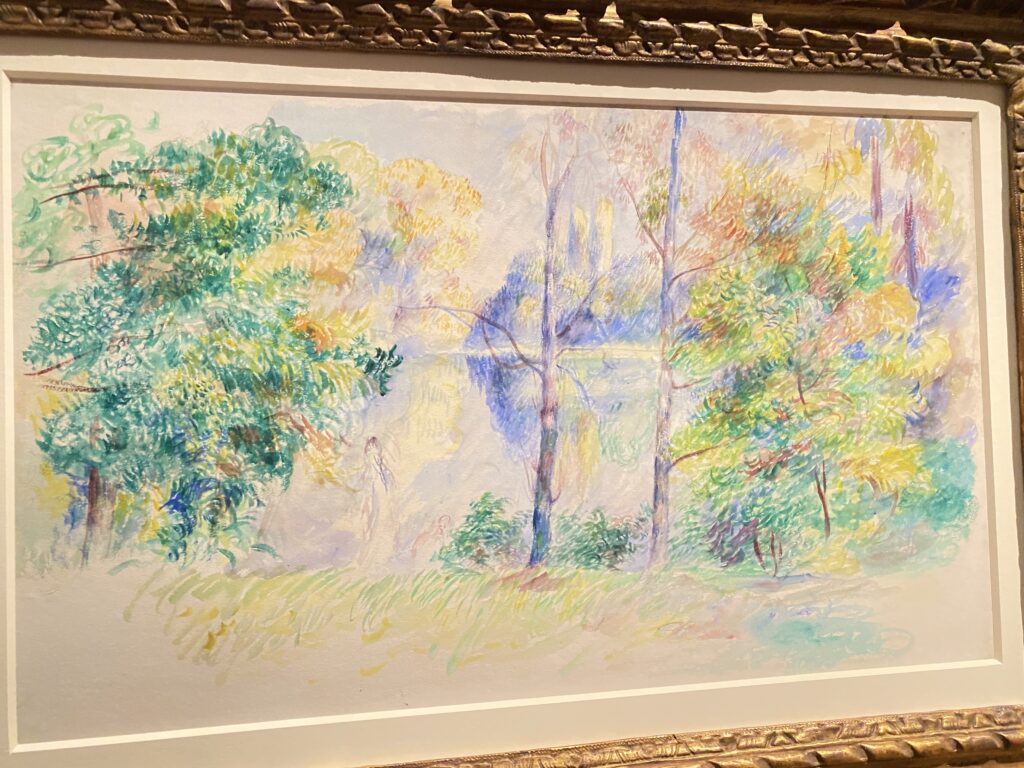
“View of a Park,” ca. 1885-90, watercolor, The Morgan Library

Step into the eternal spring of Renoir in a new exhibition of his drawings at The Morgan Library and Museum.  November brings its own kind of beauty, but the dappled Impressionist light of Renoir’s art is a joyfully irresistible invitation.

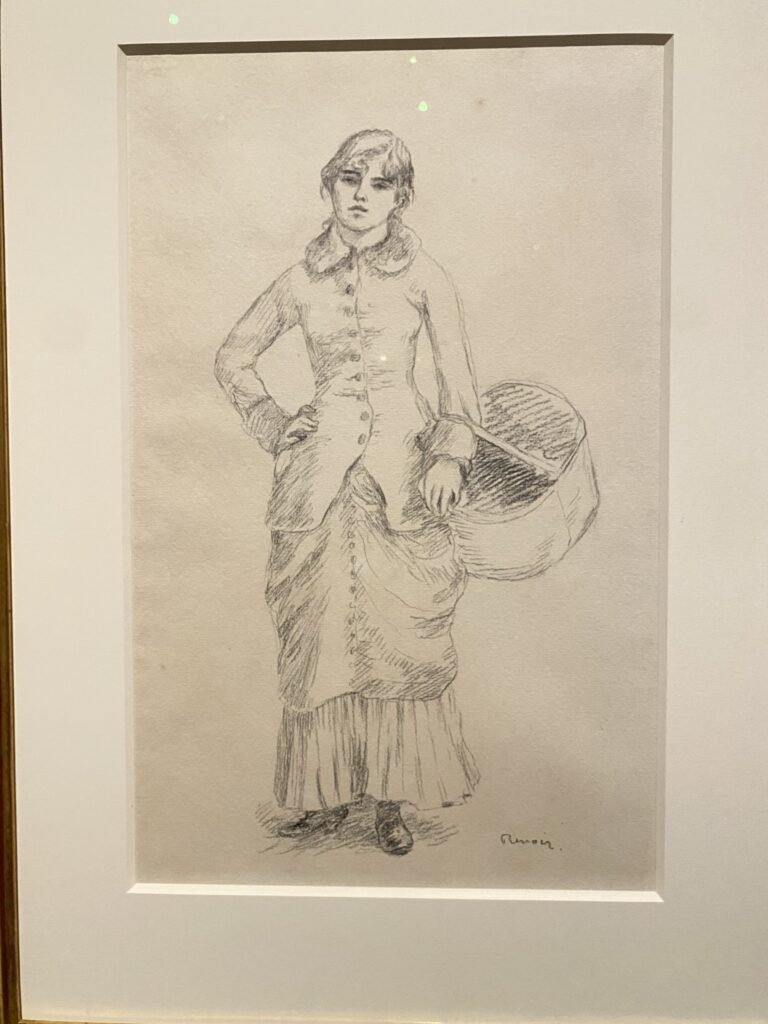
The Morgan Library exhibition is an incredible opportunity to enjoy Renoir’s rarely displayed drawings and see the process for several of his great works. The exhibition with the artist’s drawings and paintings in two large galleries features works from museums and private collections around the world.  Visitors receive an overview in the room adjoining the galleries that includes two filmed interviews with Renoir from 1915 and 1920.  The size of the exhibition is ideal for enjoying his art in pen and ink, pencil, chalk, pastels, watercolor, oil, and even plaster.

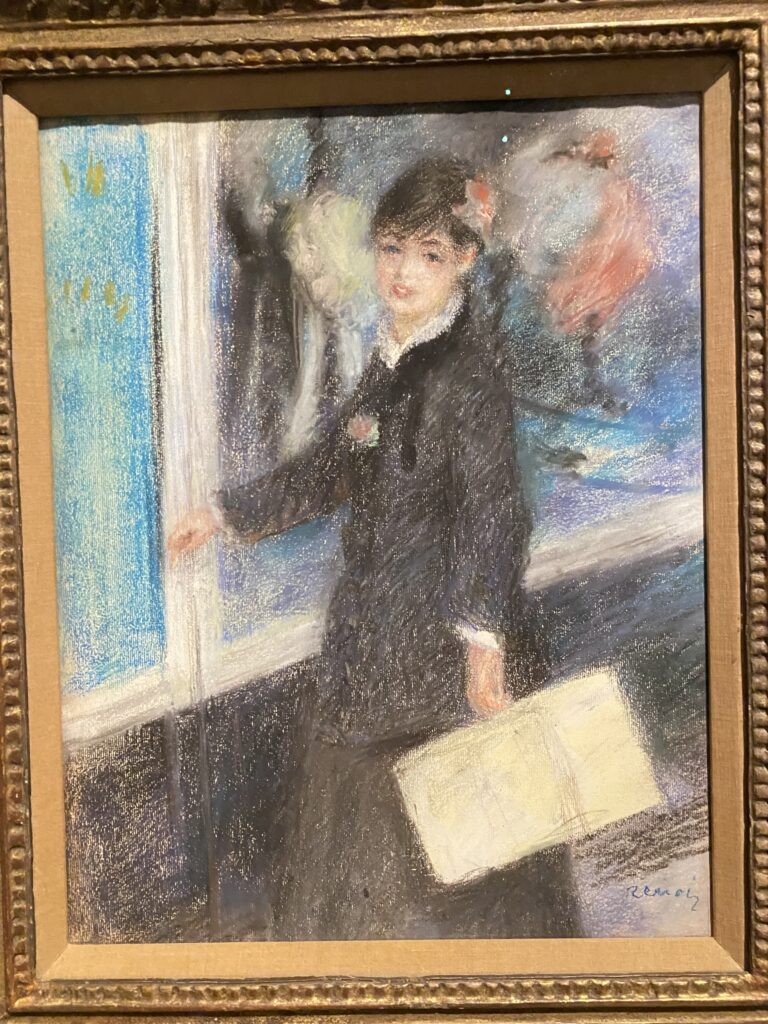
“Portrait of a Girl,” 1879, pastel, The Albertine Museum, Vienna

Renoir is an artist whom we all think we know, but the meticulously curated exhibition offered new insights, not just revisits to his beloved works.  Some of these prompted more research into Renoir’s life and art.

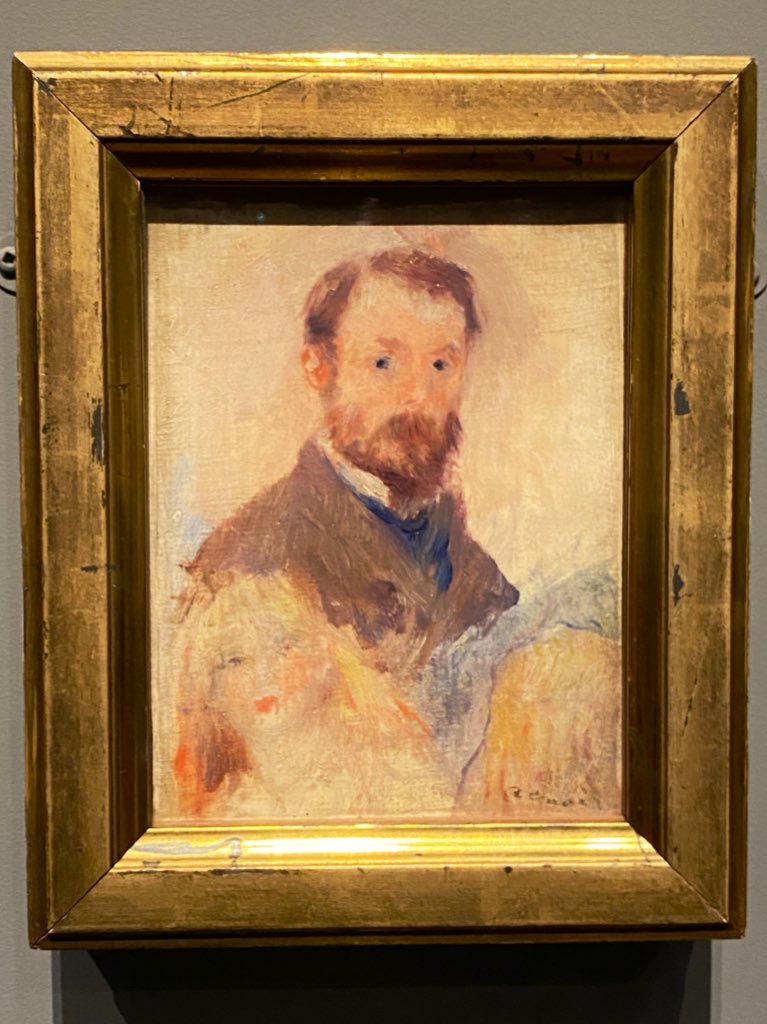
“Self-Portrait,” 1879, oil, Musee d’Orsay, Paris

Renoir as a decorative artist

Renoir, who was from a family of artisans, originally studied decorative arts and saw himself as a craftsman, not an artist. “To my mind, a picture should be something pleasant, cheerful, and pretty, yes pretty! There are too many unpleasant things in life as it is without creating still more of them.”  One of seven children, Pierre-Auguste spent his first few years in Limoges, known for its porcelain and high-end leather goods industries. Around the time of his birth in 1841 and during early childhood, there were riots among the poor workers. (Limoges was the city of the first consolidated French workers’ union in 1895.)  When Renoir was a small boy, his family moved to Paris, so his father, a tailor, might find work.  Renoir apprenticed at a porcelain factory and was highly skilled at painting decorative flowers. Clearly talented, he got a permit to sketch at the Louvre, which was near his home.  Having saved a bit, Renoir took night classes at the Ecoles Beaux-Arts (School of Fine Arts) and painting lessons with Swiss-born Charles Gleyere, who had studied with renowned Neoclassical portrait artist Jean Auguste Dominique Ingres. Renoir surprised his serious teacher by sharing, “If painting were not a pleasure to me I should certainly not do it”.

“The Milliner,” ca. 1879, The Virginia Museum of Fine Arts, Richmond

Renoir joined Claude Monet, Camille Pissarro, Berthe Morisot, Edgar Degas, and Alfred Sisley, among others, as part of the Anonymous Society of Painters for an independent art exhibition in 1874.  The studio owner, Gaspard-Félix Tournachon, known as “Nadar,” a caricaturist, journalist, and photographer, was also an outlier known for taking the first aerial photograph from a hot-air balloon.  The artists exhibited outside the established Salon, which was the annual show of the Academie des Beaux-Arts (Academy of Fine Arts).  For the Salon, a jury selected the works that the public would see.  Following the exhibition, the group’s name came from Claude Monet’s “Impression, Sunrise” and a critic’s comment that it was indeed only an impression, an unfinished painting.

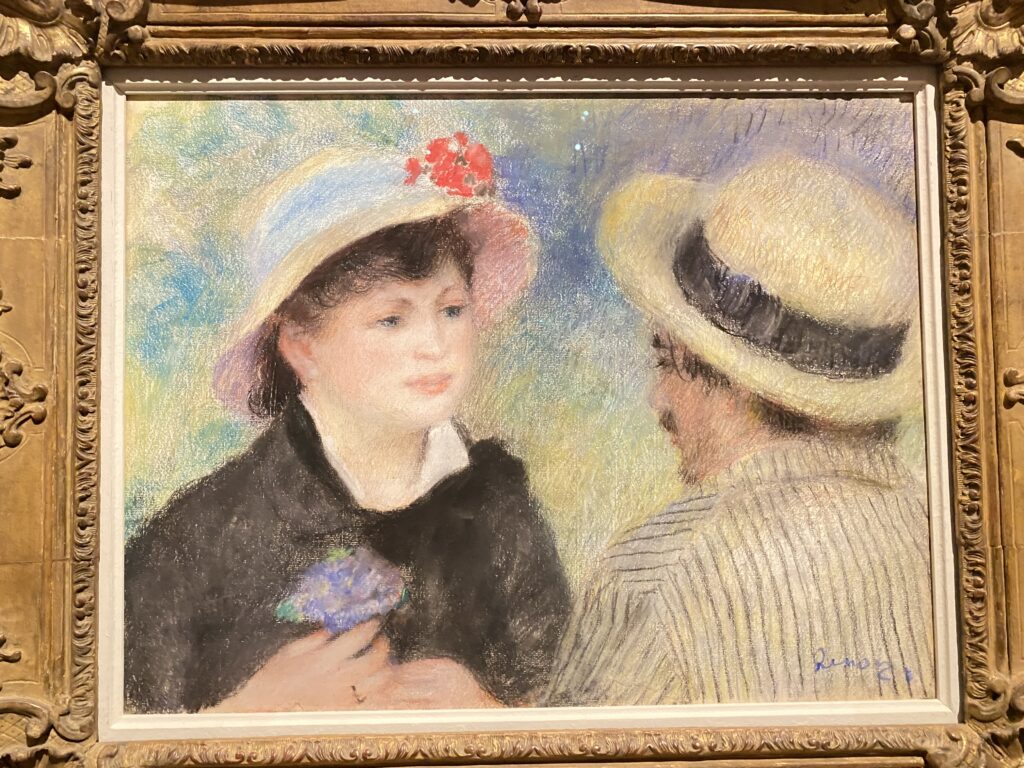
“Boating Couple,” 1880-81, smaller pastel work for “Luncheon of the Boating Party,” Museum of Fine Arts, Boston

After a period of creating sketches as a young artist and student, Renoir adopted the “spontaneous painting” of his fellow Impressionists and began his work directly on canvas.  Like the other Impressionists, whose works were originally rejected by the artistic establishment, Renoir enjoyed plein air painting, or outdoor painting “in the open air,” which captured natural light. An innovation with the production of the paints allowed for this, and Renoir and his peers made full use of the opportunity. They often painted with, and influenced, each other.

“Harvest,” ca. 1885, watercolor, white opaque watercolor, graphite, and varnish (unusually), Musee d’Orsay, Paris

“Impressionism” captured the artists’ “snapshot” style and brushstrokes.  In addition to natural light, they favored the use of bright colors, another result of improved paints, and did not varnish their works, which was done for a formal look. Such techniques lent themselves to painting nature and the countryside.

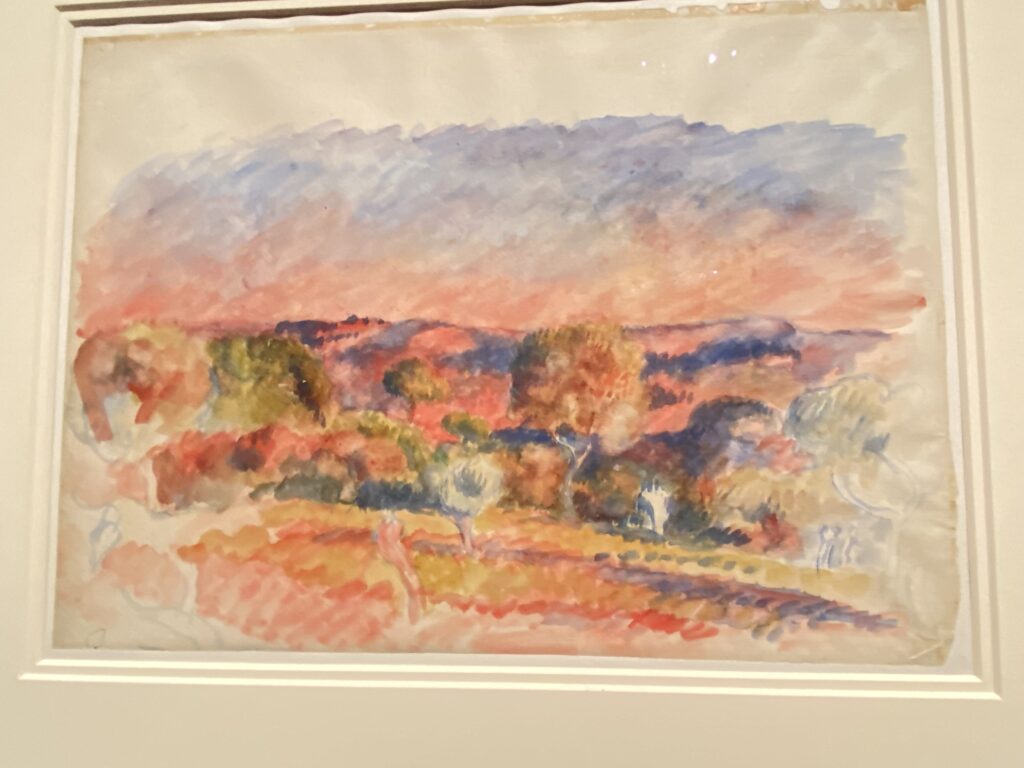
“Landscape,” 1899, watercolor, The Metropolitan Museum of Art, New York

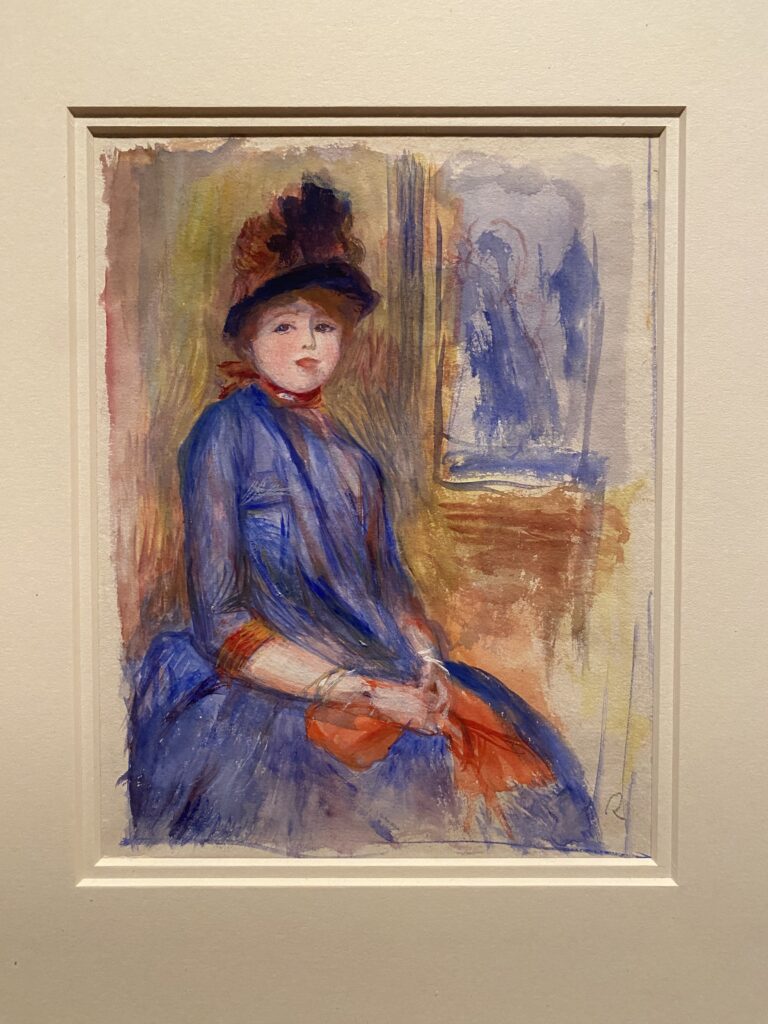
Regarding subject matter, Renoir painted working-class subjects as well as wealthy patrons, which is how he met his wife, Aline Victorine Charigot, depicted in the portrait below. Aline was working as a dressmaker when Renoir approached her to model for him.  When they married, Aline was 20, and he was 38.  After 18 years as a painter and 25 years of working in the arts, Renoir had reached career stability, which suggests a strikingly long and difficult trajectory to success.  

Aline sitting for “Young Woman in a Blue Dress,” ca. 1885-86, watercolor with opaque watercolor, The Metropolitan Museum of Art, New York

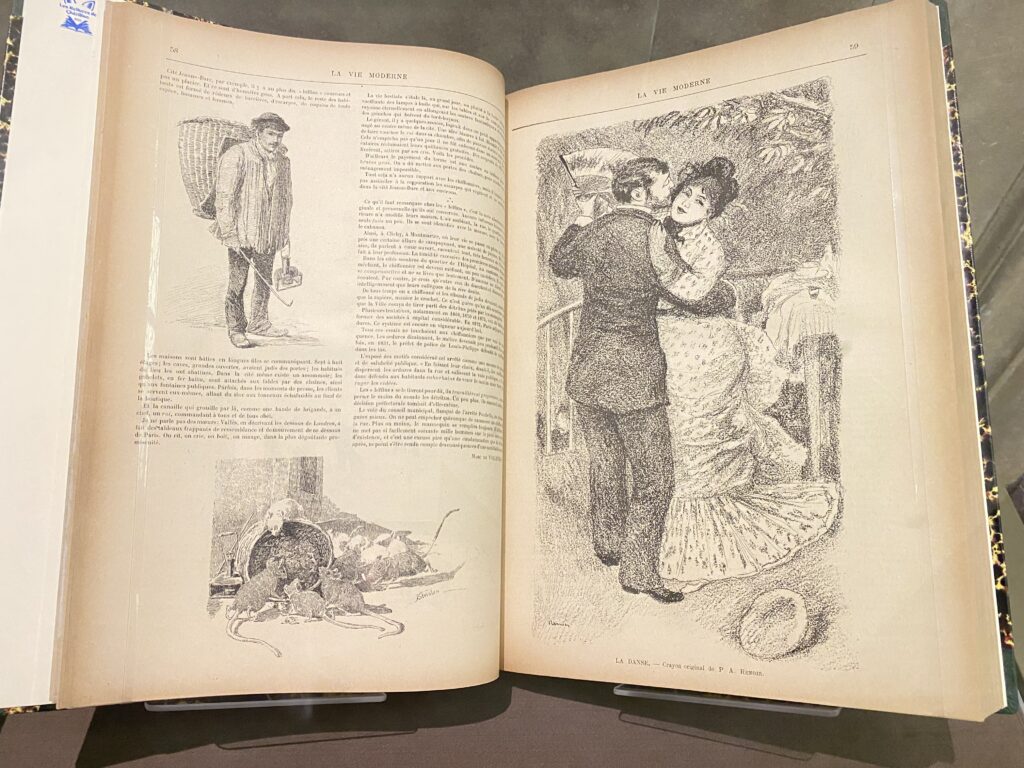
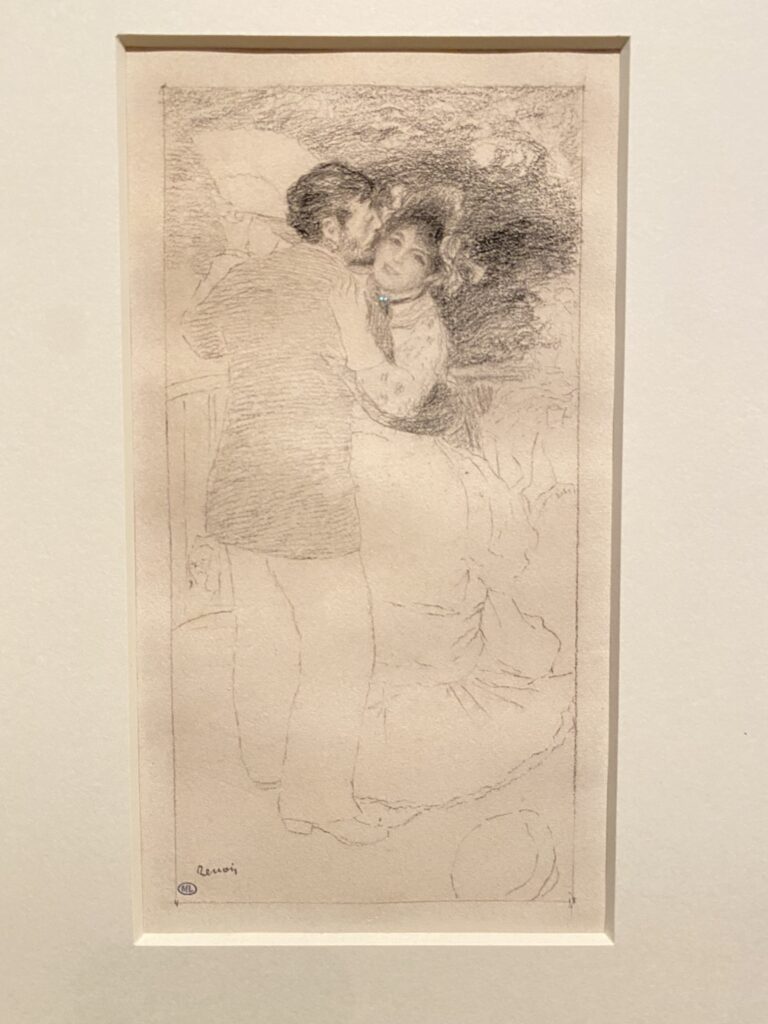
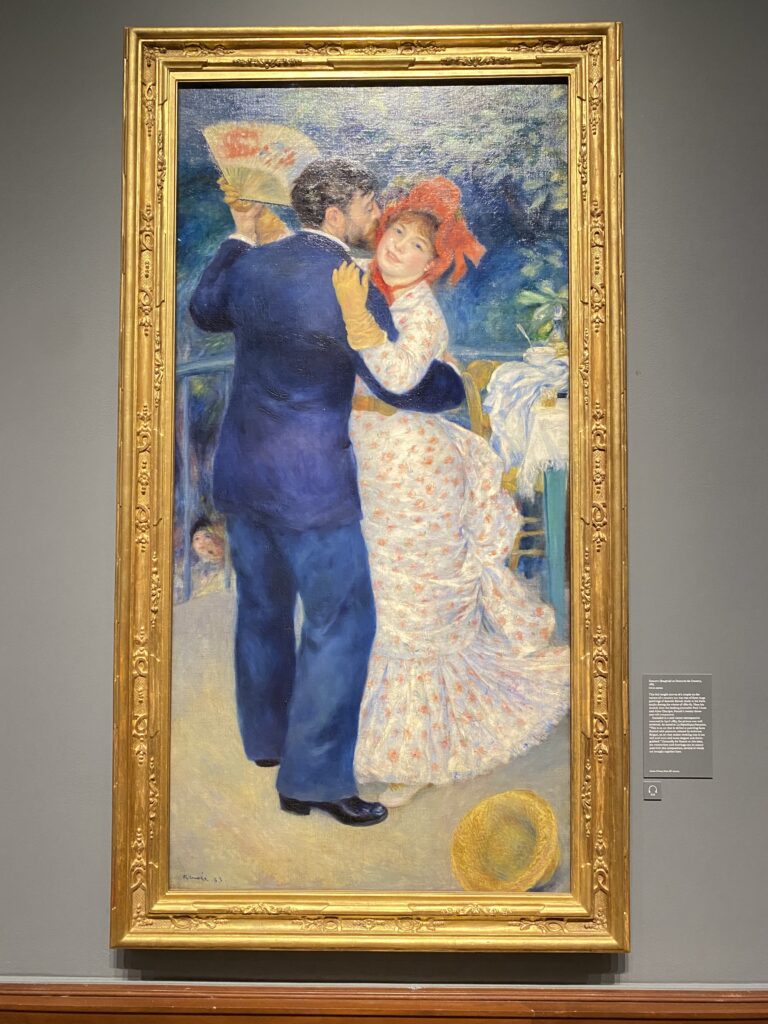
Renoir also earned income as an illustrator. Some illustrations were for stories, others reproduced his paintings, like “Dance in the Country” and “Dancing Couple”/“Dance at Bougival” in which Aline was the model for both.

Book illustration

Study for “Dance in the Country, 1883, graphite, Musee d’Orsay, Paris

“Dancers (Bougival)” or “Dance in the Country,” 1883, oil, Musee d’Orsay, Paris

Aline and Pierre-Auguste had three sons who all had careers in the arts: Pierre, an actor, Jean, a celebrated filmmaker; and Claude, a ceramic artist.  Renoir’s family was a great source of his happiness, and they were often subjects in his paintings.  Aline modeled for “Luncheon of the Boating Party,” most notably, and her cousin and the family’s nanny, Gabrielle Renard, was a frequent model for Renoir, too.  Before Aline, Renoir had a relationship with Lisa Trehot, another model, with whom he had a daughter, Jeanne, whom he supported.  Despite Renoir’s happiness with Aline, he had affairs during the marriage.  Four years before Renoir’s death, Aline passed away after a hospital visit to Jean, who was badly injured in WWI, as was his brother Pierre. 

Sketch for “Gabrielle and Jean,” 1895, National Gallery of Canada, Ottawa

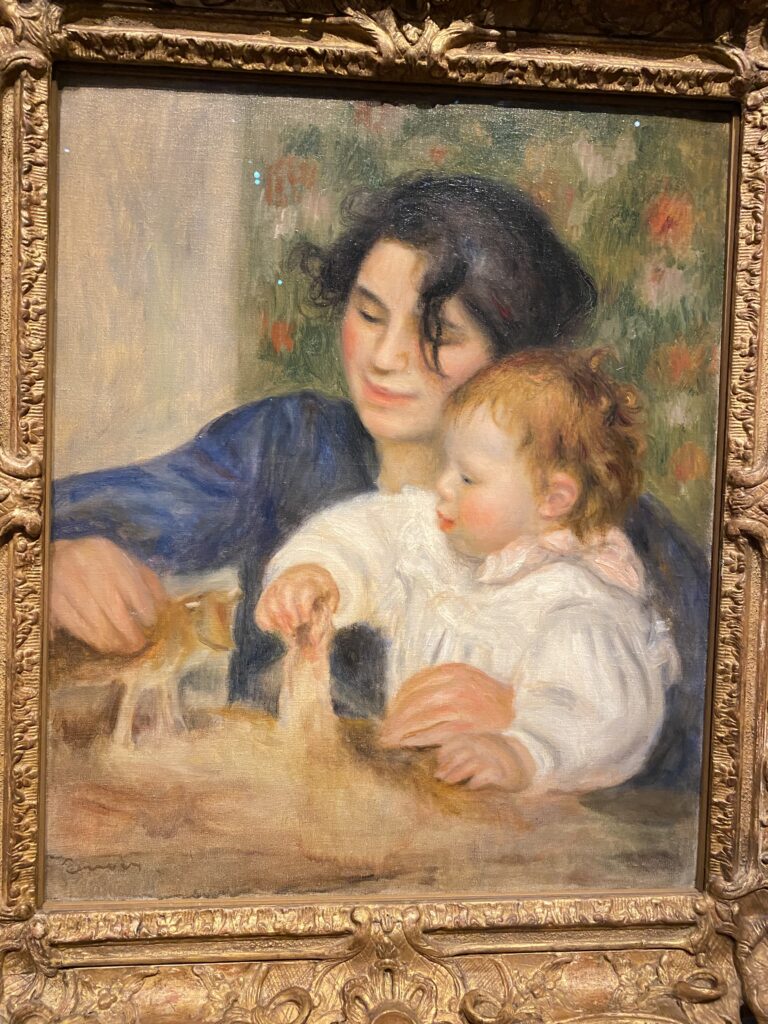
“Gabrielle and Jean,” 1895, oil, Musee de l’Organerie, Paris

(Note: On November 26th, a similar “long-lost” Renoir painting, L’enfant et ses jouets – Gabrielle et le files de l’artiste, Jean (The Child and His Toys – Gabrielle and the artist’s son, Jean sold for $2 million dollars.)

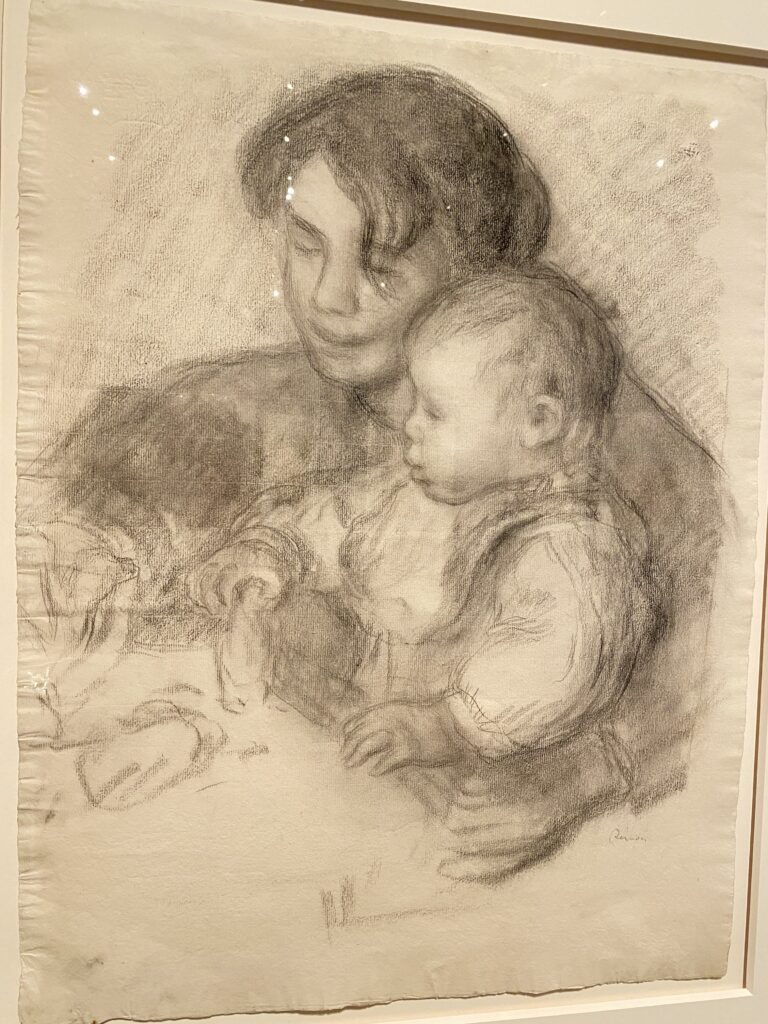
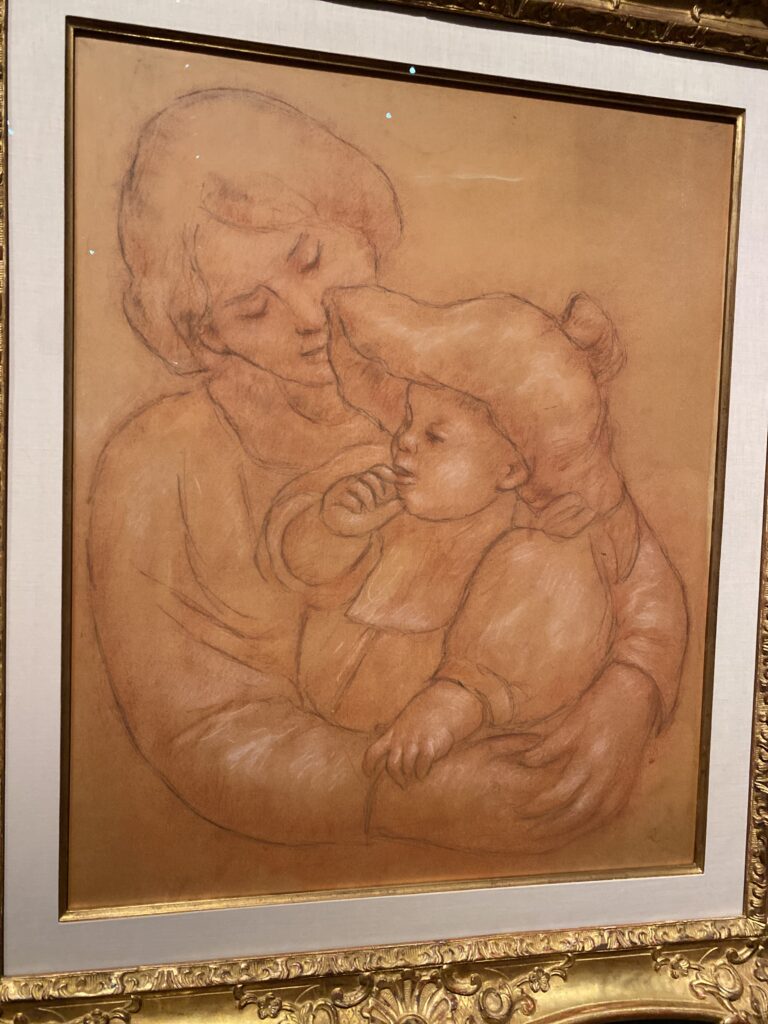
Chalk sketch of “Jean in the Arms of Gabrielle,” 1895-96, possibly reworking “Gabrielle and Jean” (exhibition note), Collection Foundation Pierre Gianadda, Martigny, Switzerland

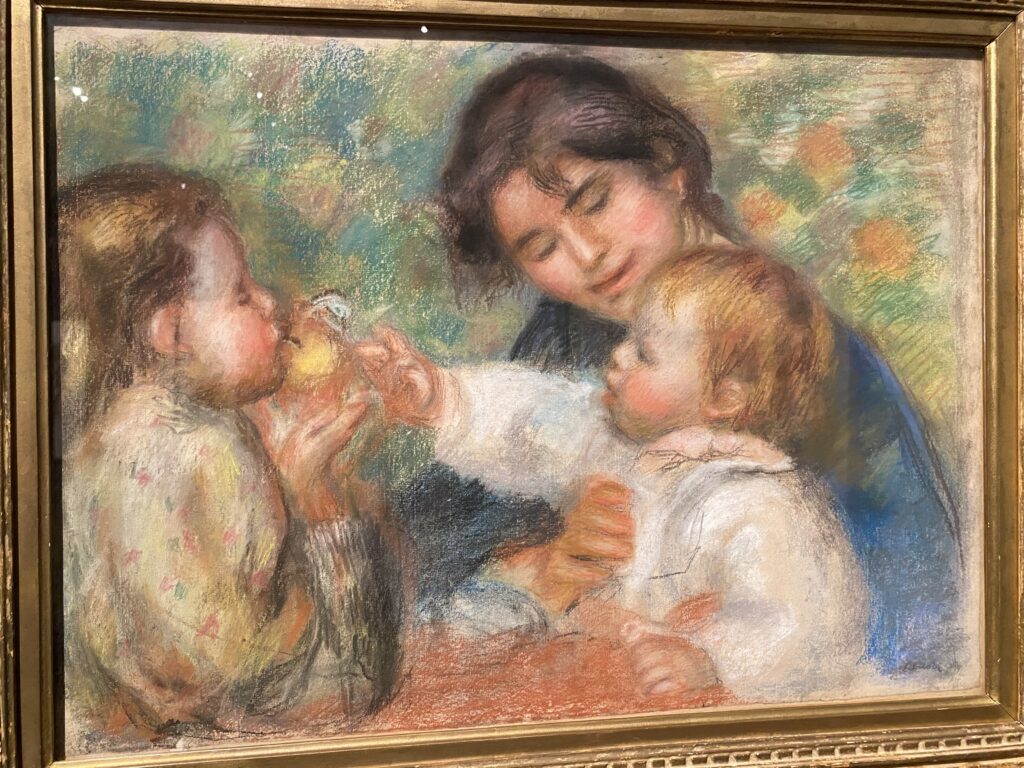
“Child with an Apple” or “Gabrielle, Jean, and a Young Girl with an Apple,” ca. 1905, Collection of Leone Cettolin Dauberville

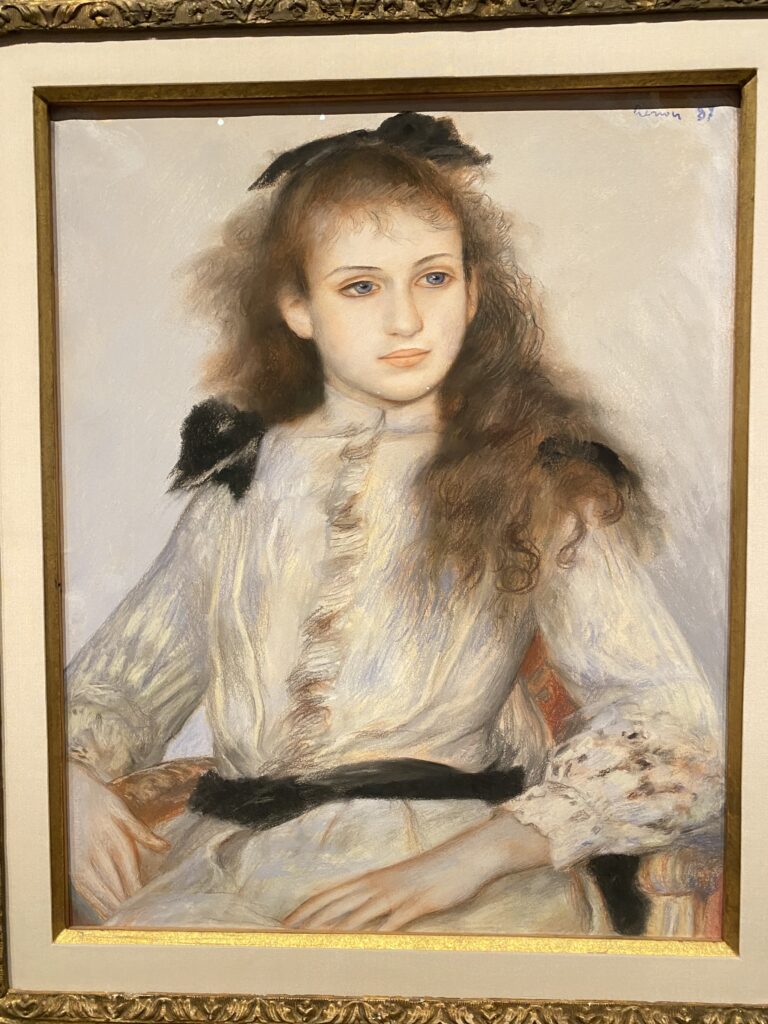
“Madeleine Adam,” 1887, pastel and graphite, Collection of Diane B. Wilsey

Division among the Impressionists

The founding members of Impressionism remained close for years.  They supported each other’s work, exhibited their art together, and looked out for each other, including each other’s families.  A falling out occurred over the Dreyfus affair.  As a quick history refresher, between 1894 and 1906, the guilt or innocence of Alfred Dreyfus, a Jewish army captain, divided then predominantly Catholic France.  Captain Dreyfus, tried twice and found guilty of espionage, was eventually exonerated.  Camille Pisarro, who was Jewish and a Dreyfusard, along with Monet, supported the captain, and Edgar Degas, an anti-Dreyfusard, who was anti-Semitic, did not, which is not to suggest that the national division was about religion and not politics.  In Renoir, My Father, Jean attributed his father’s artistic divergence from Pissarro to differing artistic and political views. In Growing Up with the Impressionists: The Diary of Julie Manet, based on the journals of the then-teenaged daughter of Pierre-Auguste’s dear friend Berthe Morisot, Julie wrote about Renoir and his family, with whom she first stayed at 16 after her mother died.  (The diary was first edited and published in 1987 by Rosalind De Boland Roberts and Jane Roberts; the latter became a Chevalier de l’Ordre des Arts et Lettres, or ‘Knight of the Order of Arts and Letters,’ France’s top honor, in 2011. In 2017, Jane Roberts edited a second, revised edition with 472 footnotes.) Julie, who had often posed for Renoir and was clearly fond of him, noted that he sometimes shared the less generous anti-Dreyfusard opinions of the time.  Renoir, however, stayed close to his Jewish sister-in-law, Blanche-Marie Blanc, and later attended the funeral of Pissarro, whereas Degas did not.

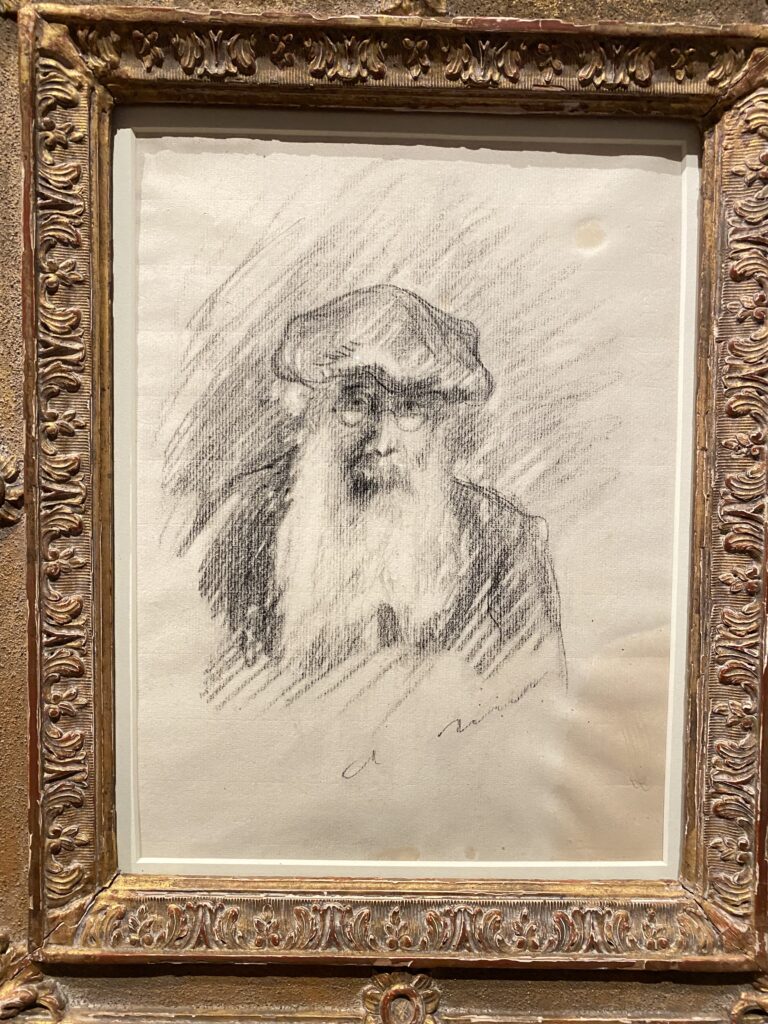
“Portrait of Camille Pissarro,” ca. 1893-94, charcoal, Dallas Museum of Art, Wendy and Emery Reves Collection

Having escaped from poverty, Renoir may have resented that he initially relied on Jewish patrons for exhibitions and commissions. Renoir’s early Jewish patrons supported his talent and influenced his early artistic direction. His portraits of these patrons, and especially those of their children, were beautiful. Greater success offered Renoir new commissions and travel around Europe and North Africa, where he saw the art of Raphael, Velázquez, and Rubens; this influenced his style, making it more classical in later years. He remained friends with the Jewish art dealers, Alexandre Bernheim-Jeune and his sons Joseph and Gaston, who curated 16 of his exhibitions.  Barbara Ehrlich White, PhD., who wrote Renoir, An Intimate Biography (2017) and Renoir: His Life, Art, and Letters (1984), and also became a Chevalier des Arts et des Lettres in 2014, attests that Renoir was the Renoir whom the public knew: warm, sociable, and kind.  He loved being around people, which his art reflects. Dr. White based her opinion on her review of 3,000 of his letters, 452 of which were previously unpublished. 

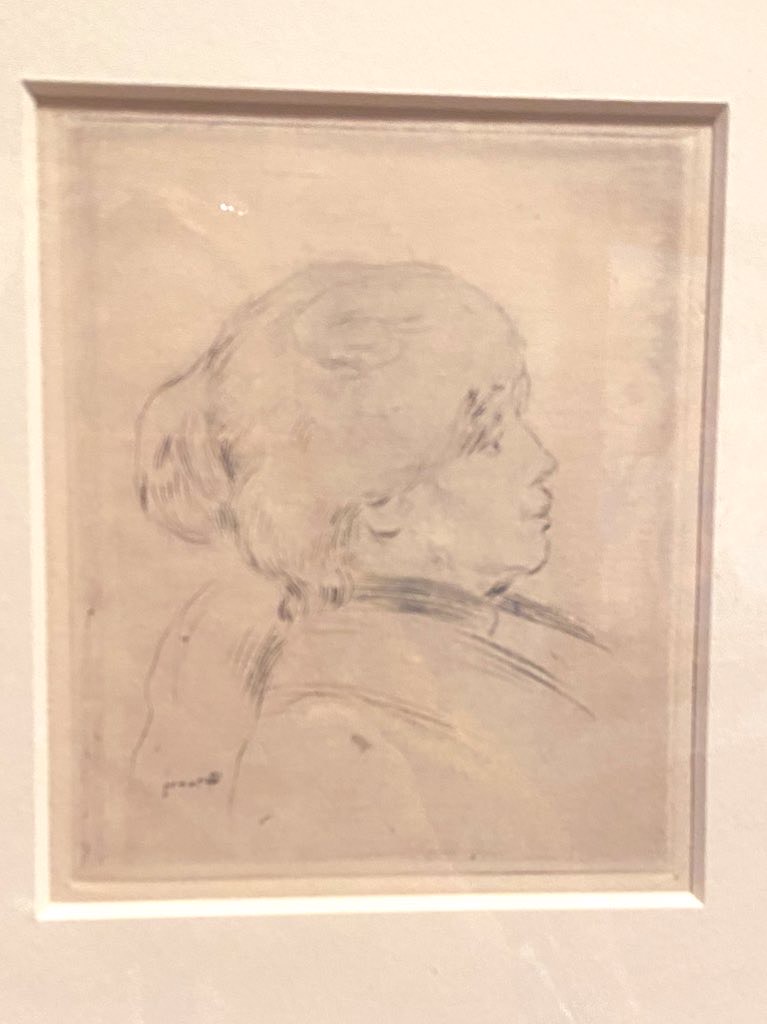
A mournful Berthe Morisot, which Renoir sketched after the death of her husband Eugene Manet for a painting memorializing her after her own passing

Renoir’s paintings were one of the first to delight me as a child, not only for their beauty, but for their joy.  He depicts children with such sweetness, which helps young viewers connect with his work. This issue concerning Renoir was mentioned on one exhibit label, as far as I noted, out of more than one hundred.  It stayed with me, however, and I read more about it.  At this point, I leave Renoir’s legacy in this regard to art historians, but I thought that I should mention it.

The artist overcomes arthritis

“The pain passes, but the beauty remains.” Admirably, Renoir continued to paint despite having crippling and painful rheumatoid arthritis, which began when he was 50.  In his late 60s, Renoir and his family moved to Cagnes-sur-Mer on the French Riviera for the warmer climate.

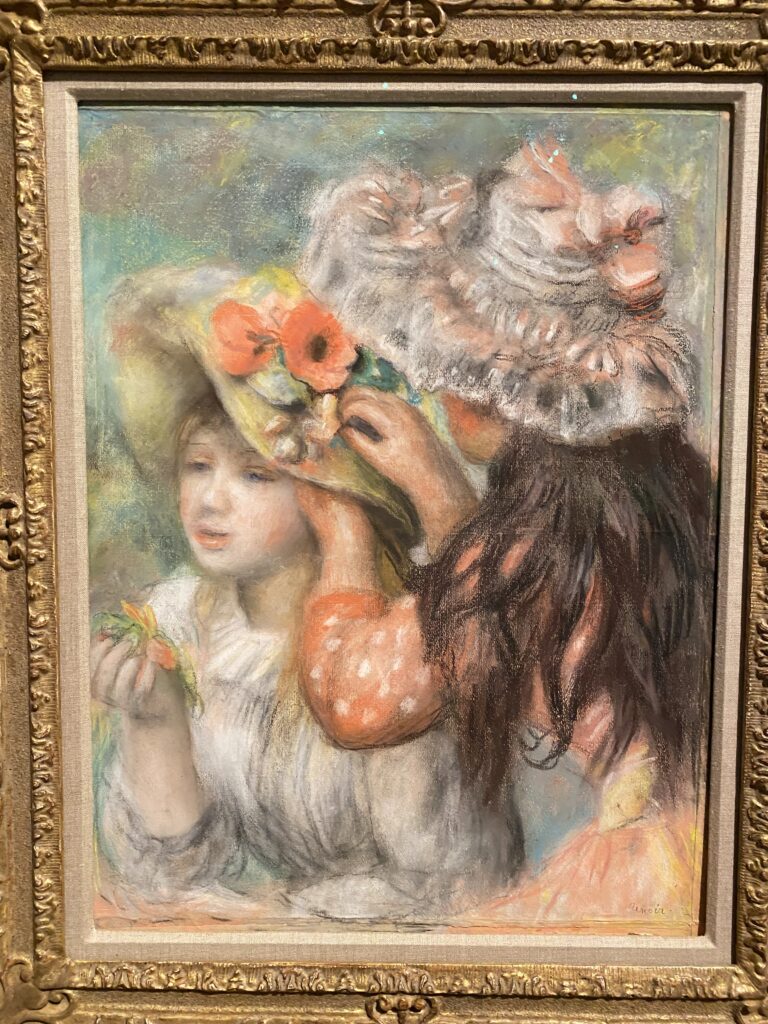
“Girls Putting Flowers in Their Hats,” 1894, oil, private collection

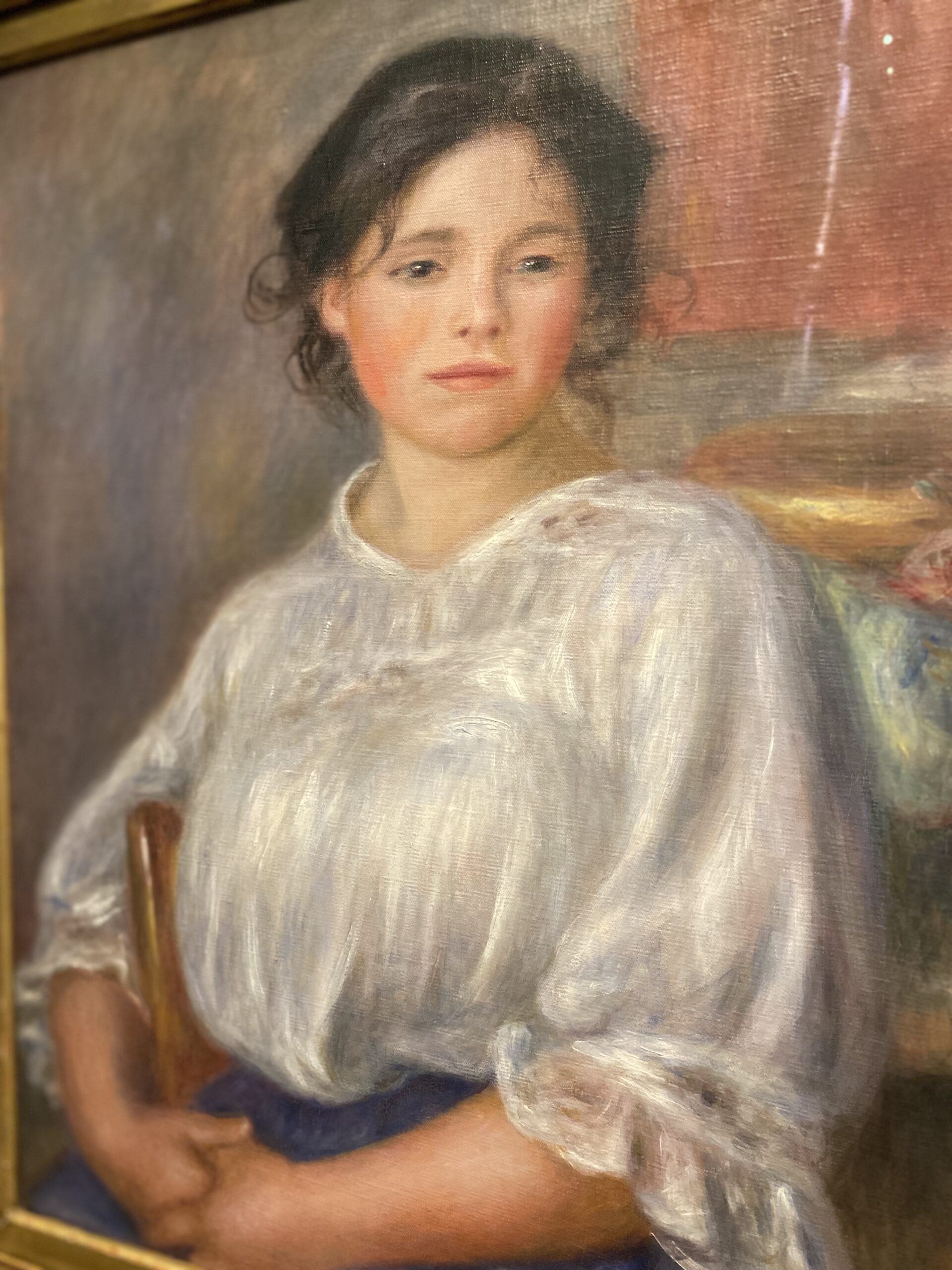
“Young Woman Seated,” 1909, oil, The Art Institute of Chicago/Admin. by Musee d’Orsay. Renoir strove for a luminous quality in his later work.

During this time, Renoir was in pain, especially when he tried to sleep, and he became progressively disabled.  He did, however, paint more than 400 works, including the masterpiece, “The Great Bathers,” which is in the exhibition along with sketches, and influenced Henri Matisse and Pablo Picasso. His family and assistants placed his painter’s palette on the arm of his wheelchair and his canvas on a rolling easel. Incredibly, Renoir’s paintings became lighter and more joyful.

The film and newsreel interviews in the exhibition show the deformed joints in Renoir’s hands.  Brushes were not strapped to his hands as sometimes noted, but they had to be placed into them. These interview clips were fascinating to watch, and though film was an early art form, Renoir charmed by periodically turning to the camera with a smile.
An arthritic Renoir, painting, [public domain]

On the day of his passing at 78, having painted for several hours, Renoir told his studio assistant, “I think I’m beginning to learn something about it.”
Enjoy seeing “Renoir Drawings” at The Morgan Library, which also offers detailed information about these works on their website, through February 8th.

Sing a New Song: The Psalms in Medieval Art and Life

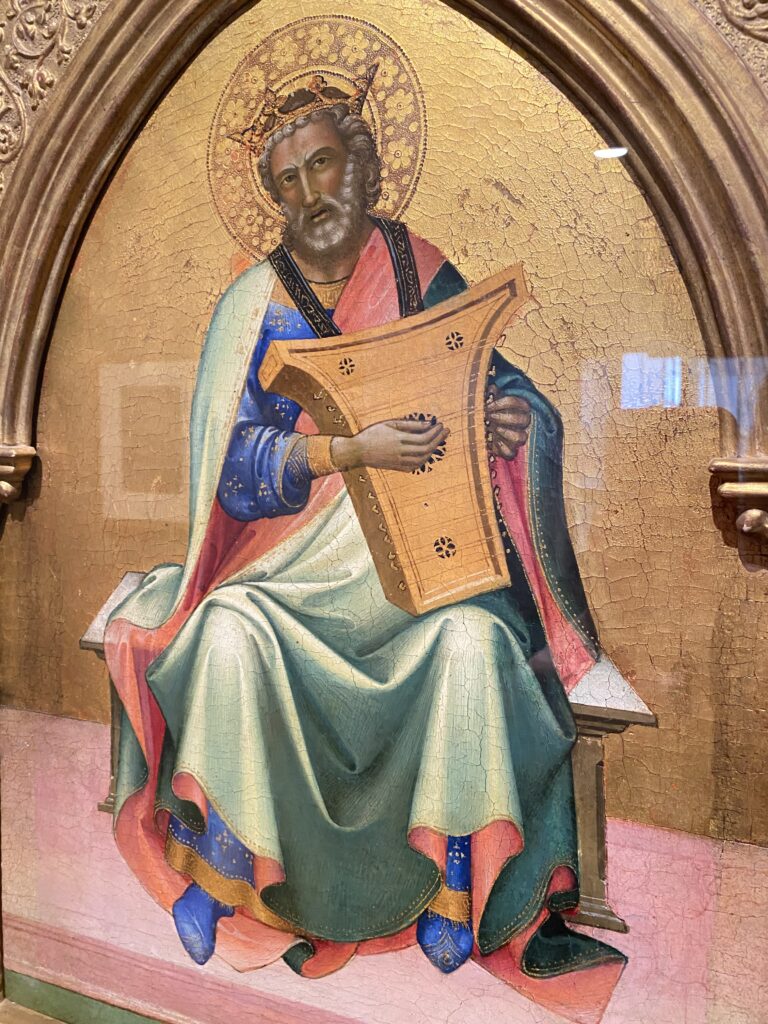
The illustrated Bibles, many from The Morgan Library’s own collection, are exquisitely beautiful.  As the exhibition notes, the Book of Psalms, the most popular book of the Bible, is known as Tehillum, or “Praises,” in Hebrew, and King David is credited as the primary author. The exhibition begins with King David’s composition of the Psalms, or “songs accompanied by stringed instruments” from the Greek “psalmos”. 

“King David as Psalmist” (instrument), 1408-10, by Lorenzo (Piero di Giovanni)

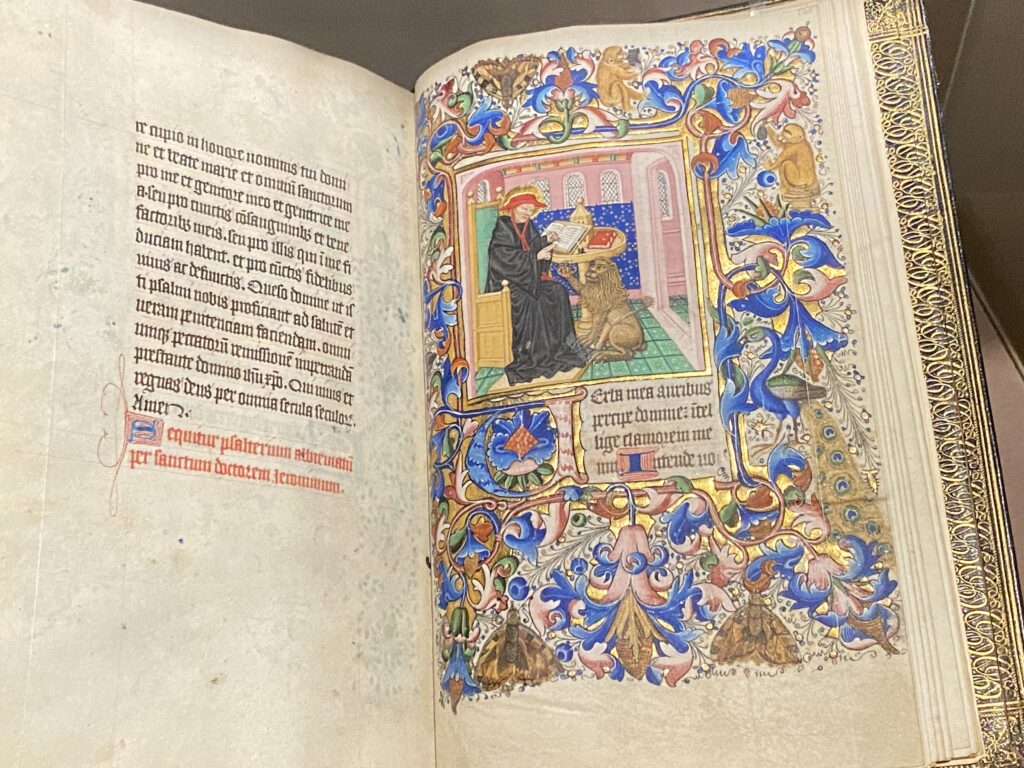
During the Middle Ages, psalters, or books with the 150 psalms, were initially the clergy’s prayerbooks. These promoted literacy and the study of Latin. Priests, monks, friars, and nuns had to recite all the psalms daily. The Book of Hours, customized psalters, were most popular among lay people, or non-clergy. The faithful looked to these prayers for hope, comfort, celebration, and forgiveness. Children had their own psalters, or primers, from which they learned to read.

“[St.] Jerome in His Study,” Book of Hours, in Latin, ca. 1440-50, Fastolf Master, England

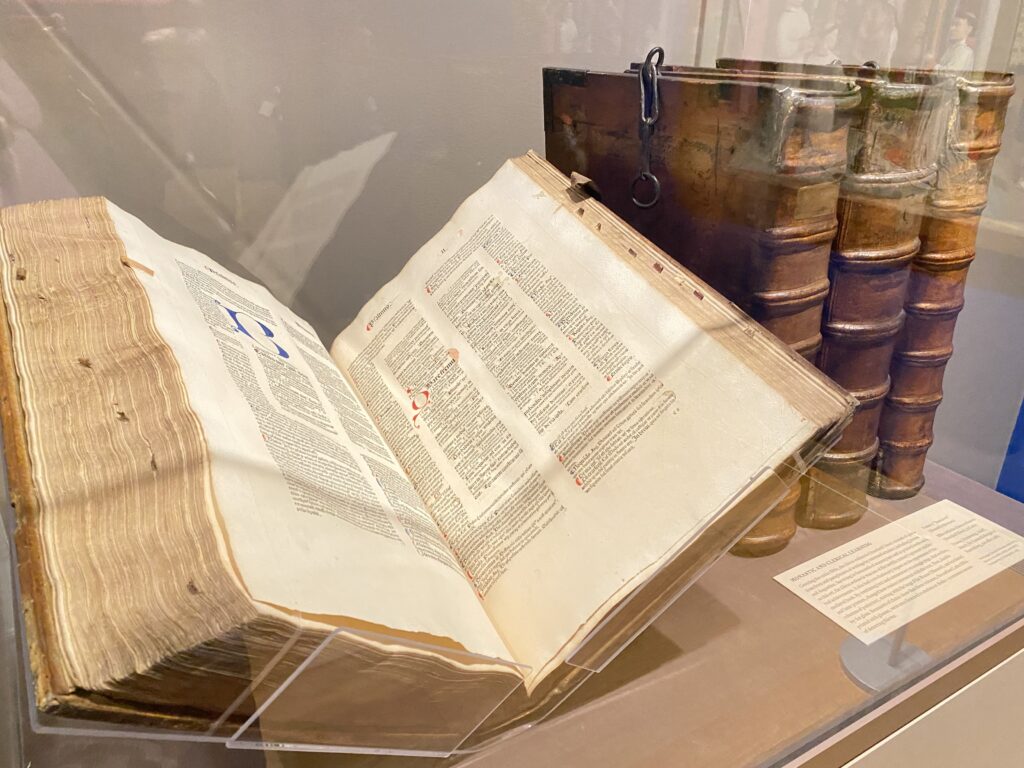
Glossa ordinaria (Standard Gloss), the complete Bible with the writings of Saints Jerome and Augustine, intellectuals and scholars of the Church, before 1480, The Morgan Library, open to Psalm I: “Blessed is the man.”

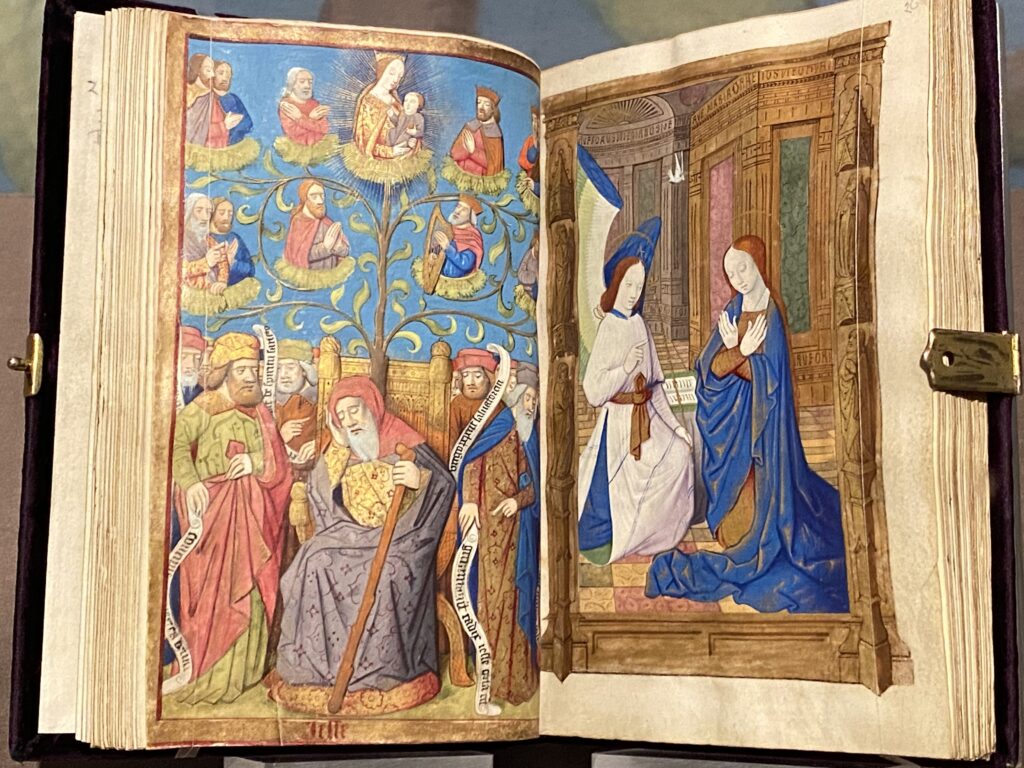
“Tree of Jesse” and “Annunciation,” depicting “David as Ancestor of Christ,” Book of Hours in Latin and French, Robert Boyvin, ca. 1495-1593, France

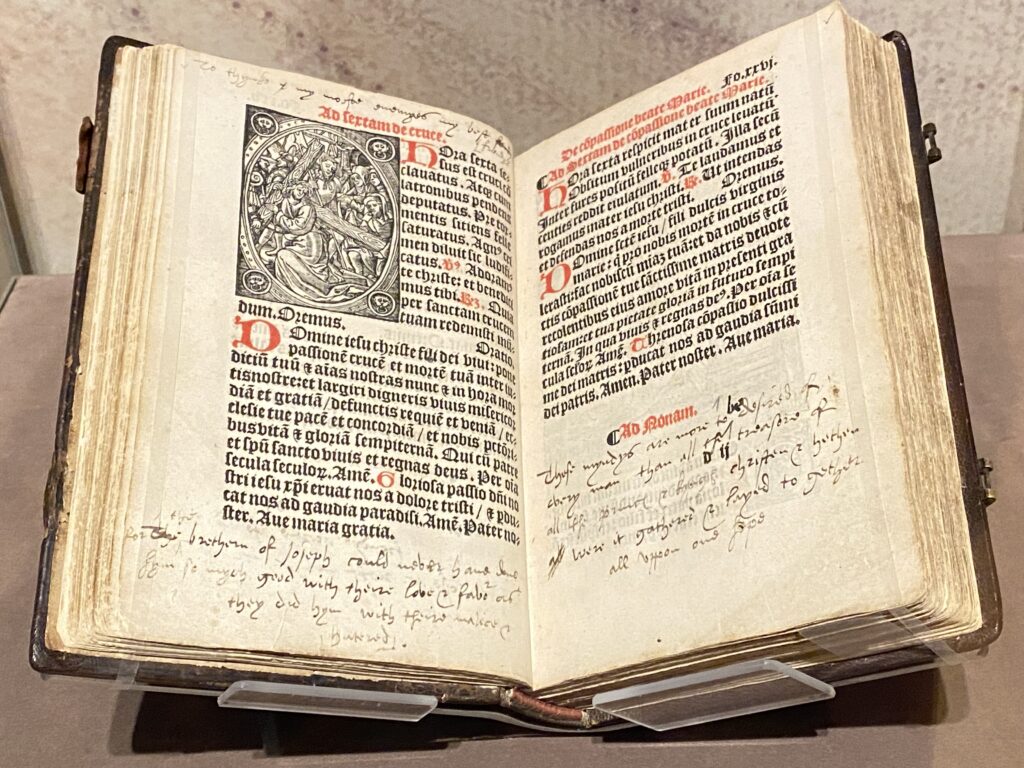
The exhibition concludes with Sir Thomas More’s Book of Hours and Psalter. Visitors can see his handwritten notes in Latin, which are moving to see. As a brief historical note, Sir Thomas More, the respected and beloved clergyman, lawyer, statesman, and humanist, served as the Lord Chancellor to King Henry VIII.  Sir Thomas refused to recognize Henry as Head of the Church, a move intended to facilitate the king’s annulment from Catherine of Aragon, and to break with the Roman Catholic Church and Pope Clement VII. Imprisoned in the Tower of London for well over a year, Sir Thomas was executed and later canonized as a saint. Today, some people may know him from the word “utopia,” which came from his sociological and political satire of the same name; this writing was somewhat out of character, though his motives were always honorable. Below: “To think my most enemies my best friends….,” final verses of “A Godly Meditation,” Francois Regnualt, Book of Hours. 1530, Paris/Franz Birckman, Psalter, 1522, noted below.

For more detail on this period and the beautiful exhibition, enjoy visiting upstairs in the Engelhard Gallery through January 4th, or finding the book in the gift shop.

Other treasures on exhibit are:

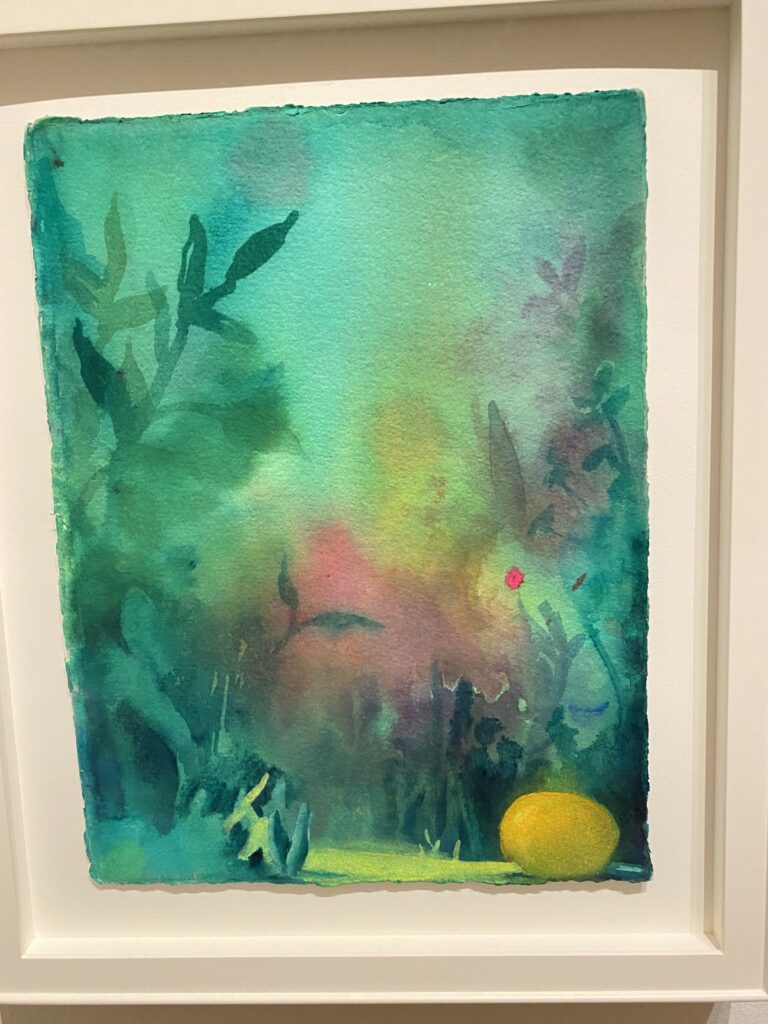
From “Lisa Yuskavage: Drawings”

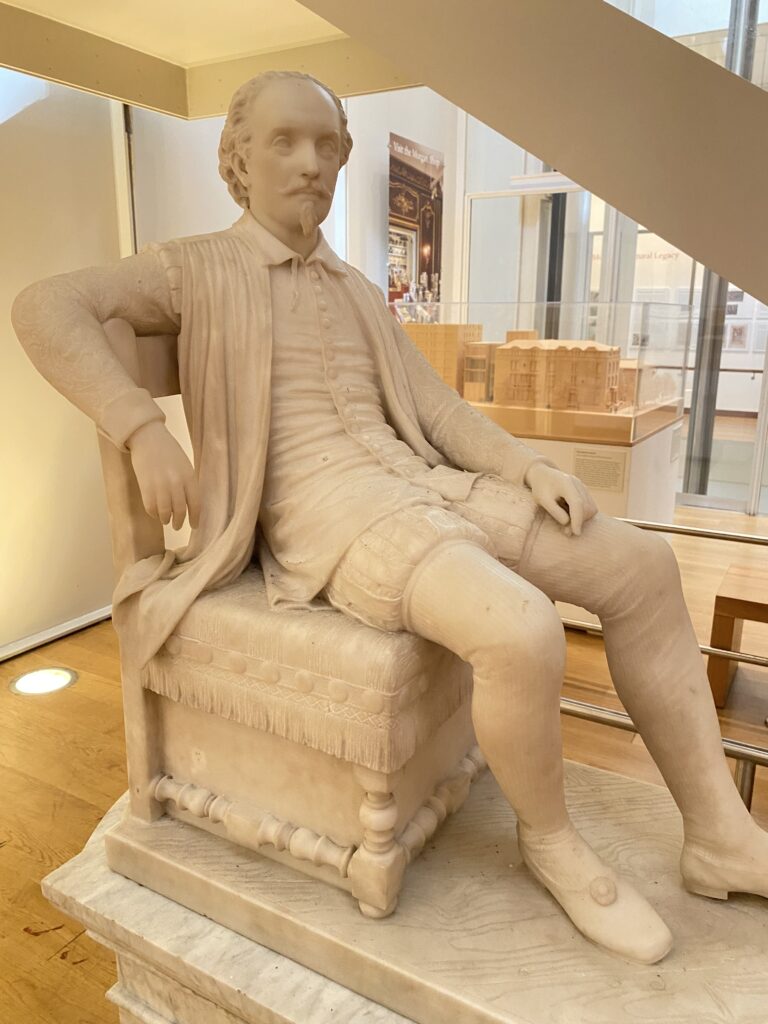
“William Shakespeare, Seated,” 1881, marble, William Wetmore Story, permanent collection

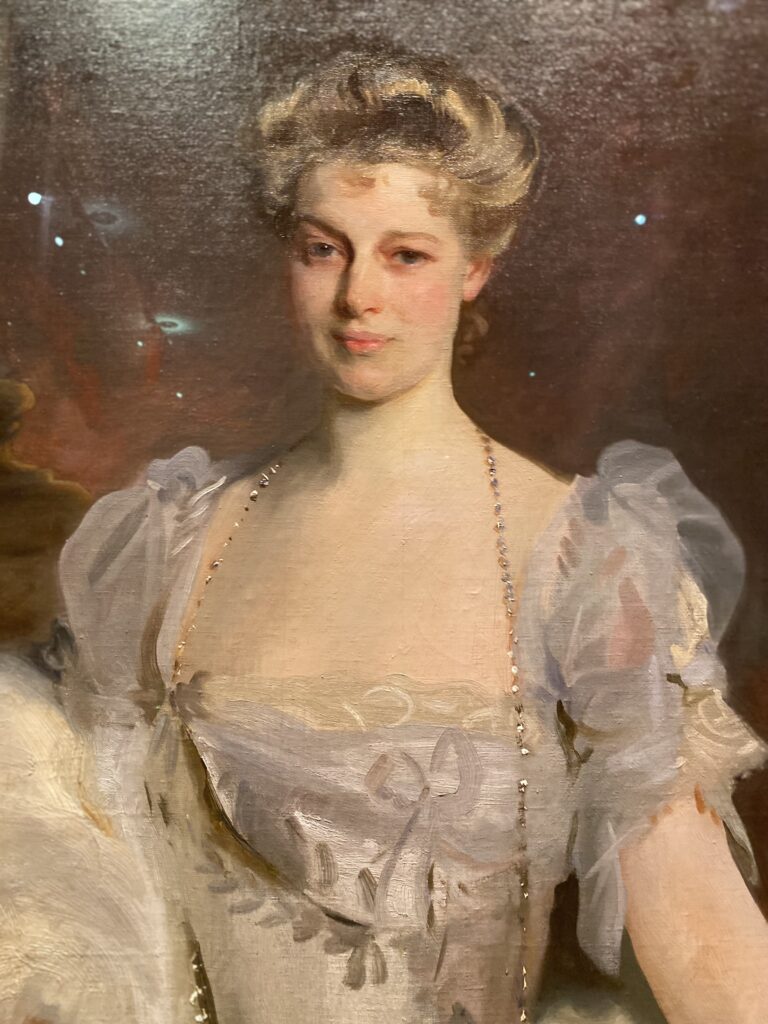
“Jane Norton Grew Morgan,” ca. 1905, oil, by John Singer Sargent, permanent collection. Enjoy another visit to his work via “Travel with John Singer Sargent at the Metropolitan Museum of Art”.

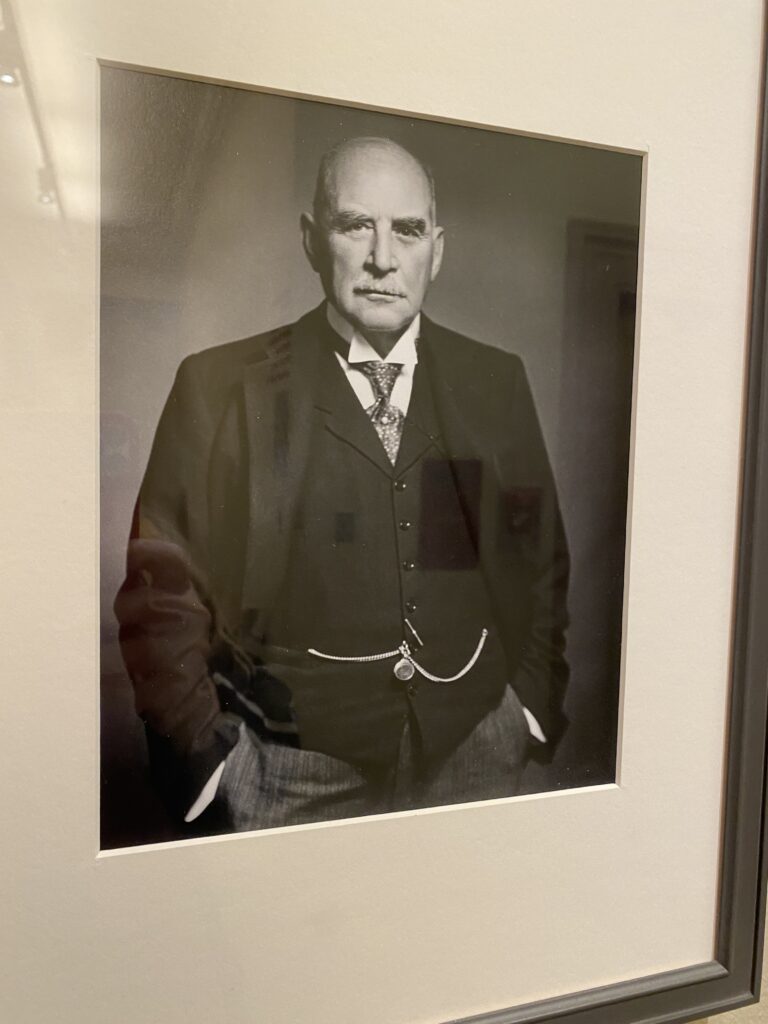
John Pierpont “Jack” Morgan, Jr., ca. 1930 by Fayer of London and Vienna, permanent collection

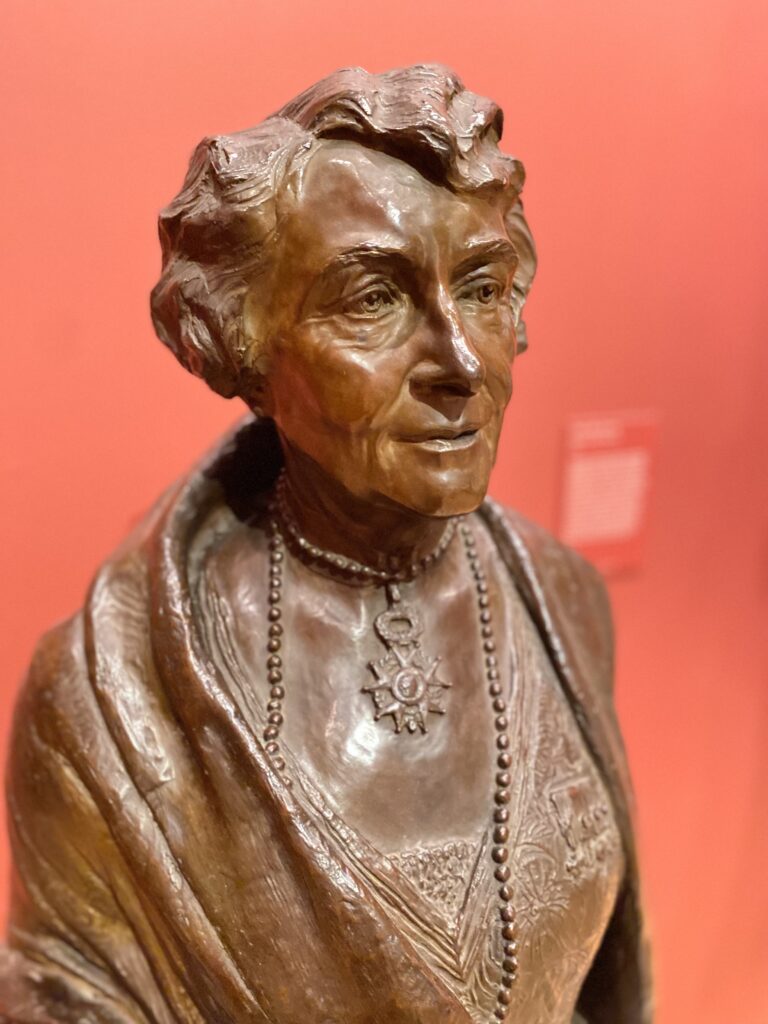
“Bust of Anne Tracy Morgan,” philanthropist and youngest daughter of J.P. Morgan, bronze, 1937, by Malvina Hoffman, permanent collection

Enjoy seeing the beautiful Gilded Age mansion, designed by premier architect Charles McKim of McKim, Mead & White, and appreciating the breathtaking library. Time did not allow for a revisit this time, but that will be the perfect excuse to return and fully appreciate the 2024 renovations, which everyone can appreciate. Free admission for everyone is available Friday evenings from 5-7 p.m.. College students with IDs may enjoy free admission the first Sunday of each month with a reservation. Fellowships and internships are available at times for college students, and for NYC university students, there is a college ambassador program. There are a a number of teen programs (writing challenge, summer reading, and drawing) and teacher resources.

The Morgan is wheelchair accessible and offers wheelchairs and walkers. Additionally, discounted tickets are available.  (Kindly call (212) 685-0008 or email visitorservices@themorgan.org with questions regarding any accommodations.) If visitors plan a longer day at the library, there is an inviting café.

(Sources: The Morgan Library, musee-orsay.com, metmuseum.org, britannica.com, goodreads.com, artinsociety.com, clarkart.edu, openculture.com, 19thc-artworldwide.org, medium.com, nytimes, nationalgallery.org.uk, 19thc-artworldwide.org, apollo-magazine.com, thephilipscollection.org, getty.edu, dailyartmagazine.com, art-renoir.com, adventuresintheprinttrade.blogspot.com, pmc.ncbi.nlm.nih.gov, latimes.org, bbc.co.uk, harvardartmuseums.org, pasonlinelectures.com, galeriemagazine.com, theatlantic.com, theparisreview.org, shop.themorgan.org, amazon.com, legendarte.shop, Wiki)

“Renoir and the Psalms at The Morgan Library” All Rights Reserved ©2025 Kathleen Helen Levey

The Frick Collection: A Splendid Dream

“I dream my painting, and then I paint my dream.” Van Gogh

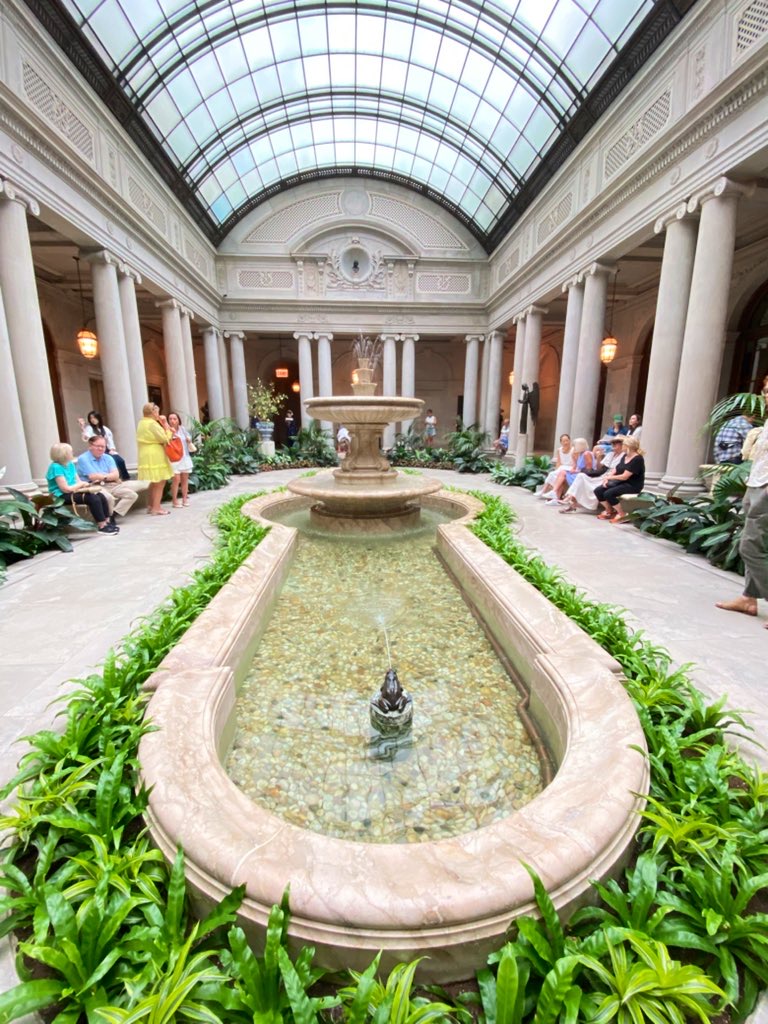
Visiting the newly reopened The Frick Collection is like stepping into an artist’s dream.  After an experience that is wonderous and splendid, one wakes upon leaving, startled by unfiltered daylight and the sounds of the city street.  Putting iPhones away upon entering the museum, a polite requirement for viewing the collection, visitors immerse themselves in the art. The uninterrupted viewing of the artwork, combined with its location in a former home, creates a feeling of intimacy.  Underscoring this intimacy is the exhibition, “Vermeer’s Love Letters” on view only until August 31st.  Comprised of “Woman Writing a Letter, with her Maid,” c.1670, on loan from the National Gallery of Ireland, Dublin, “Mistress and Maid,” ca. 1664-67, The Frick Collection, and “The Love Letter,” c. 1669-1670, on loan from the Rijksmuseum, Amsterdam, the exhibition showcases another art not lost at The Frick.  Vermeer fans will also enjoy “Officer and Laughing Girl,” ca. 1657, and “Girl Interrupted at Her Music,” ca. 1658, in the permanent collection.  

Garden Court designed by John Russell Pope (Visitors may take photos here.)

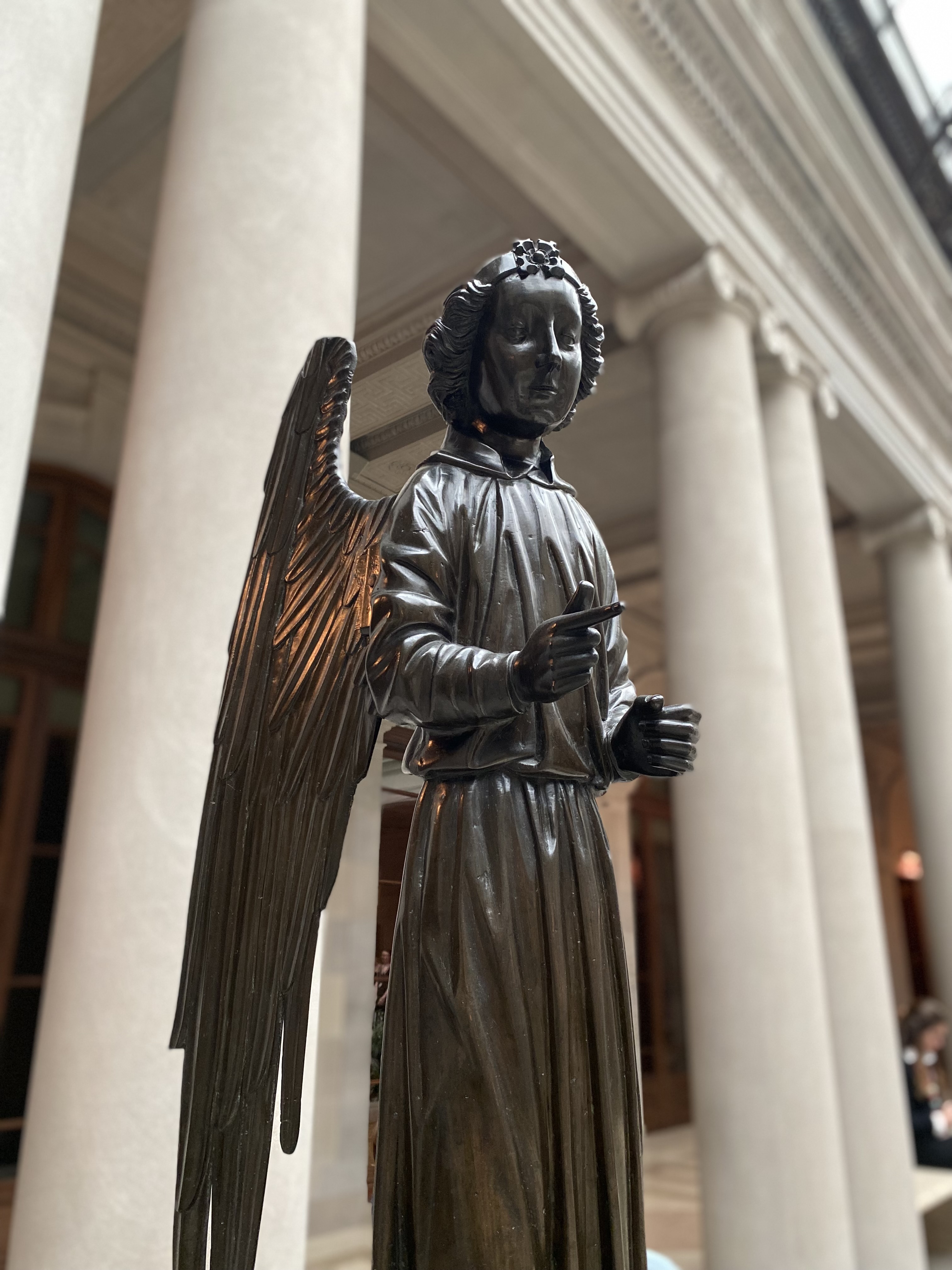
“Angel” by Jean (Jehan) Barbet (France, 16th century)

To truly appreciate such an incredible collection, visitors must return and make it a cornerstone of every visit to New York City.  (What visitors saw before the recent renovation was 25% of the collection; now they can see 47%, a boon for art lovers.) New visitors will be dazzled by the sumptuous décor by English interior designer Charles Allon of White, Allom & Co., primarily on the ground floor, and by Elsie de Wolfe, one of the first American interior designers, mostly on the second floor, which includes ceiling art in the hallway that connects the galleries.  Returning visitors will enjoy the improved lighting and relish ascending the formerly roped staircase to the second floor.  Though the works of Van Gogh have only graced the museum via exhibitions, the quote was irresistible.  Still, the artists’ works on view are beyond imagination (noted in order via “Featured Artists” from The Frick): Bellini, Carreira, van Dyck, Fragonard, Goya, El Greco, Ingres, Monet, Rembrandt, Titian, Turner, and Vermeer.  (If visitors are able to turn their gaze away from the paintings, the beautiful Sevres porcelain, antique clocks, and Chinese vases are a few of the other exquisite treasures.)  As a complement to the Old Master works, highlights of drawings from the collection are on view through August 11th, and Vladimir Kanevsky’s porcelain floral art, commissioned by the museum, is on view until Nov. 17th.

View along Fifth Avenue with a hint of the elevated garden


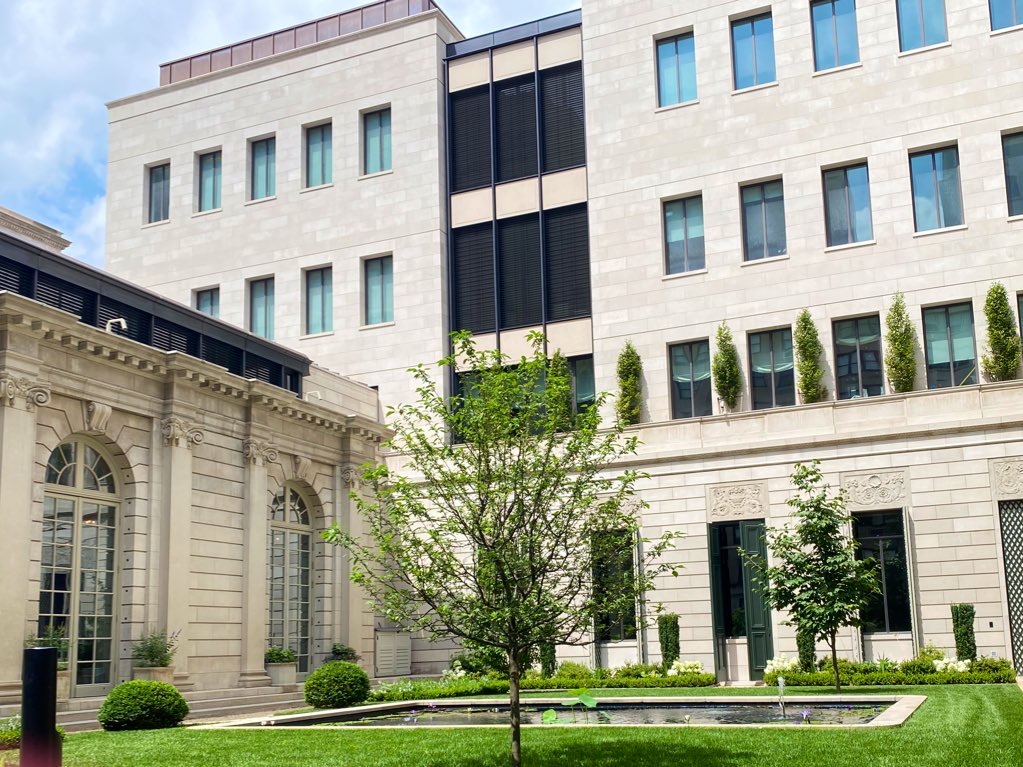
Partial views of the Russell Page Garden along East 70th Street

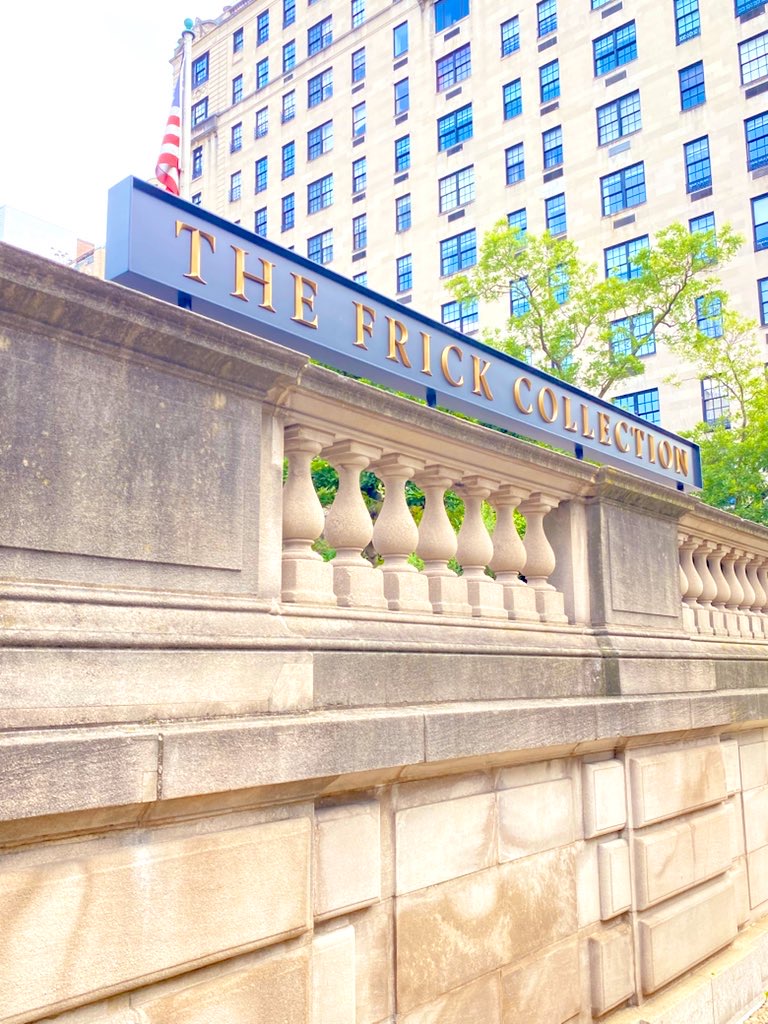
The building that houses the collection is magnificent.  The three-story Gilded Age Beaux Arts mansion with its limestone facades was originally the home of collector Henry Clay Frick and, strikingly, fills a city block.  At various times, premier architects have created, expanded, and renovated the building which include the original architect Thomas Hastings of Carrere and Hastings, 1912-1914, and John Russell Pope, who converted the home to a museum with the addition of the entrance, the Garden Court (formerly the carriage pavilion and where visitors may take photos), and The Frick Research Library, all in 1935, when Frederick Olmsted, Jr. updated the elevated the garden that elegantly sets the building back from the street and complements the serenity of his father and Calvert Vaux’s Central Park across Fifth Avenue.  In 1977, the museum added a pavilion and another garden with a rectangular pool along East 70th Street, designed by Russell Page OBE. Annabelle Selldorf of Selldorf Architects designed the most recent renovations, which included enhancing the galleries, creating an auditorium, and adding a cafe and gift shop. Beyer Blinder Belle assisted with the historic preservation. Both the mansion and Frick Research Library are New York City and National Historic Landmarks.

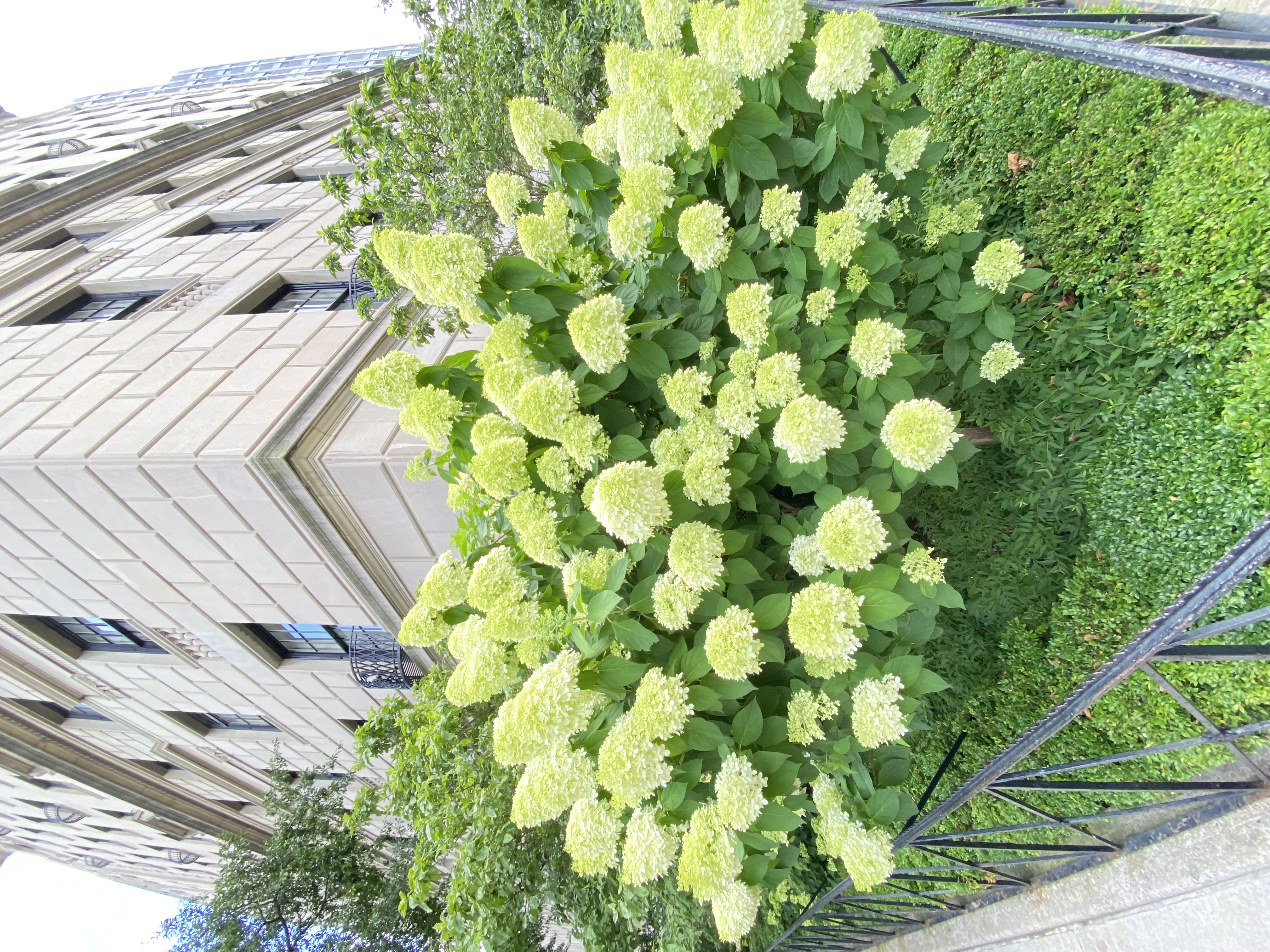
Blooming hydrangeas on the Upper East Side near The Frick

The friendly and professional staff members, who are proud to share such a treasure, warmly welcome visitors, which was a lovely part of the visit. A courteous guard explained to a surprised visitor that people sometimes try to touch the art, especially Mr. Kanevsky’s lifelike flowers. Though most of the visitors seemed awed, delighted, and considerate, kudos to the staff for their patience as this surely happens.

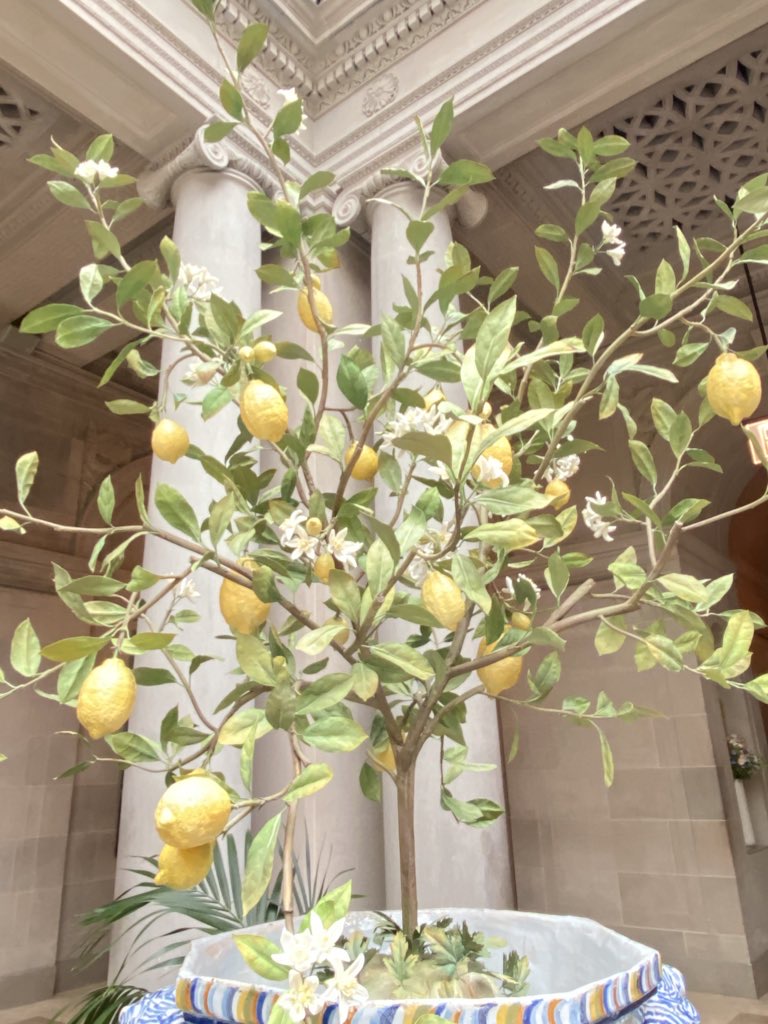
“Lemon Tree” by Vladimir Kanevsky in the Garden Court

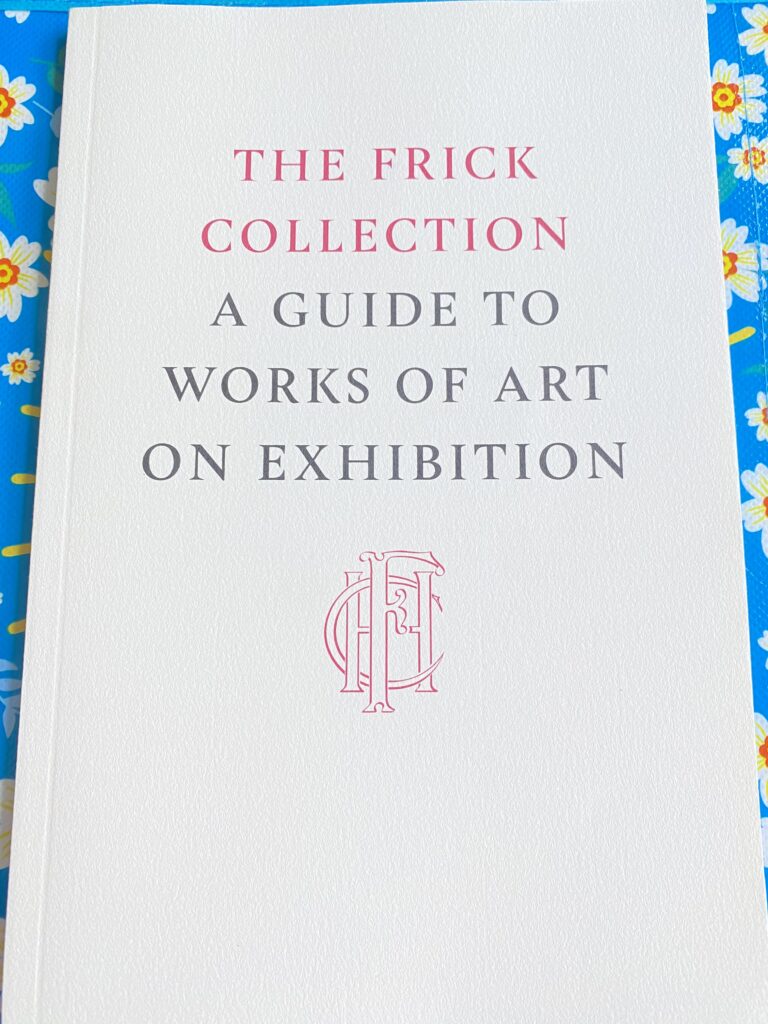
Some logistics: Visitors must reserve timed tickets to view the galleries which have accessibility for most types of wheelchairs.  (Discounted tickets are available for visitors 10-18, those with disabilities, seniors, and students with valid IDs. Admission is free for care partners and active military with valid IDs. Note: Visitors must be over 10.)  Memberships may interest repeat visitors, and donations are always welcome.  The art does not have labels, but the museum offers a $5 guide (which has a new book smell) that may be purchased along with tickets, or visitors may enjoy an audio tour via Bloomberg Connects.  (My first tour was with a wonderful teacher and friend who suggested a visit; the website offers audio for some artwork, helpful for teaching and study, and tours are available for class trips.) Some discounts are available, particularly on Wednesdays from 1:30 to 5:30, when admission is “pay-as-you-wish” with programs that are open to the public.  A charming new café, “Westmoreland,” named after Henry Clay Frick’s Pullman car, and a shop complement the experience.  Students and faculty with valid IDs from the City University of New York, the Fashion Institute of Technology, New York University, and Pratt Institute may receive two complimentary tickets. To visit the Frick Art Research Library, first-time visitors must register. 

Much beloved, the Frick Collection initially sparked debate over its renovation, but with different perspectives coalescing, the result is a harmonious and inviting city oasis.

(Sources: frick.org, nypost.com, newsart.net.com, artnews.com, www.tclf.org, nps.gov)

“The Frick Collection: A Splendid Dream” All Rights Reserved ©2025 Kathleen Helen Levey

Highlights from “Superfine: Tailoring Black Style” at the Metropolitan Museum of Art

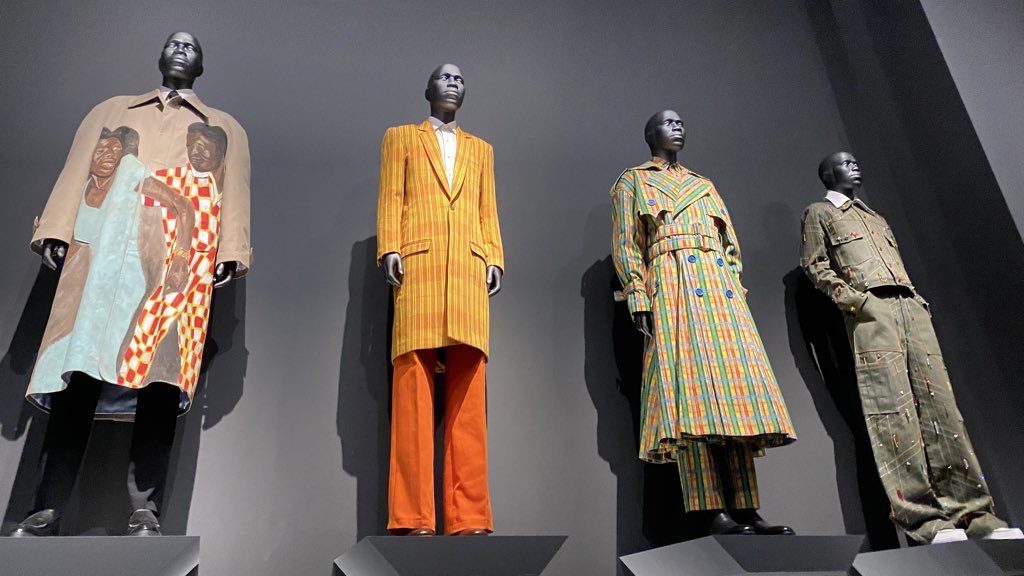
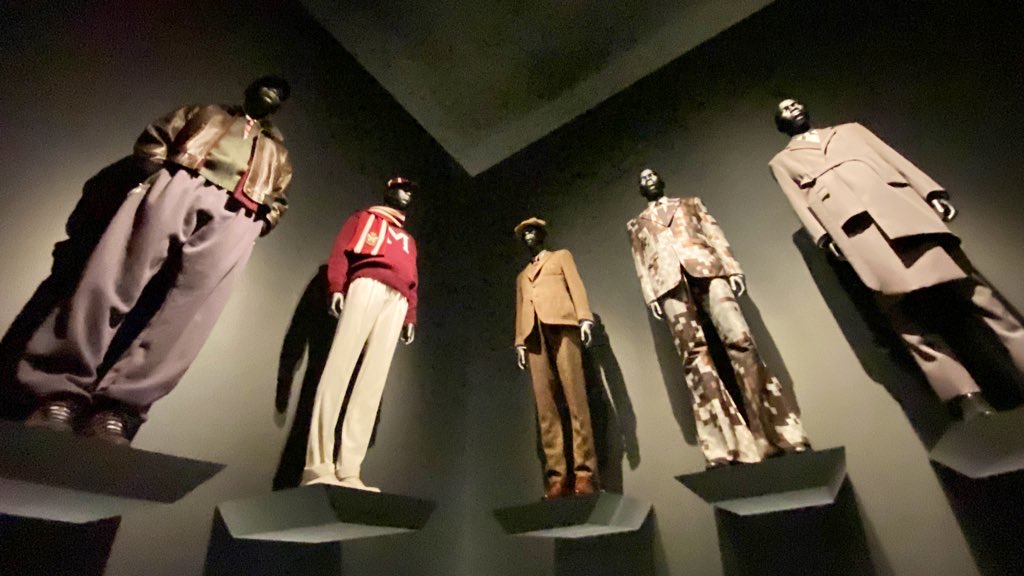
Enjoy seeing “Superfine: Tailoring Black Style,” this year’s exhibition of the Costume Institute of the Metropolitan Museum of Art, through October 26th. The exhibition examines Black style over a 300-year period via dandyism, a fusion of African and European styles, and how style has contributed to the development of Black identity.  The exhibit defines a dandy as a person who “studies above everything else to dress elegantly and fashionably”. Zora Neale Hurston’s essay “Characteristics of Negro Expression” (1936) was the springboard for the twelve sections, or aspects, of dandyism that the exhibition presents. Following are a few highlights:

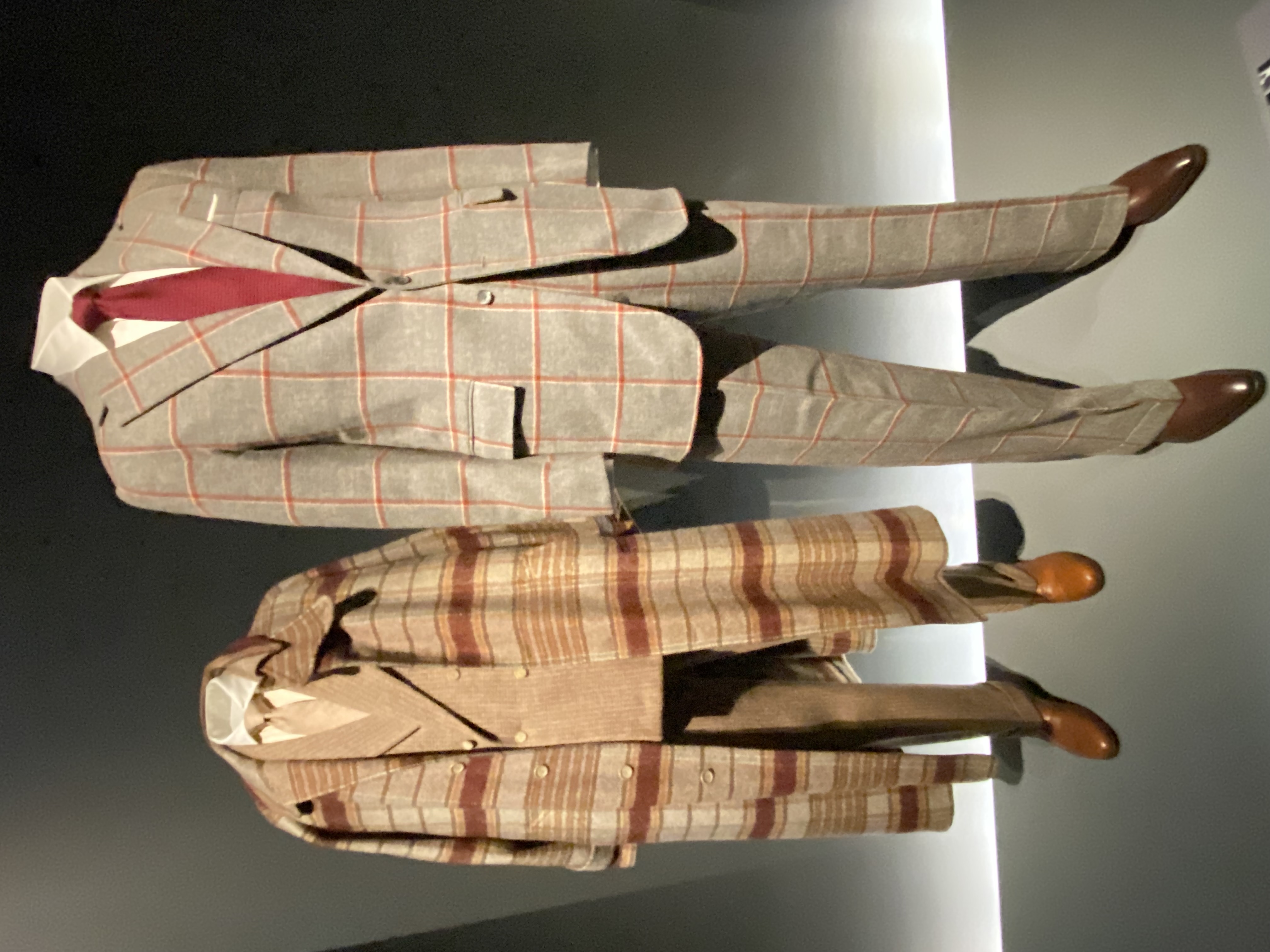
A Jeffrey Banks Ensemble [1980’s] and suit for Andre Leon Talley, “fashion icon,” “creative director and editor at large at ‘Vogue,’ and Paris bureau chief of ‘Women’s Wear Daily'” by Morty Sills (1986), the latter “bespoke tailor” mentioned in the film “Wall Street”:

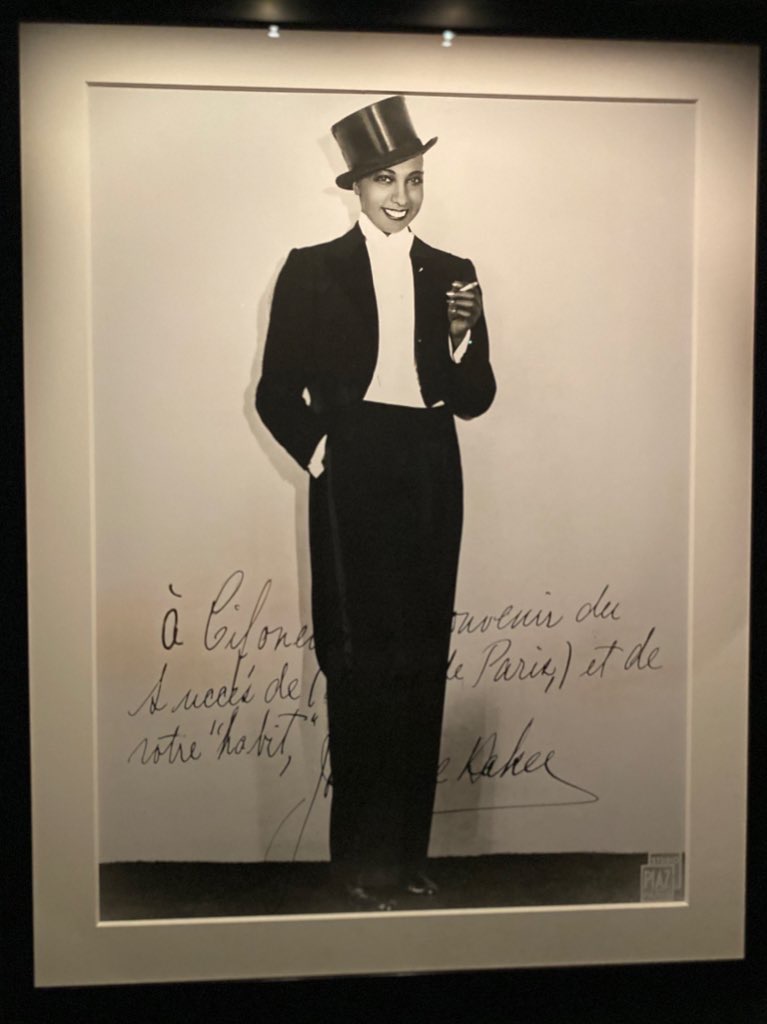
Josephine Baker portrait by Teddy Piaz (1932) in a tailless tuxedo by Arturo Cifonelli; Ms. Baker, who fought in the French Resistance and wore a Free French uniform at the March on Washington with Dr. King, was the first Black woman inducted into the Pantheon with France’s other military heroes:

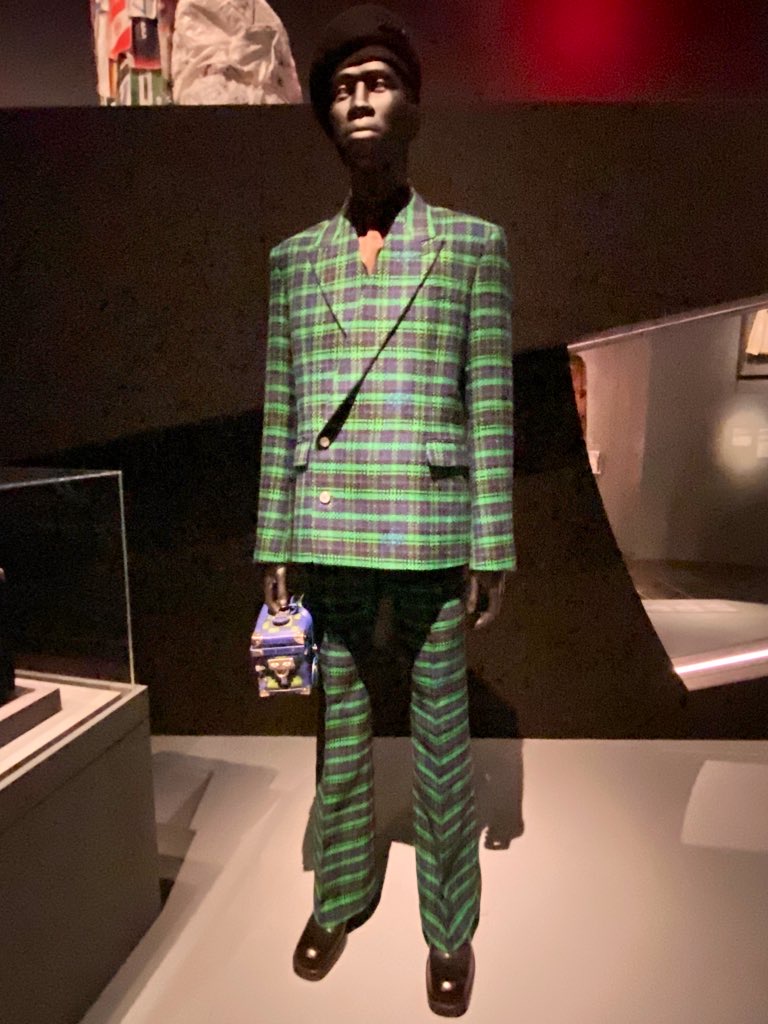
Louis Vuitton Ensemble by Pharrell Williams (2025), inspired by the Air Afrique uniforms revived in a collective by Lamine Diaoune; Air Afrique, with stylish uniforms by Dior, supported African art, films, and fashion, was an airline founded by eleven decolonized African countries in 1961 to promote “intra-African travel and culture development”:

“Tailcoat worn by Grace Jones” by Jean Paul Gaultier (2011-12) at the annual amfAR Inspiration Gala in Brazil in 2012.  Ms Jones collaborated with both Mr. Gaultier and headwear designer Philip Treacy:

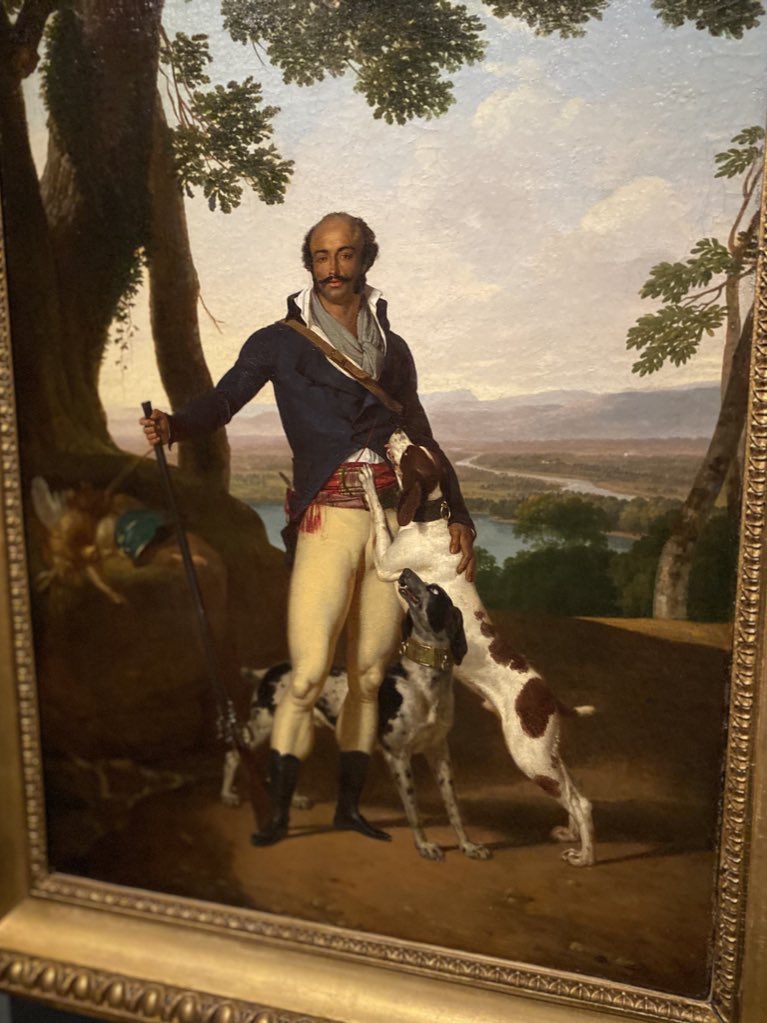
“Portrait of Thomas-Alexandre Dumas,” (1801), by Louis Gauffler depicts the father of the novelist Alexader Dumas; Thomas-Alexandre, son of a marquis and a mother who was a slave in Saint-Domingue (Haiti), he was the first Black to rise to the rank of General-in-Chief of the French Army; his imprisonment in a dungeon during part of the French Revolutionary War inspired “The Count of Monte Cristo”:

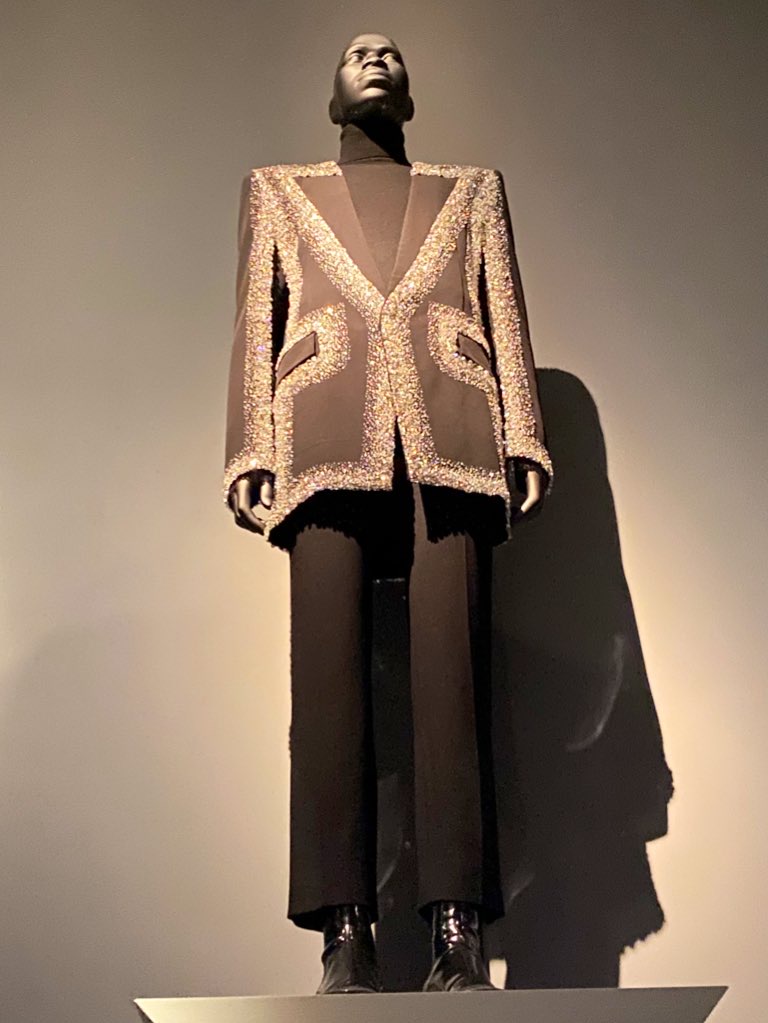
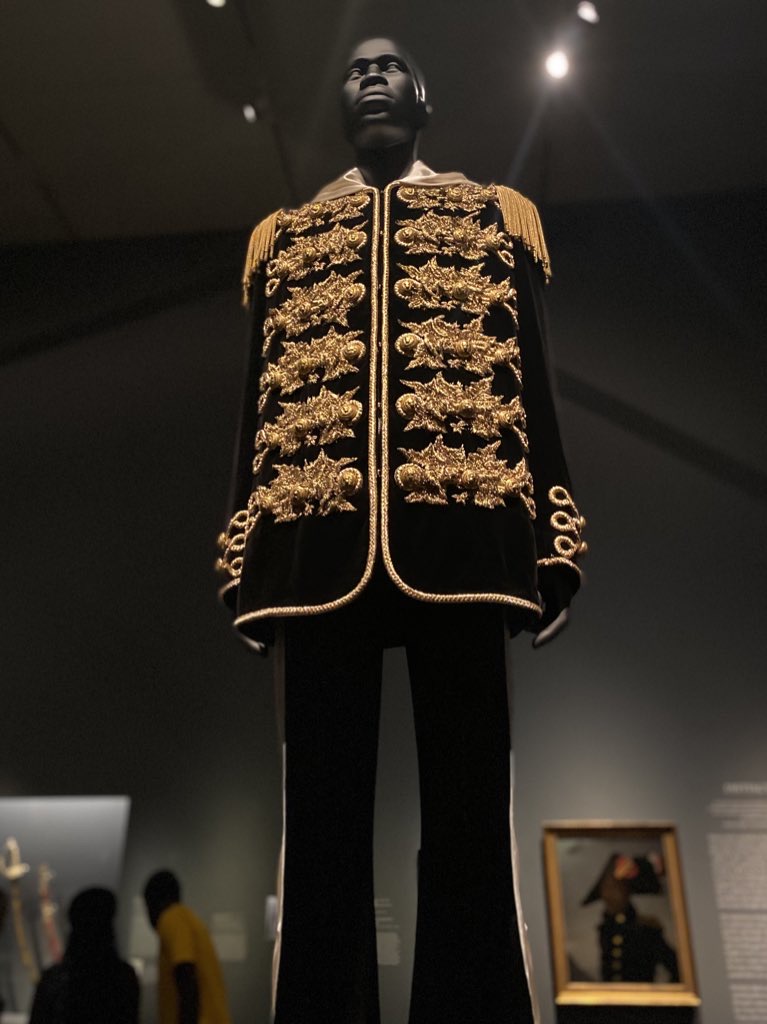
House of Balmain Ensemble by Olivier Rousteing (2023), black velvet coat with gold metallic braid embroidered with pearls and crystals inspired by a 19th-century French cavalry jacket paired with black track pants; Mr. Rousteing refers to those who wear and admire his clothes as “Balmain’s Army”:

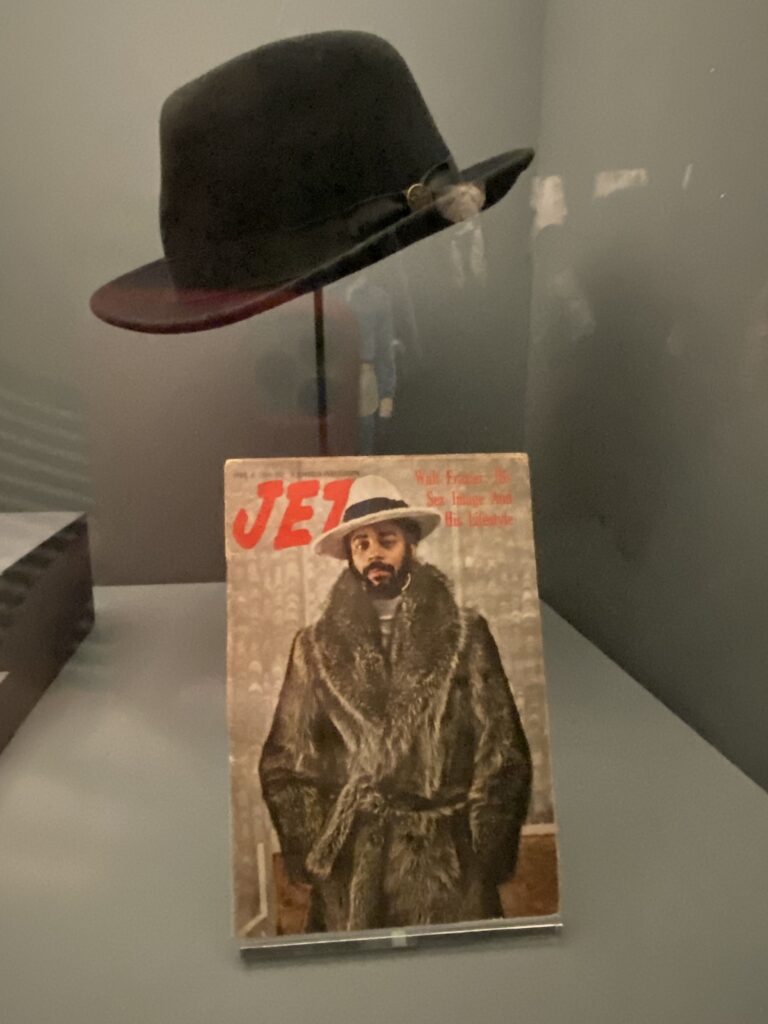
Hat worn by Walt Frazier (ca. 2010) and ‘Jet’ magazine cover (1974); Mr. Frazier’s nickname “Clyde” came from the fedoras he wore that were reminiscent of Warren Beatty’s from ‘Bonnie & Clyde’; Mr. Frazier developed the Clyde line of sneakers with PUMA, still popular today.

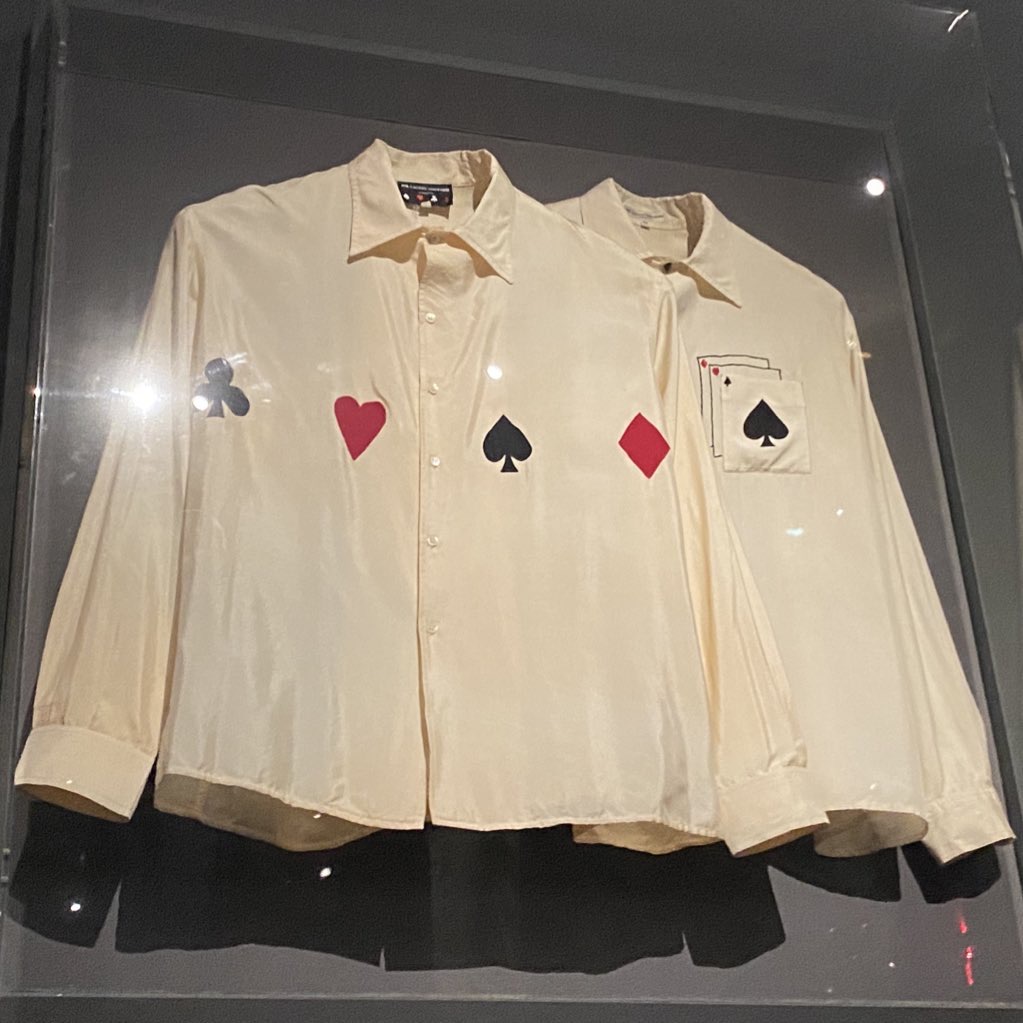
Silk shirts by Joe Casely-Hayford OBE [1980’s], part of a series from the renowned tailor for whom the British Fashion Council Foundation have established a scholarship with Casely-Hayford. (britishfashioncouncil.co.uk):

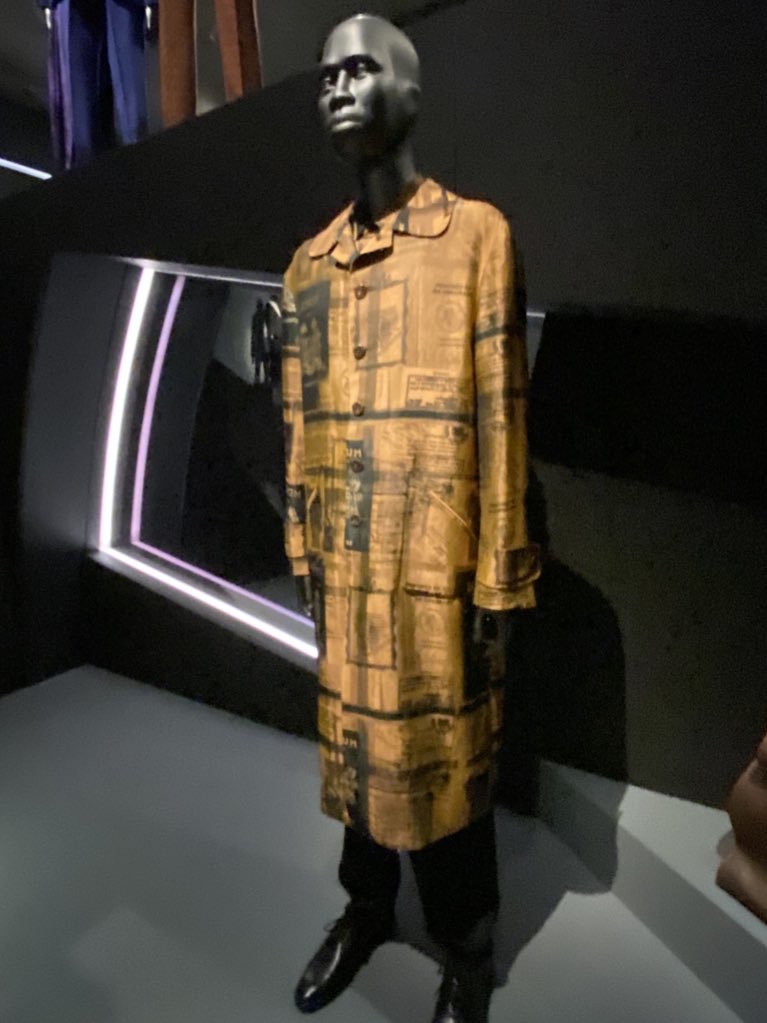
“Maya Angelou Passport Ensemble” (2023-24) from LABRUM London by Foday Dumbaya, which represents Mr. Dumbaya’s immigration journey from Sierra Leone to London; inspired by Ms. Angelou’s ‘Passports to Understanding’ essay in “Wouldn’t Take Nothing from My Journey Now” (1993):

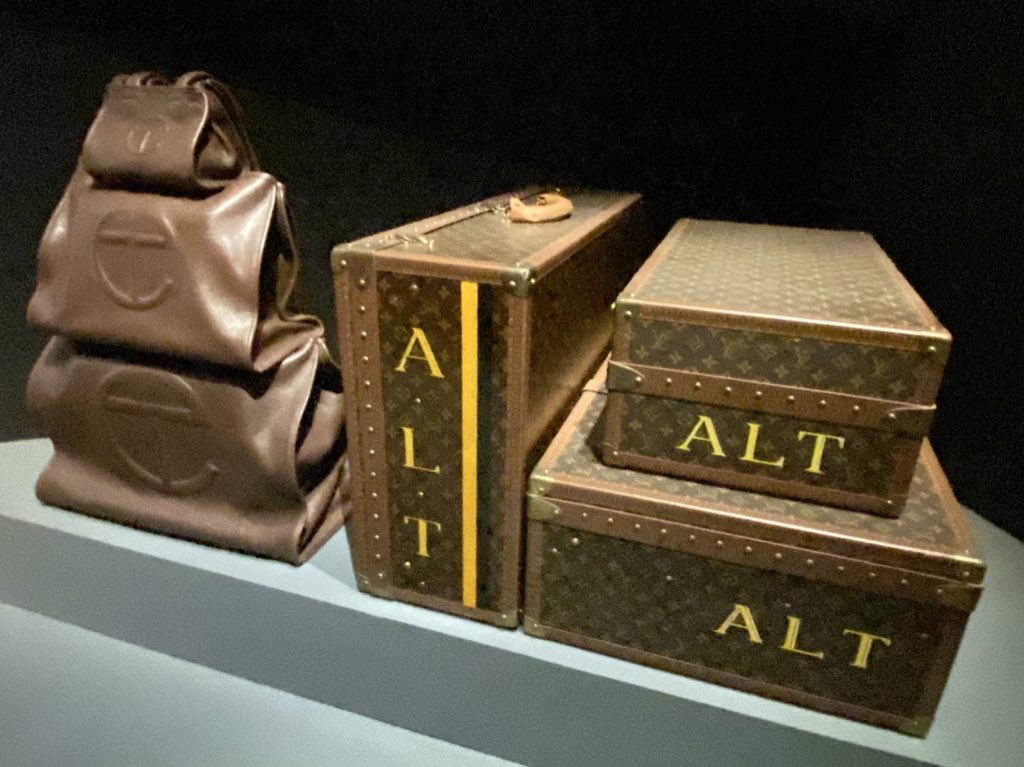
Andre Leon Talley Louis Vuitton trunks (1990) – The possession of luggage represents freedom and prosperity:

Guest curator and Barnard College professor Moncia L. Miller, author of “Slaves to Fashion: Black Dandyism and the Styling of Black Diasporic Identity,” wrote the labels for the exhibition. Funding is by Luis Vuitton with “Instagram, the Hobson/Lucas Family Foundation, Africa Fashion International, founded by Dr. Precious Moloi-Motsepe, The Perry Foundation, and Conde Nast”.

Some of the tailors and designers from or relevant to the exhibition, like Charlie Casely-Hayford, the son of Joe Casely-Hayford, shared their interpretations of dandyism for attendees of this year’s Met Gala.

Music in the Instagram post @kathleenhelenlevey: “Take the ‘A’ Train” by Duke Ellington and Billy Strayhorn. (Additional sources: Met Museum, apnews.com, vogue.com, nytimes, wiki, Andre Leon Talley @andreltalley, americainclass.org/RutgersU/Cheryl Wall, 1997, essence.com, casely-hayford.com, rolfpotts.com, esquire.com, barnard.edu, isac.uchicago.edu/museum-exhibit, @chrisroyerscollections IG, monacolife.net, airmail.news, amazon.com, us.puma.com)

“Highlights from ‘Superfine: Tailoring Black Style’ at the Metropolitan Museum of Art” All Rights Reserved ©2025 Kathleen Helen Levey

Travel with John Singer Sargent at the Metropolitan Museum of Art

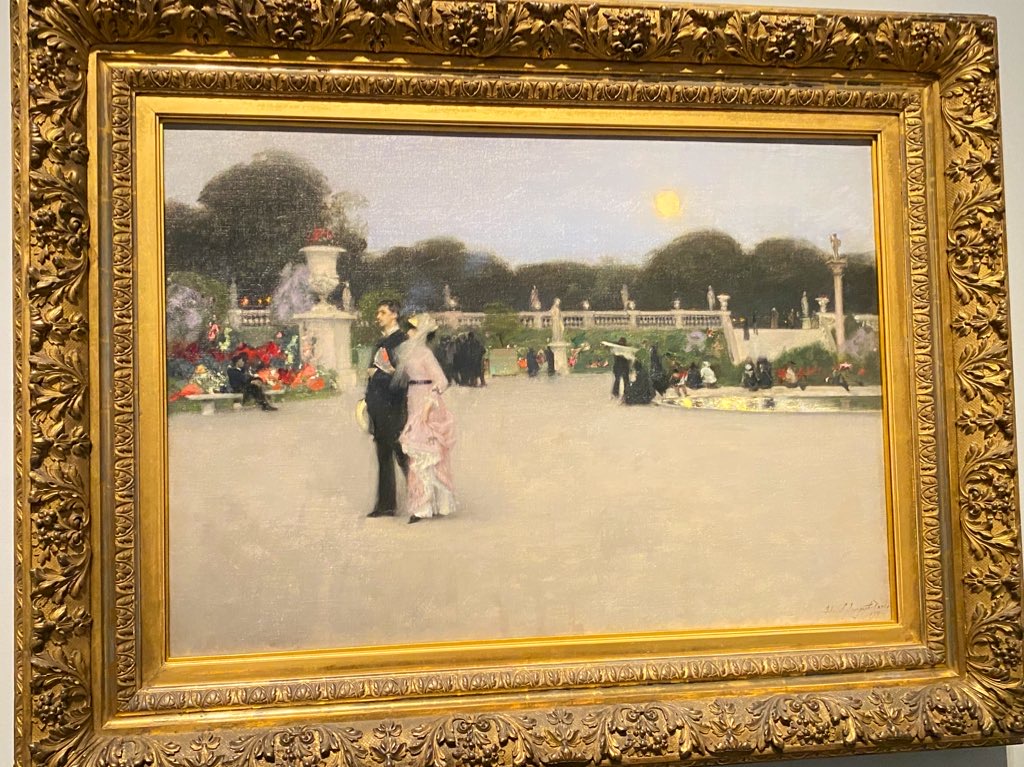
“In the Luxembourg Gardens”

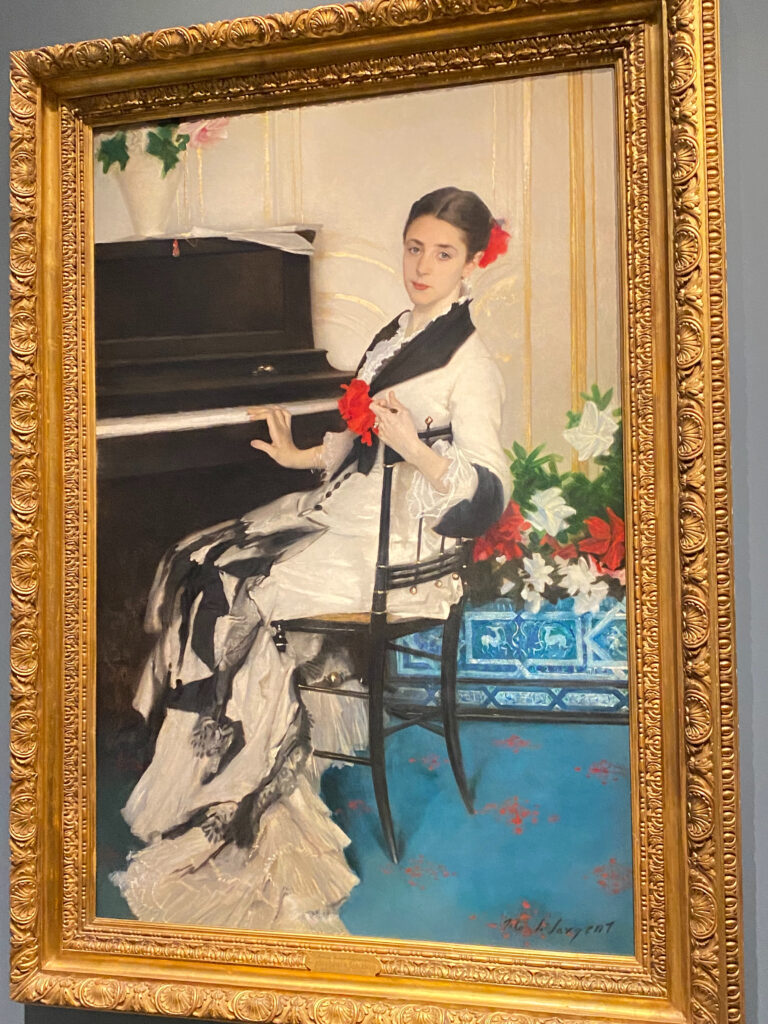
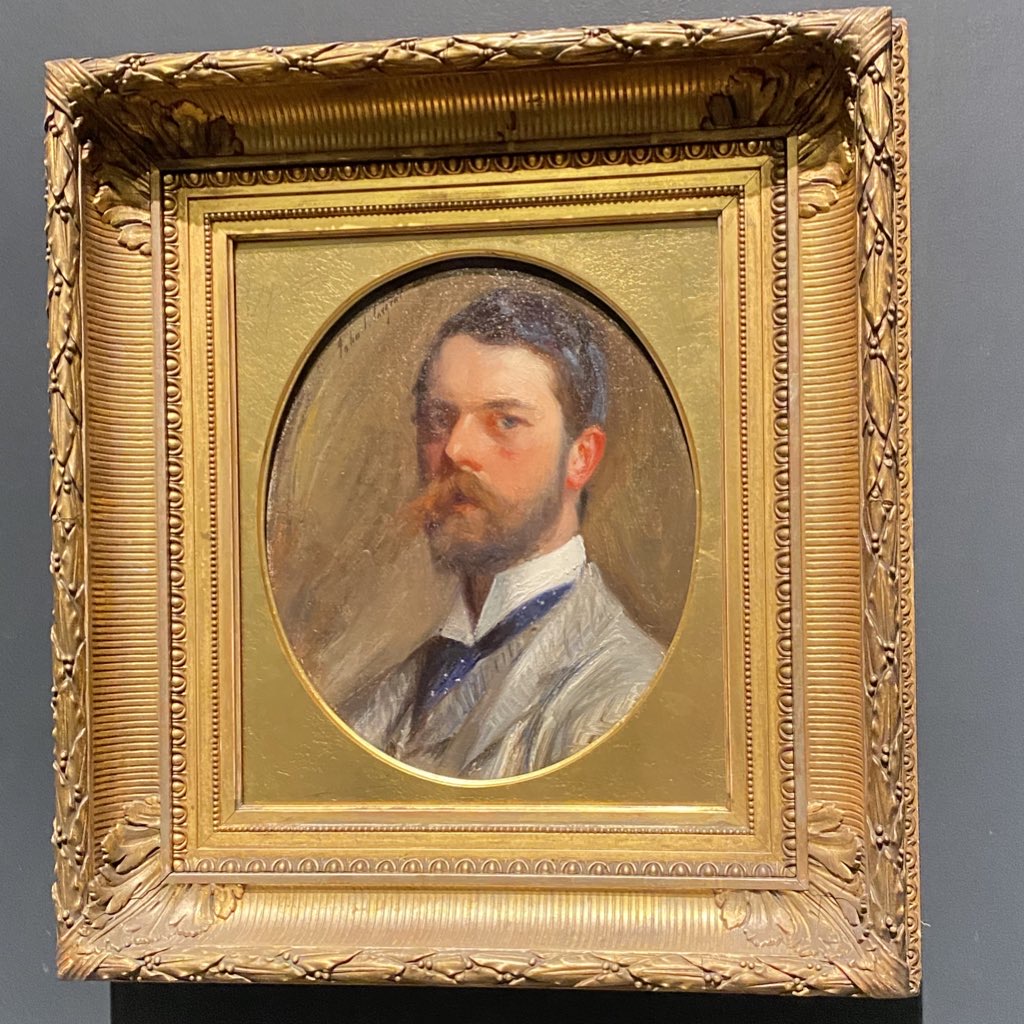
Enjoy seeing the splendid “Sargent and Paris,” 1874-1884, at the Metropolitan Museum of Art, New York through August 3rd. The early paintings of the American expatriate, who spoke several languages and was an accomplished pianist, reveal not only his brilliance but the genuine friendships he had with his patrons and fellow artists with whom he exchanged works as gifts and who praised his work publicly as he did theirs. The world traveler had a natural curiosity about people, their lives, and cultures. He mastered Realism, though he showed skillful use of Impression. Well-known for his portraiture, he painted murals in later years.

Following are a few highlights of the exhibition:

“Madame Ramon Subercaseaux,” wife of his friend Ramon Subercaseaux, Chilean diplomat and artist

A self-portrait at age 30

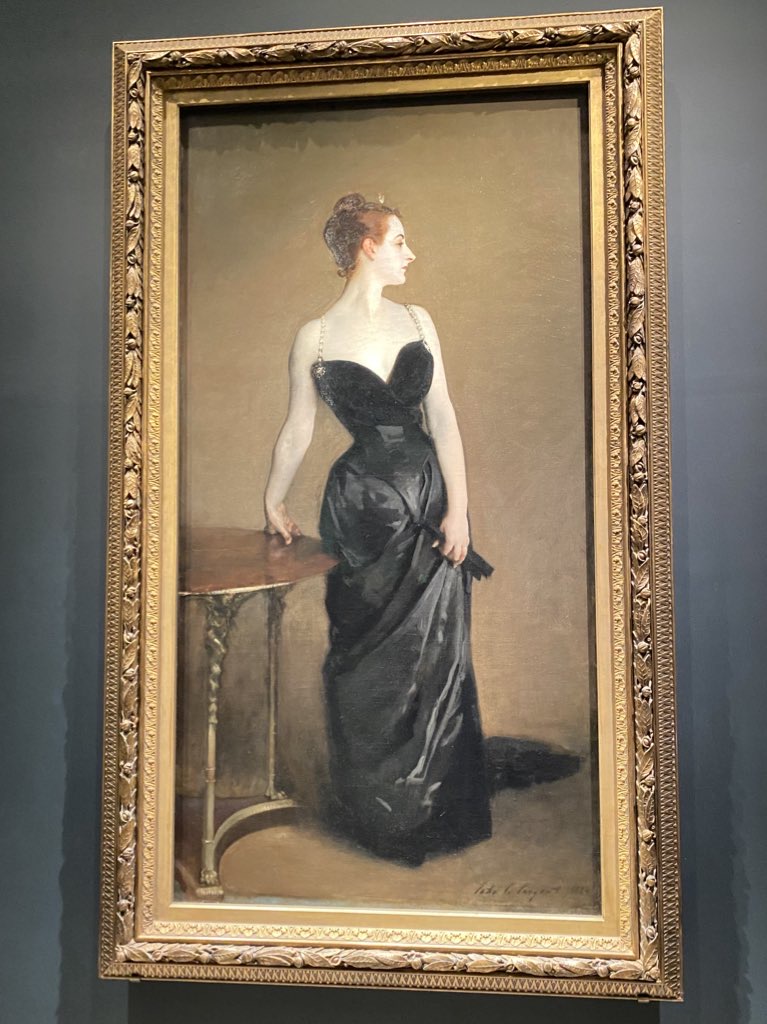
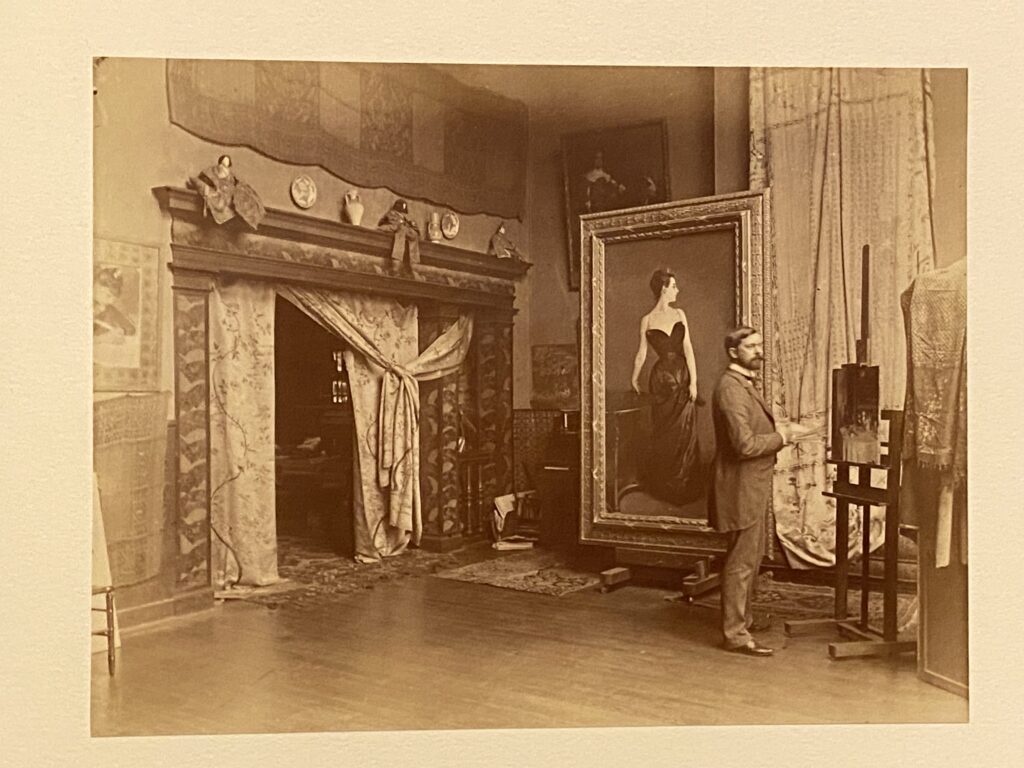
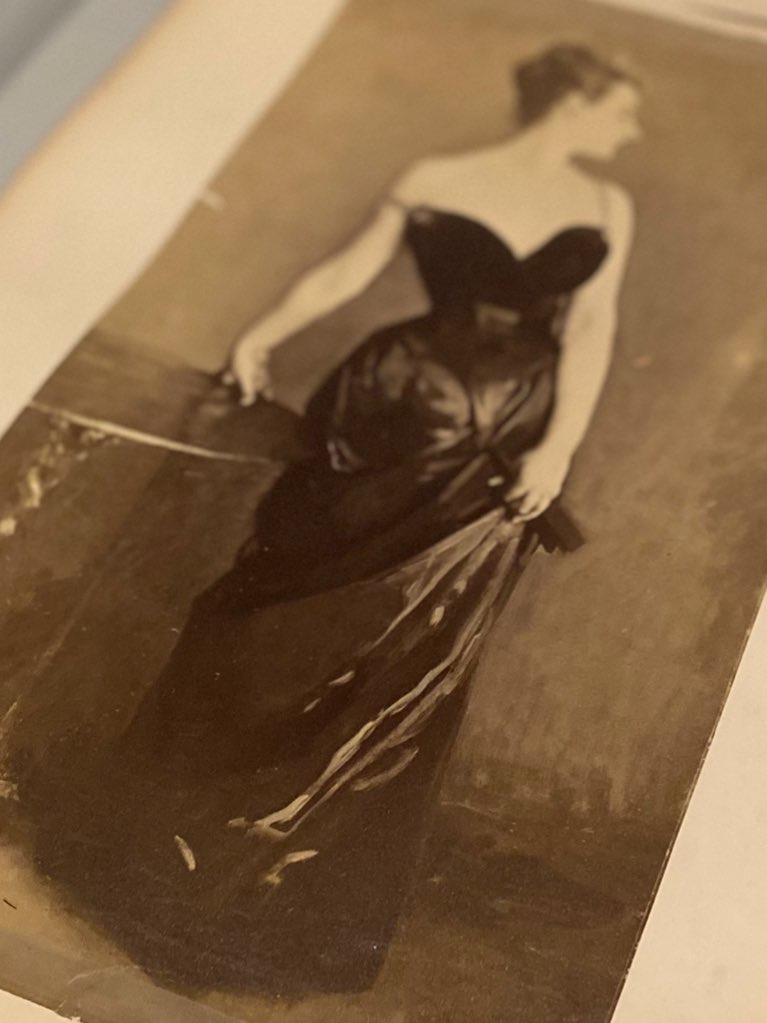
The initially scandalous and later renowned “Portrait of Madame X”: John Singer Sargent excelled at depicting society women with great elegance. Subjects usually sought him out; in this instance, he pursued the renowned beauty American-born socialite Virginie Amelie Avegno Gautreau, who had married a prominent French banker. Initially, the right shoulder strap of the gown was down in the portrait, but this, combined with so much exposed skin, i.e., no evening gloves, created a scandal. The artist repainted a raised strap, but his subject rejected it. Mr. Sargent left for London and took the portrait with him. John Singer Sargent was confident that this was his best work, and his loyal friends supported him.

The artist in the studio

Photo of Virginie Amelie Avegno Gautreau with the gown’s strap down

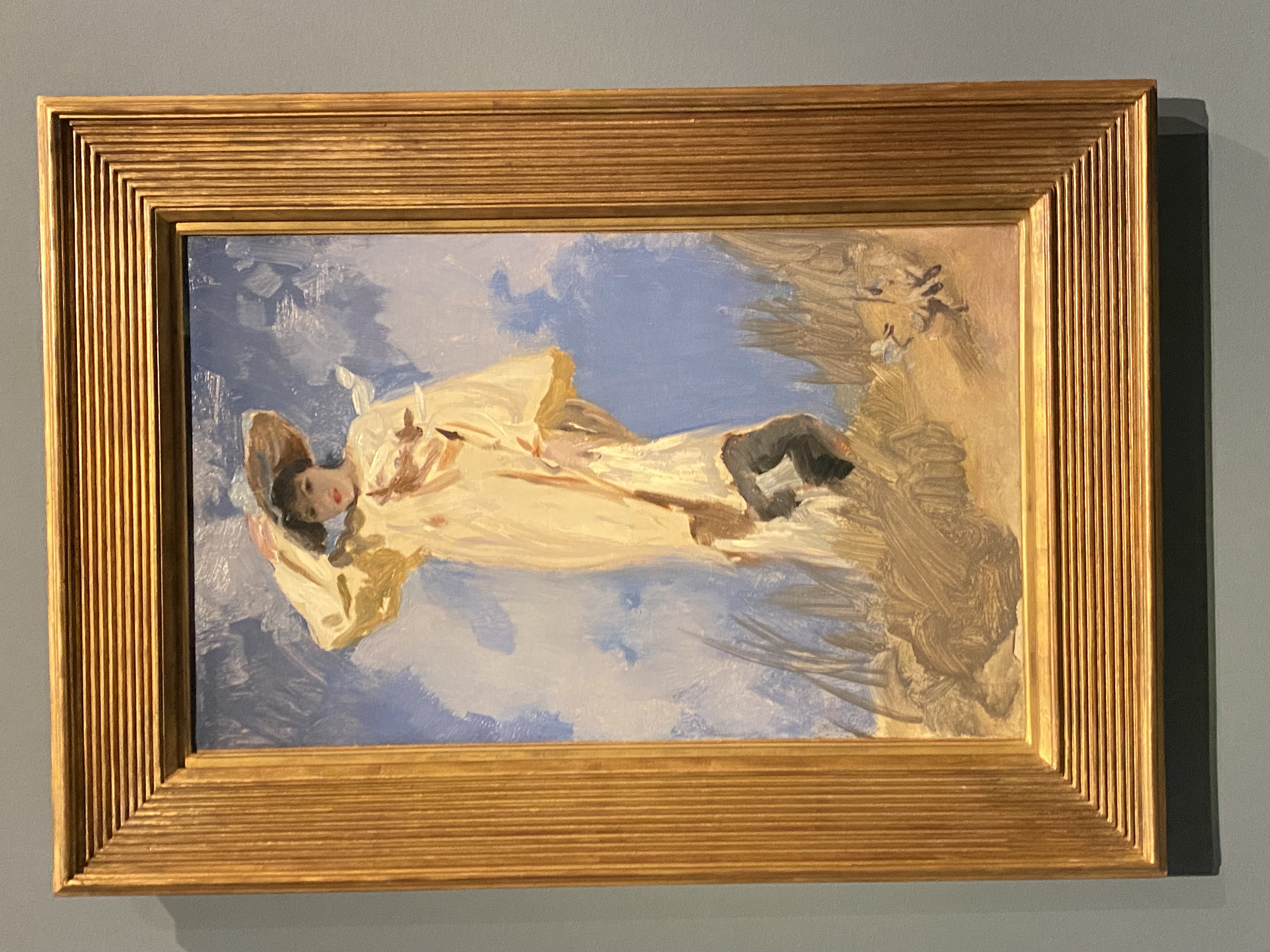
A Gust of Wind (Judith Gautier)”

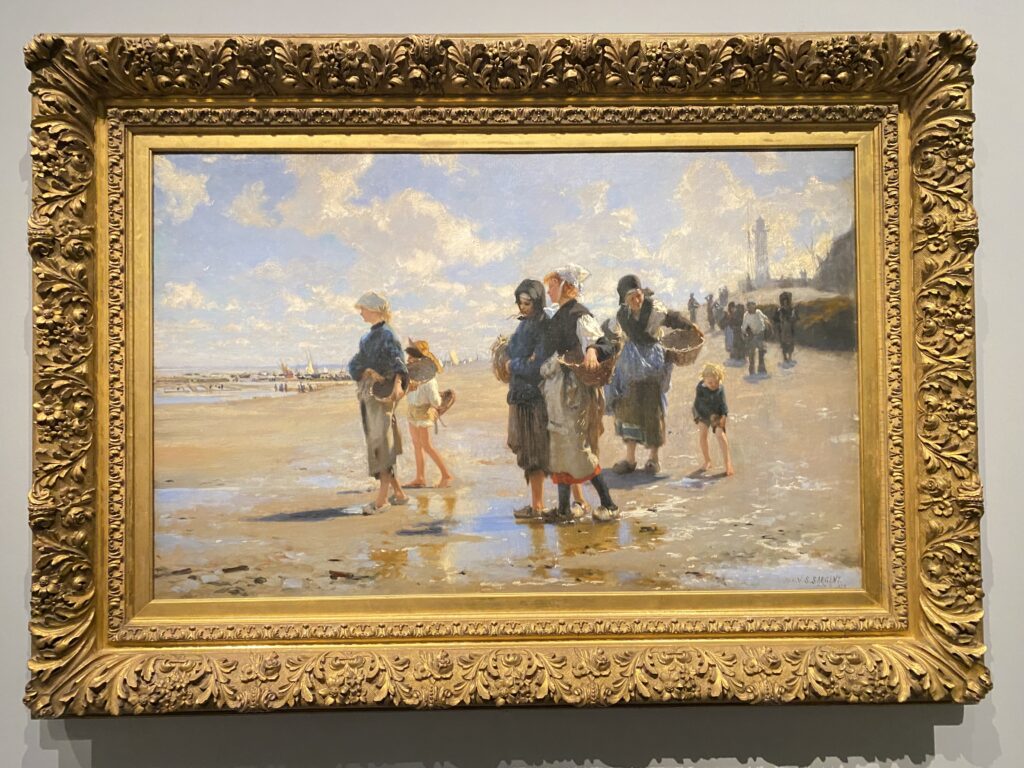
“Oyster Gatherers of Cancale”; one of a series of this scene that Sargent created with models whom he posed.

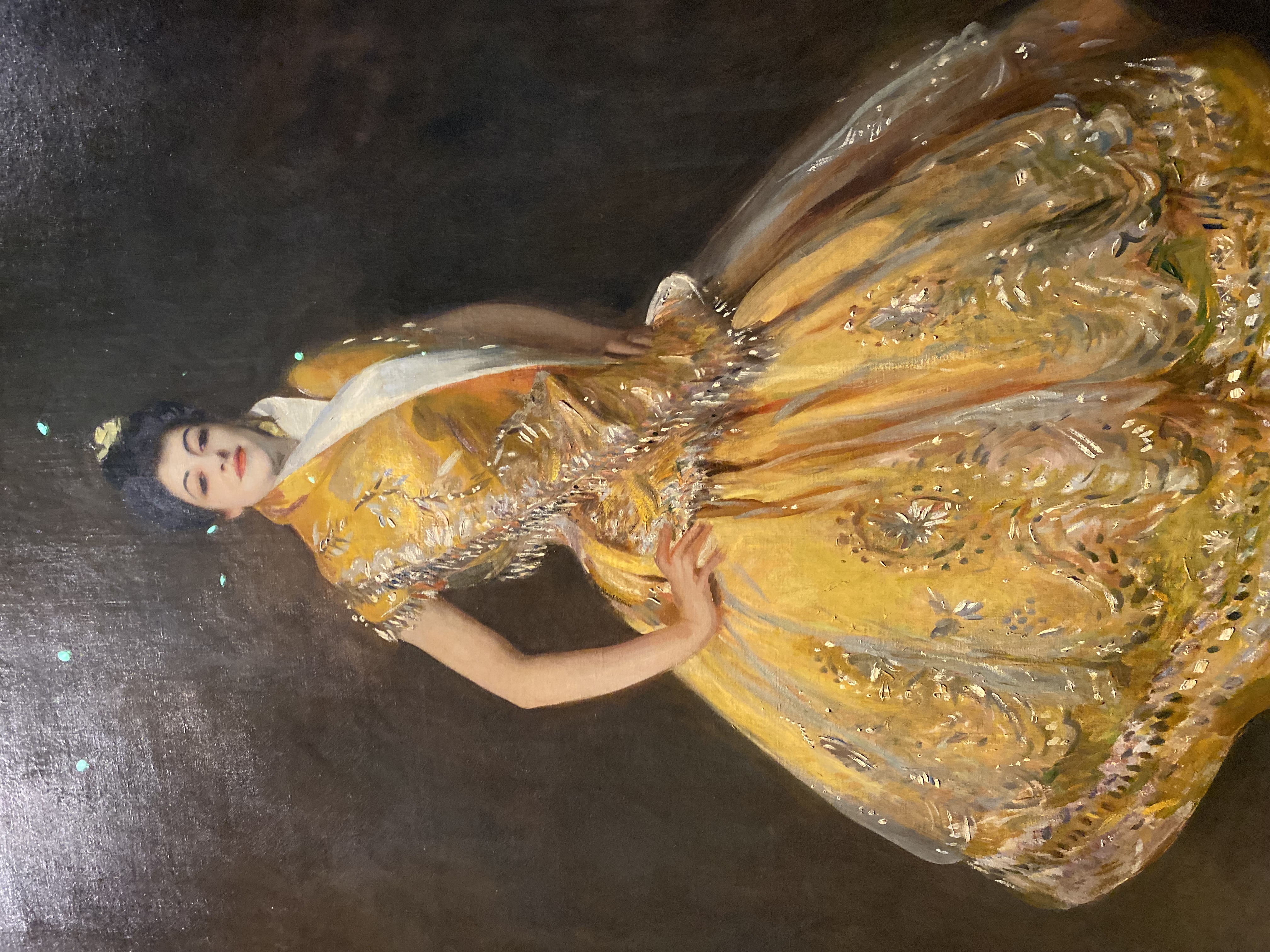
“La Carmencita (Carmen Dauset Moreno),” a Spanish style dancer and the first woman featured in film (1894).

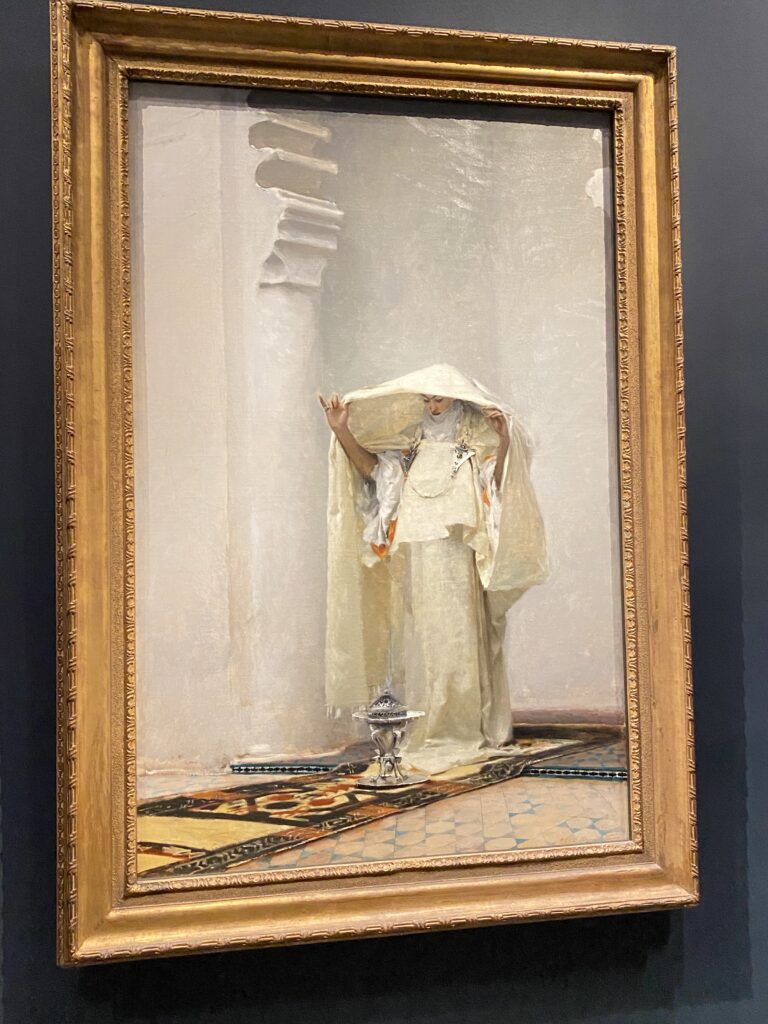
“Fumée D’Ambre Gris (Smoke of Ambergris)”; the artist had a model pose in Tangiers for this painting of ambiguous meaning, possibly religious, which he completed in his Paris studio.

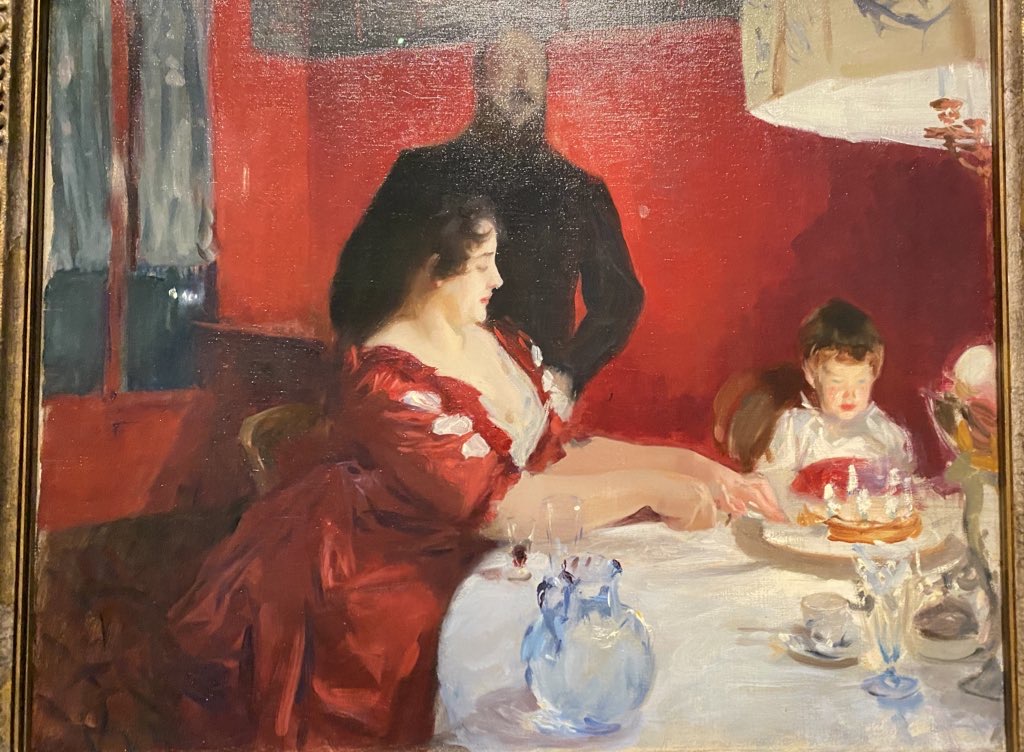
“Fete Familiale (The Birthday Party)” depicts John Singer Sargent’s friends and fellow artists Albert Besnard and his wife Charlotte Dubray, and their son, Robert.

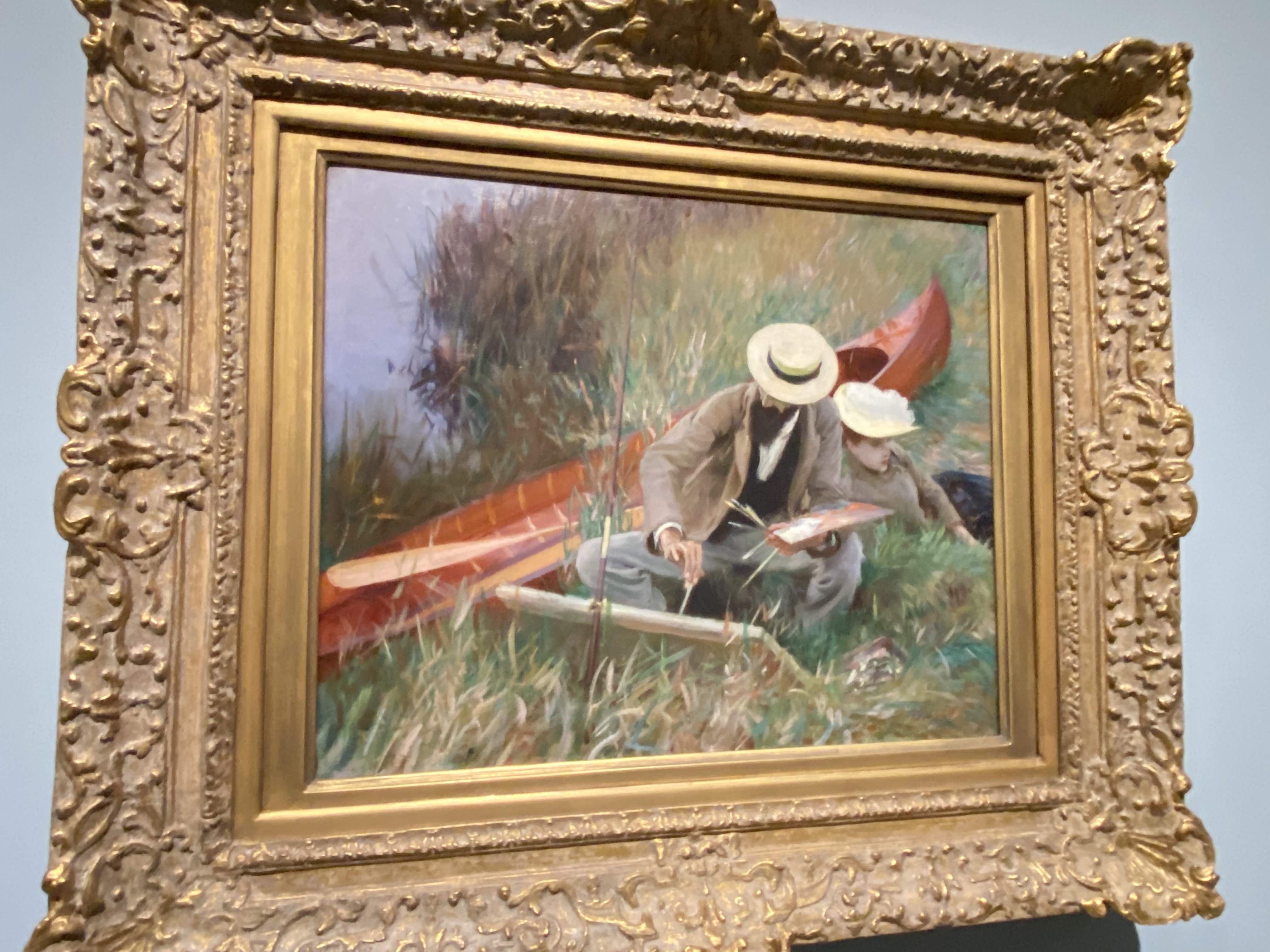
“An Out-of-Doors Study” (Paul Helleu Sketching with His Wife)

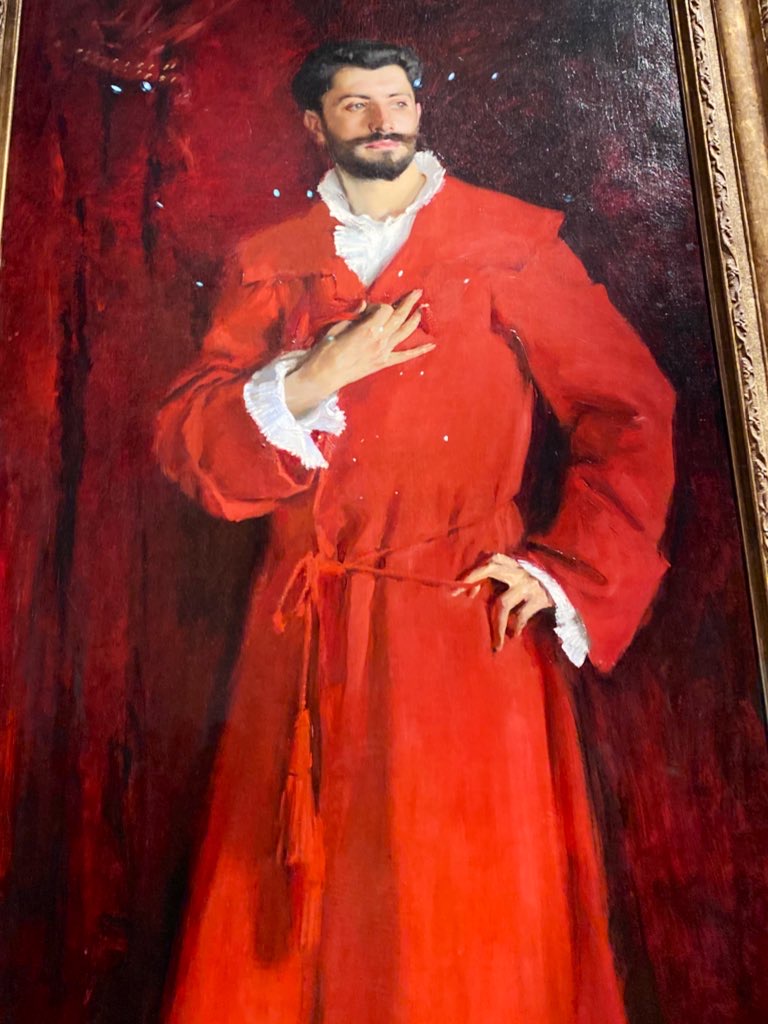
“Dr. Pozzi at Home,” Samuel Jean Pozzi, an Italian medical doctor who was also “an aesthete and a collector” (partial view)

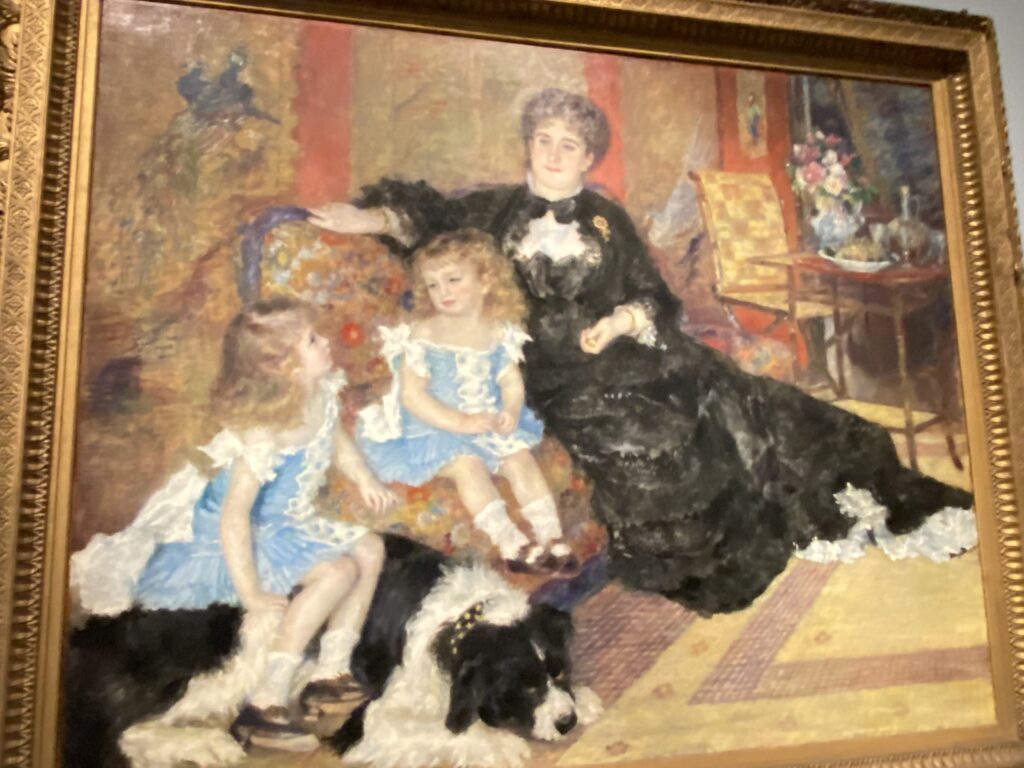
“Madame Georges Charpentier and Her Children” by Renoir, one of the paintings by a Sargent peer in the exhibition

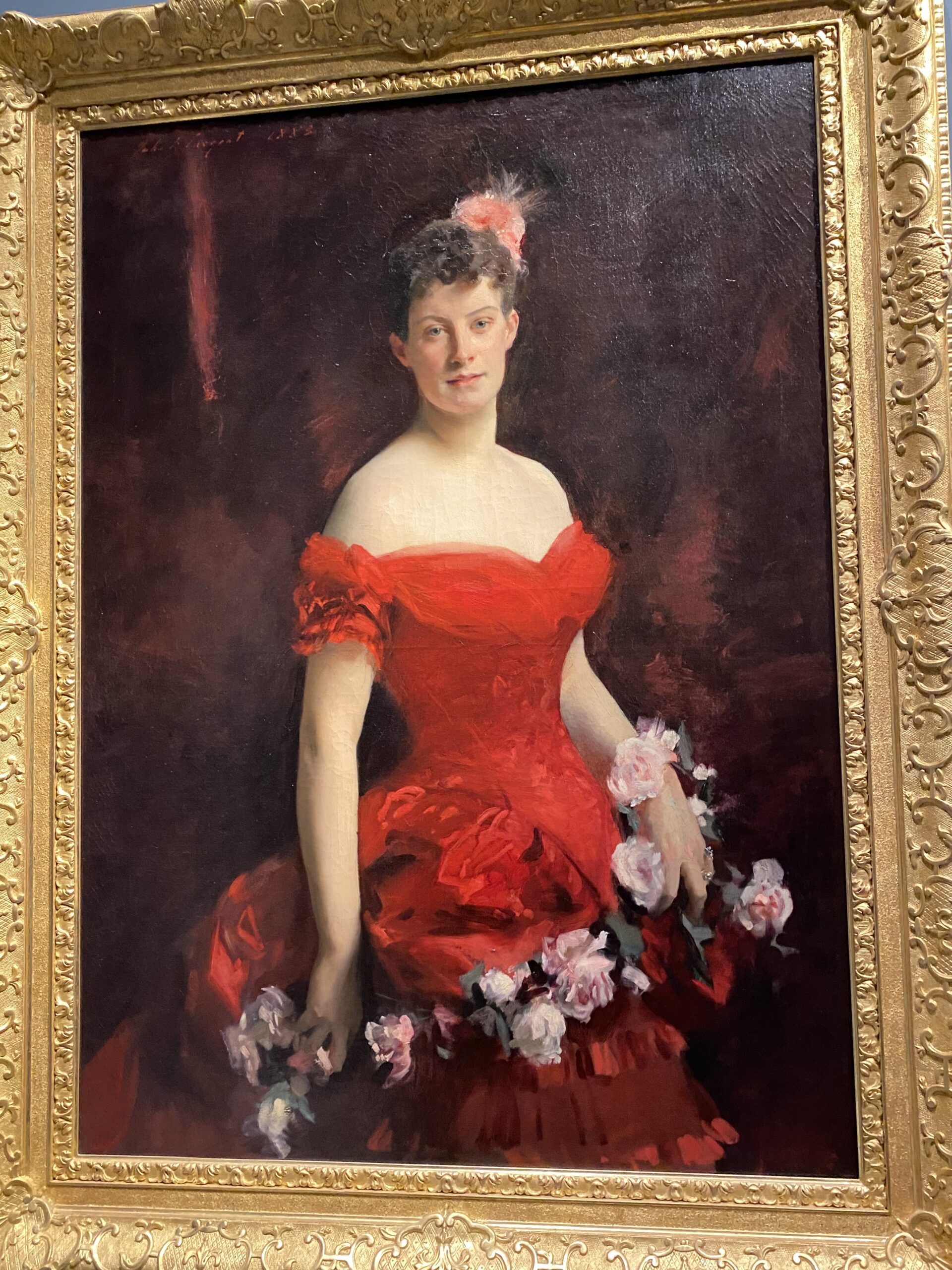
“La Vicomtesse de Pouilloue de Saint-Perier (Marie Jeanne de Kergolay)”

Looking forward to returning to see the works of John’s sister Emily Sargent on view through March 8th. Music on Instagram @kathleenhelenlevey, published on July 19, 2025, is by the artist’s friend Faure.

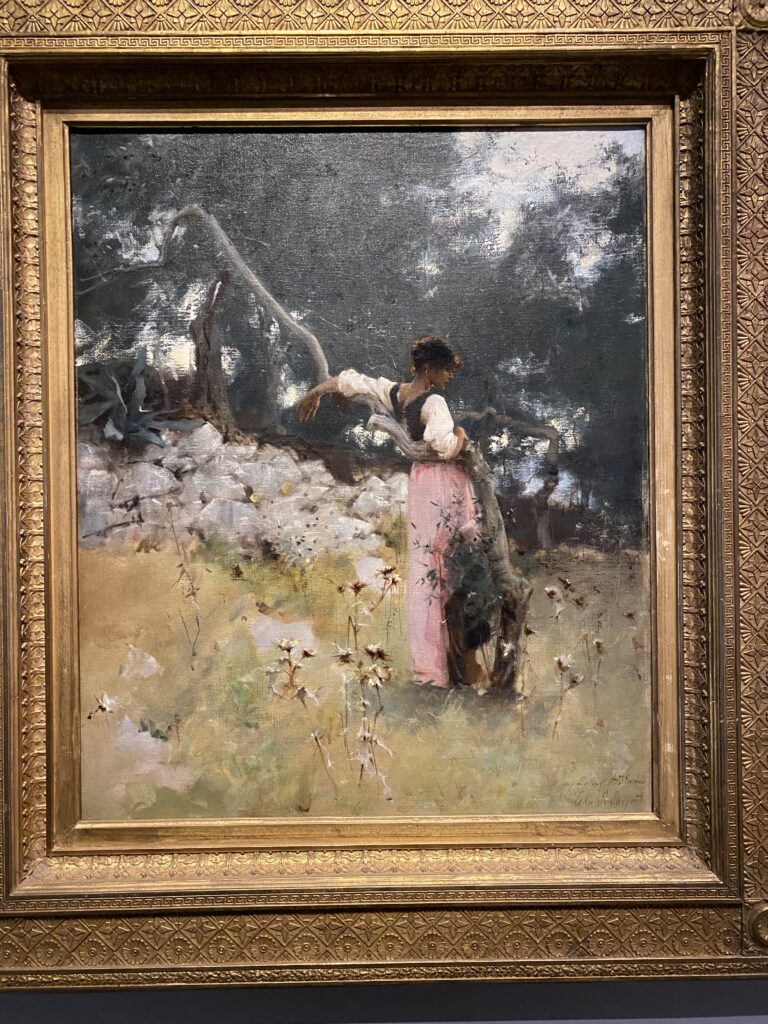
Dans les Olivier’s a Capri (Among the Olive Trees, Capri)

The Met Museum and the Musee d’Orsay organized the exhibition. The generous sponsors are The Marguerite and Frank A. Cosgrove Jr. Fund with Bank of America, The Sam and Janet Salz Trust, GRoW @ Annenberg, Jim Breyer, the Aaron I. Fleischman and Lin Lougheed Fund, and Trevor and Alexis Traina.

(Sources: Met Museum, arthistory.net, Museum of Fine Arts Boston, Clark Art, new.artsmia.org, Wiki).

“Travel with John Singer Sargent at the Metropolitan Museum of Art” All Rights Reserved ©2025 Kathleen Helen Levey

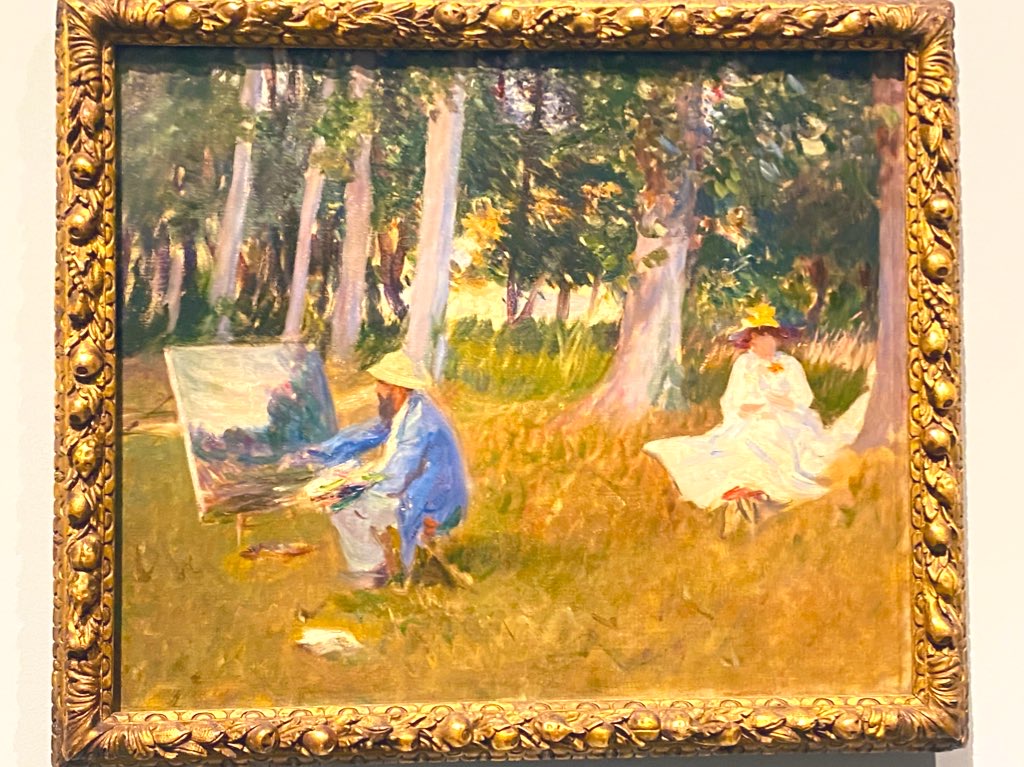
“Claude Monet Painting by the Edge of a Wood”: Monet paints at his home near Giverney; his wife Alice keeps him company.

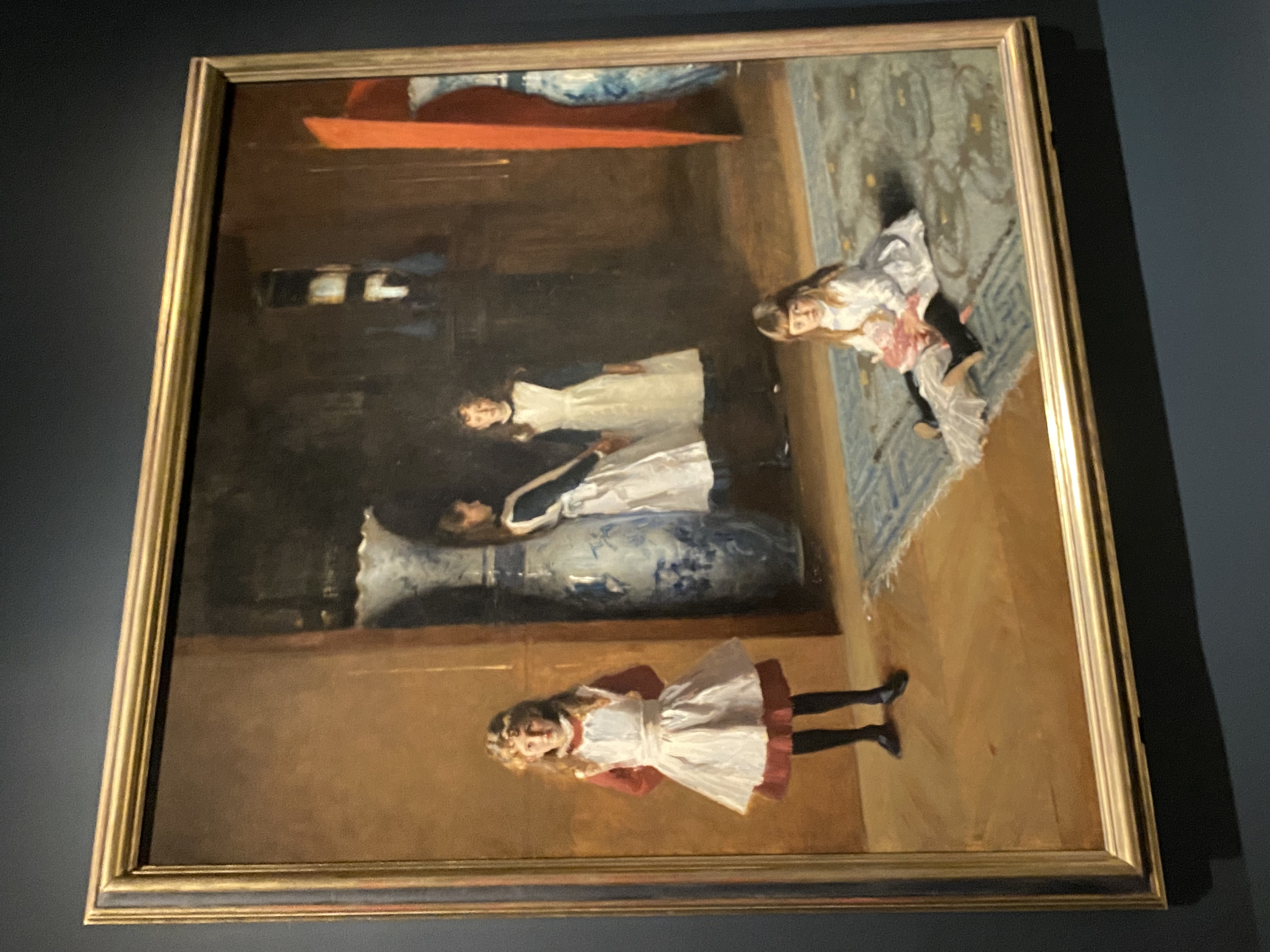
”The Daughters of Edward Darley Boit” in a style influenced by Velasquez.

Page 1 of 8

Powered by WordPress & Theme by Anders Norén